Profiting from a cloud deployment

Cloud computing does offer enterprises and organizations a mixed bag of goodies. For one it provides for a utility style computing, the ability to grow and shrink with changing loads, zero upfront costs etc. The benefits of cloud computing are many but does it all add up to profit for an enterprise? That is the critical question that needs to be answered.

This post will take a look on what it takes for a cloud deployment to be profitable for an organization.

The critical parameters for any web application are latency and throughput.  A well designed web application whether it is an e-retail site or an ad serving application will try to minimize the latency or response time while at the same time maximizing the throughput of the application. For any application while the latency can be kept within specified limits the throughput will tend to plateau at a certain level and will not increase with increasing traffic. Utilizing a larger instance can improve the throughput plateau slightly. In any case the reality is that throughput tends to flatten as the traffic is increased.
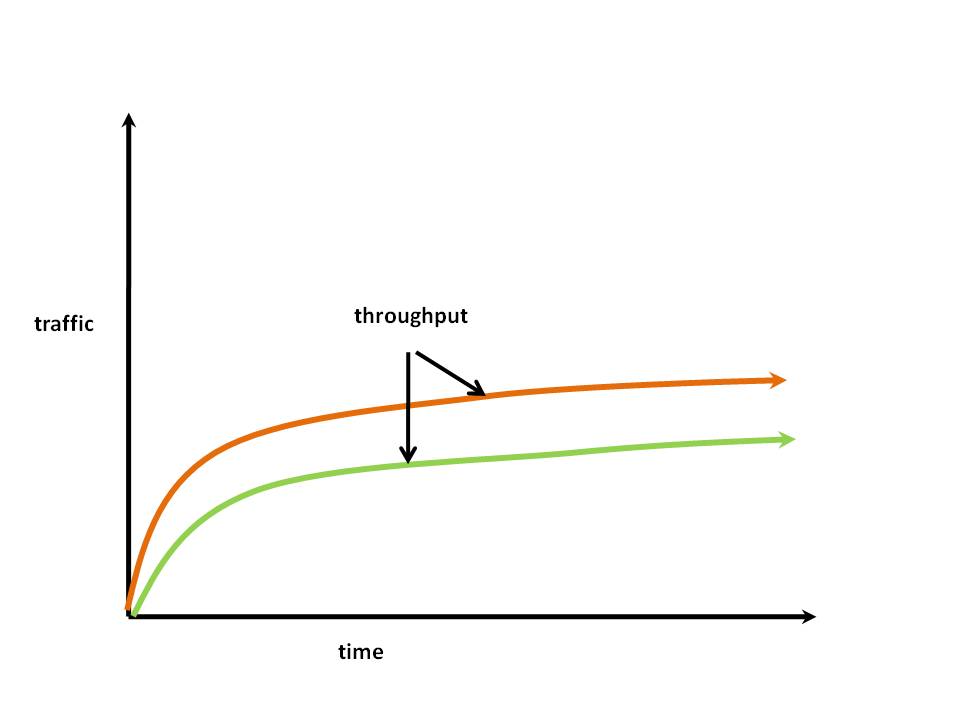
A typical cloud application will be made of several compute instances, database instances, DNS services etc. Cloud usage is billed by the hour. Hence we can represent the cost of a cloud deployment as follows

Cost (cloud deployment) = m * compute instance + n * database instance + o * network bytes + P

Where P = cost of DNS + Elastic IPs + other costs.

This can be represented by the formula

C = a * D * t

where C = cost of cloud deployment

D = costs per hour of the deployment

and ‘a’ is some arbitrary constant and ‘t’ is the time

Let us assume that for the cloud deployment we get a throughput of T.

The revenue for a web application whether it is an e-commerce site, an e-ticketing site or an ad serving engine will all depend on the throughput i.e. larger the throughput, larger the revenue and hence profit. We can then say that ‘R’ the revenue is

R (revenue) α k * T * t

In others words  the revenue is proportional to the throughput.

Hence to determine the profitability of a particular cloud deployment we need to compare the cost of the deployment for a given throughput versus a projected  profit margin. As long the cost of the deployment is less than the revenue arising from the throughput, the deployment will be profitable.  This can be represented pictorially as below.
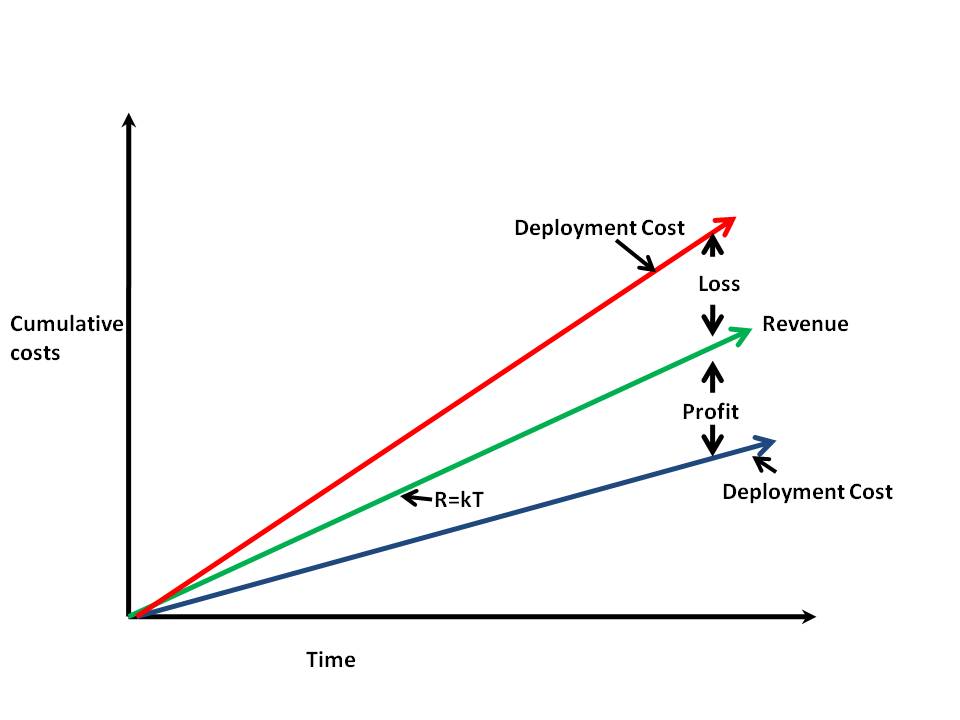
The graph clearly shows that for a profitable deployment

d/dt (k * T *t) > d/dt (a * D * t) or

k * T > a * D

Hence as can seen from the picture as long as the slope of the cumulative deployment costs are less that the slope of the revenue the deployment will be profitable.

Find me on Google+

Software Defined Networks (SDNs): A glimpse of tomorrow

Published in Telecom Asia, Jul 28,2011 – A glimpse into the future of networking

Published in Telecoms Europe, Jul 28 2011 – SDNs are new era for networking

Networks and networking, as we know it, is on the verge of a momentous change, thanks to a path breaking technological concept known as Software Defined Networks (SDN). SDN is the result of pioneering effort by Stanford University and University of California, Berkeley and is based on the Open Flow Protocol and represents a paradigm shift to the way networking elements operate.

Networks and network elements, of today, have been largely closed and have been based on proprietary architectures. In today’s network and switching and routing of data packets happen in the same network elements for e.g. the router.

Software Defined Networks (SDN) decouples the routing and switching of the data flows and moves the control of the flow to a separate network element namely, the flow controller.   The motivation for this is that the flow of data packets through the network can be controlled in a programmatic manner. A Flow Controller can be typically implemented in a standard PC.  In some ways this is reminiscent of Intelligent Networks and Intelligent Network Protocol which delinked the service logic from the switching and moved it a network element known as the Service Control Point.

The OpenFlow Protocol has 3 components to it. The Flow Controller that controls the flows, the OpenFlow switch and the Flow Table and a secure connection between the Flow Controller and the OpenFlow switch. The OpenFlow Protocol is an open source API specification for modifying the flow table that exists in all routers, Ethernet switches and hubs.  The ability to securely control the flow of traffic programmatically opens ups amazing possibilities.

OpenFlow Specification

Alternatively, existing branded routers can implement the OpenFlow Protocol as an added feature to their existing routers and Ethernet switches. This will enable these routers and Ethernet switches to support both production traffic and research based traffic using the same set of network resources.

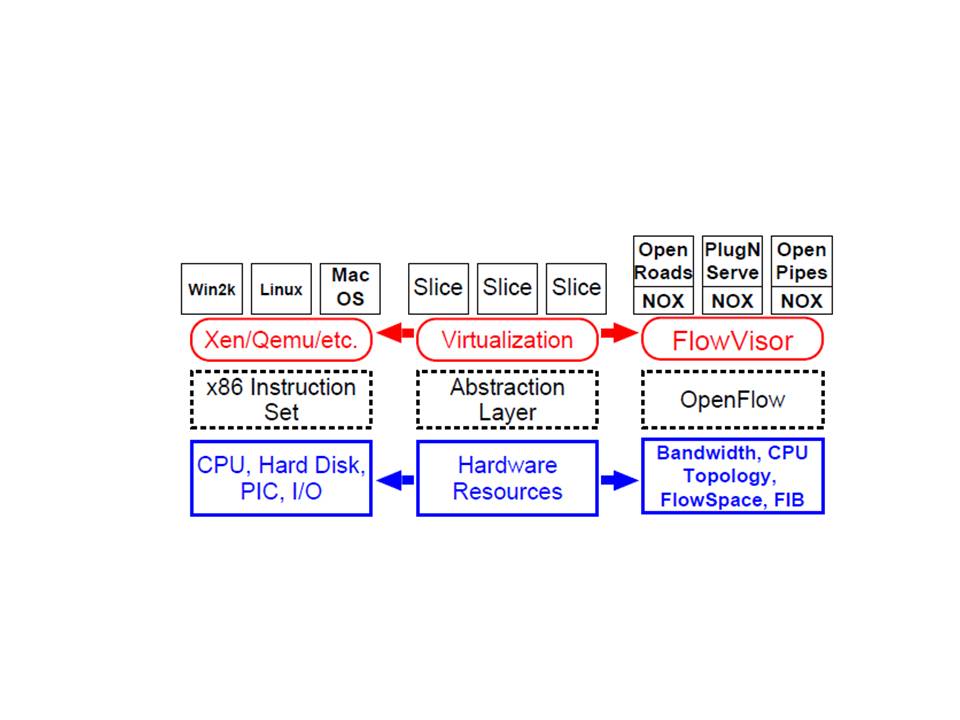
The single greatest advantage of separating the control and data plane of network routers and Ethernet switches is the ability to modify and control different traffic flows through a set of network resources. In addition to this benefit Software Define Networks (SDNs) also include the ability to virtualize the network resources. Virtualized network resources are known as a “network slice”. A slice can span several network elements including the network backbone, routers and hosts.

Computing resources can be virtualized through the use of the Hypervisor which abstracts the hardware and enables several guest OS to run in complete isolation. Similarly when a network element a FlowVisor, experimentally demonstrated, is used along with the OpenFlow Controller it is possible to virtualize the network resources. Hence each traffic flow gets a combination of bandwidth, routers, traffic flows and computing resources. Hence Software Defined Networks (SDNs) are also known as Virtualized Programmable Networks owing to the ability of different traffic flows being able to co-exist in perfect isolation of one another allowing for traffic flows through the resources to be controlled by programs in the Flow Controller.

The ability to manage different types of traffic flows across network resources opens up endless possibilities. SDNs have been successfully demonstrated in wireless handoffs between networks and in running multiple different flows through a common set of resources. SDNs in public and private clouds allow appropriate resources to be pooled during different times of the day based on the geographical location of the requests. Telcos could optimize the usage of their backbone network based on peak and lean traffic periods through the Core Network.

The OpenFlow Protocol has already gained widespread support in the industry and has resulted in the formation of the Open Networking Foundation (ONF). The members of ONF include behemoths like Google, Facebook, Yahoo, and Deutsche Telekom to networking giants like Cisco, Juniper, IBM and Brocade etc. Currently the ONF has around 43 member companies

Software Define Networks is a tectonic shift in the way networks operate and truly represent the dawn of a new networking era. A related post of interest is “Adding the OpenFlow variable in the IMS equation

Find me on Google+

The Case for a Cloud Based IMS Solution

IP Multimedia Systems (IMS) has been in the wings for some time. There have been several deployments by the major equipment manufacturers, but IMS is simply not happening. The vision of IMS is truly grandiose. IMS envisages an all-IP core with several servers known as Call Session Control Function (CSCF) participating to setup, maintain and release call sessions.

In the 3GPP Release 5 Architecture IMS draws an architecture of Proxy CSCF (P-CSCF), Serving CSCF(S-CSCF), Interrogating CSCF(I-CSCF), Breakout CSCF(B-CSCF), Home Subscriber Server(HSS) and Application Servers (AS) acting in concert in setting up, maintaining and release media sessions. The main protocols used in IMS are SIP/SDP for managing media sessions which could be voice, data or video and DIAMETER for connecting to the HSS and the Application Servers.

IMS is also access agnostic and is capable of handling landline or wireless calls over multiple devices from the mobile, laptop, PDA, smartphones or tablet PCs. The application possibilities of IMS are endless from video calling, live multi-player games to video chatting and mobile handoffs of calls from mobile phones to laptop. Despite the numerous possibilities IMS has not made prime time. While IMS technology paints a grand picture it has somehow not caught on. IMS as a technology, holds a lot of promise but has remained just that – promising technology.

The technology has not made the inroads into people’s imaginations or turned into a money spinner for Operators. One of the reasons may be that Operators are averse to investing enormous amounts into new technology and turning their network upside down.

This article provides an innovative approach to introducing IMS in the network by taking advantage of the public cloud!

Since IMS is an all-IP network and the protocol between the CSCF servers is SIP/SDP over TCP IP it can be readily seen that IMS is a prime candidate for the public cloud. An IMS architecture that has to be deployed on the cloud would have several instances of P-CSCFs, S-CSCFs, B-CSCFs, HSS and ASes all sitting on the cloud. An architectural diagram is shown below.

Deploying the CSCFs on the public cloud has multiple benefits. For one it a cloud deployment will eliminate the upfront CAPEX costs for the Operator. The cost savings can be passed on to the consumers whose video, data or voice calls will be cheaper. Besides, the absence of CAPEX will provide better margins to the operator. Lower costs to the consumer and better margins for the Operator is truly an unbeatable combination.

Also the elasticity of the cloud can be taken advantage of by the operator who can start small and automatically scale as the user base grows.

Thus a cloud based IMS deployment is truly a great combination both for the subscriber, the operator and the equipment manufactures. The cloud’s elasticity will automatically provide for growth as the irresistibility of  IMSes high speed video applications catches public imagination.

If IMS as a technology needs to become common place then Operators should plan on deploying their IMS on the public cloud and reap the manifold benefits.

Please see my post for a more detailed view of the above post in “Architecting a cloud based IP Multimedia System (IMS)

A related post of relevance is “Adding the OpenFlow variable to the IMS equation“.

Find me on Google+

Cache-22

If you want performance you need to partition data. If you partition data you will not get performance! That sounded clever but is it true? Well, it can be if the architecture of your application is naïve.

The problem I am describing here is when there is a need to partition data across multiple geographical regions. Partitioning data essentially spreads data among several servers resulting in fast accesses. But when the data is spread across large geographical distances then this will result in significant network latencies. This is something that cannot be avoided.

Memcached is a common technique to store commonly read data into in-memory caches preventing frequent dips to the database. Memcached accesses data through “gets” and updates data through “sets”. Data is accessed based on a key which is hashed to one of several participating servers. Thus memcached distributes the data among several participating servers in a server list.  Reads and writes are of the order of O(1) and extremely fast. This works fine as long as servers belong to a single region or if the data center is in the same region. The network latencies will be low and the latency of the application will not be severely affected.

Now consider a situation where the memcached servers have to be distributed to multi-region data centers. While this is an excellent scheme for Disaster Recovery (DR) it introduces its own set of attendant problems.

Memcached will hash the entire data set and distribute it over the entire server list. Now “gets” of data from one geographical region to another will have significant latency. Since the laws of physics mandate that nothing can exceed the speed of light, we will be stuck with appreciable latencies for inter-region reads and writes.  So while a multi-region deployment provides for geographical resiliency it does introduce issues of latency and degraded throughput.

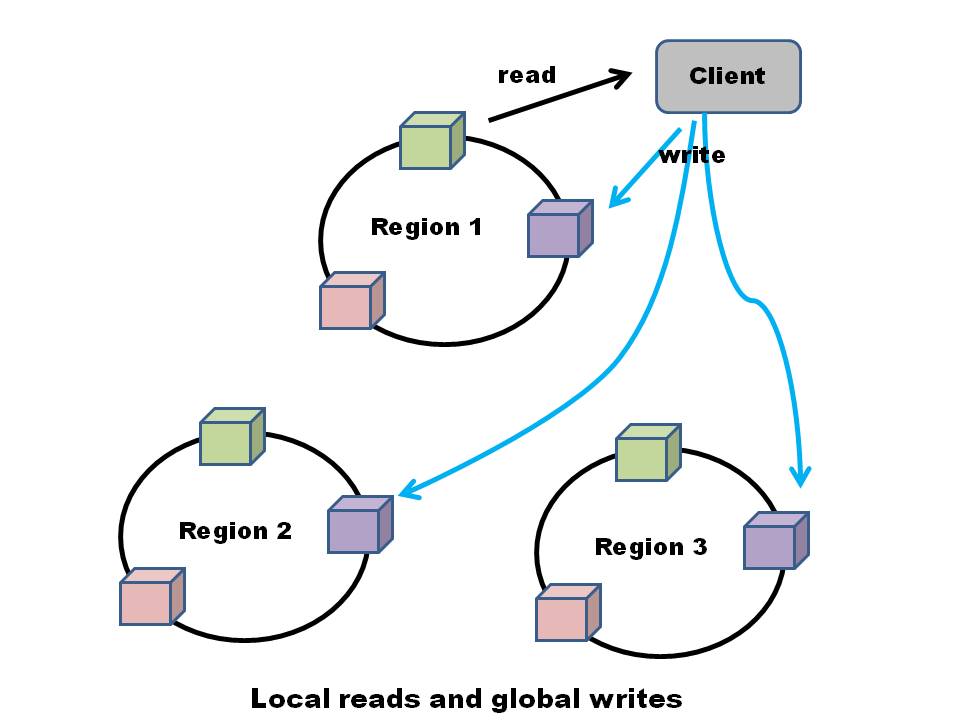
So what is the solution? One possible solution is to replicate the data across the regions. The solution to this problem is to replicate data in all the regions.  One technique that I can think of is to have the application to implement “local reads & global writes”.  This technique provides for the AP part of the CAP Theorem. The CAP theorem states that it is impossible to completely provide Consistency, Availability and Partition tolerance to distributed application. The “local reads & global writes” method will assure availability and partition tolerance while providing for eventual consistency.

In this technique, updates are done both on local servers along with asynchronous writes to all data centers. The writes are hence global in nature. The updates will not wait for all writes to complete before moving along. However reads will be local ensuring that the latency is low. Data reads based on data proximity will ensure that latency is really low.

Since writes are asynchronous the data will tend to be “eventually consistent” rather than being “strongly consistent” but this is a tradeoff that can be taken into account. Ideally it will be essential to implement the quorum protocol along with the “local reads & global writes” technique to ensure that you read your writes.

The application could have a modified quorum protocol such that R+ W > N where R is the number of data reads and W is the number of writes to servers and N is the total number of servers in the memcached server list.

Similar technique has been used in Cassandra & CouchDB etc.

With the “local reads & global writes” technique it is possible keep the latencies within reasonable limits since data reads will be based on proximity. Also replication the data to all regions will also ensure that eventually all regions will have a consistent view of the data.

Find me on Google+

Eliminating the Performance Drag

Nothing is more important to designers and architects of web applications than performance.   Everybody dreams of applications that can roar and spit fire! Attributes that are most sought after in large scale web applications are low latency and high throughput.  Performance is money. So it is really important to work the design and churn the best possible design.

Squeezing performance from your application is truly an art. The challenges and excitement are somewhat similar to what a race car designer or an aeronautical engineer would experience in reducing the drag on the machine while increasing the thrust of the engine. Understanding the physics of program execution is truly a rare art.

This post will attempt to touch upon some key aspects that have to be looked at a little more closely to wring the maximum performance from your application.

The Store Clerk Pattern: This is an oft quoted analogy to describe the relation between latency and throughput. In this example the application can be likened to retail store with store clerks checking out customers who queue with their purchases. Assume that there are 5 store clerks and each take 1sec to process a customer. If there 5 customers the response time for each customer will be 1 sec and a total throughput of 5 customers/sec can be achieved. However if a 6th customer enters then he/she will have to wait 1 sec in the queue while 5 customers are being handled by the store clerks. For this customer the response time will be 1 sec (waiting) + 1 sec (processing) or a total response time of 2 secs. It can be readily seen that as more customers queue up the wait times will increase and the latency will keep increasing. Also it has to be noted that the throughput will plateau at 5 customers/sec and cannot go above that.

The first point of attack in improving performance is to identify the store clerk pattern in your application. Identify where you application has a queue of incoming requests and a thread pool to address these requests as they get processed.  The latency and throughput are governed by the number of parallel thread (store clerks) who process and the wait times in the queue. One naïve technique is to increase the number of threads in the pool or increase the number of pools. However this may be limited by the CPU and system limitations. What is extremely important is to identify what factors contribute to the processing of each request. While processing, do threads need to access and retrieve data? Do they have to make API or SQL calls?  Identify what is the worst case performance of the thread and determine if this worst case can be improved by a different algorithm. So the key in the store clerk pattern is a) to optimize the threads in the pool and b) to improve the worst case performance of processing the request.

Resource Contention: This is another area of the application that needs to be looked at very closely. It is quite likely that data is being shared by many threads. Access to shared data is going to involve locks and waits. Identify and determine the worst case wait for threads. Is your application read-heavy and write-light or write-heavy and read-light? In the former situation it may be worthwhile to use a Reader-Writer locking algorithm in which many number of readers can simultaneously read data by updating a semaphore. However a write, which happens occasionally, will result in locking the resource and cause the  wait of all reader threads. However if the application is write-heavy then other alternatives like message based locking could be used. Clearly thread waits can be a drain on performance.

Algorithmic changes: If there are modules that perform enormous number of insertions, updates or deletions on data in memory then this has to be looked at closely. Determine the type of data structures or STLs being used.  The solution is to be able to re-organize data so that the operation happens much more efficiently ideally reaching towards   O (1). Maybe the data may need to be organized as hash map of lists or a hash map pointing to n-ary trees instead of a list of lists. This will really require deep thought and careful analysis to identify the best possible approach that provides the least possible times for the most common operation.

From Relational to NoSQL : Though the transition from a RDBMS to a NoSQL databases like Cassandra, CouchDB  etc would really be based on scalability, the ability to partition data horizontally and hash the key for accesses, updations and deletions will be really fast and is an avenue that is worth looking into.

Caching : This is a widely used technique to reduce frequent SQL queries to the database. Data that is commonly used can be cached in-memory. One such technique is to use memcached.  Memcached caches data across several servers. Access to data is through hashing and is of the order of O (1). If there is a miss of data in the memcached server’s then data is accessed through a SQL query. Access to data is through simple get, put methods in which the key is hashed to identify the server in which the data is stored.

Profiling : The judicious use of profiling tools  is extremely important in  optimizing performance. Tools like valgrind truly help in identifying bottlenecks. Other tools also help in monitoring thread pools and identifying where resource contention is taking place. It may also be worthwhile to timestamp different modules and collect data over several thousand runs, average them and pin-point trouble spots.

These are some technique that can be used for optimizing performance. However improving performance beyond a point will really depend on being able to visualize the application in execution and divining problem hot spots.

Find me on Google+

To Hadoop, or not to Hadoop

Published in Telecom Asia, Jul 23, 2012 – To Hadoop or not to Hadoop

To Hadoop, or not to Hadoop: that is the question.  In many  of my discussions I find that Hadoop with its implementation of Map-Reduce crops  ups time and time and again.  To many Map-Reduce is the panacea for all kinds of performance evils. It appears that somehow using the Map-Reduce in your application will magically transform your application into a high performing, screaming application.

The fact is the Map-Reduce algorithm is applicable to only certain class of problems.  Ideally it is suited to what is commonly referred to as “embarrassingly parallel” class of problems.  These are problems that are inherently parallel for e.g. the creation of inverted indices from web crawled documents.

Map-Reduce is an algorithm that has popularized by Google. The term map –reduce actually originates from Lisp in which the “map” function takes a list of arguments and performs the same operation on all of its argument. The” reduce” then applies a common criterion to pick a reduced set of values from this list. Google uses the Map-Reduce to create an inverted index. An inverted index basically provides a mapping of a word with the list of documents in which it occurs. This typically happens in two stages. A set of parallel “map” tasks take as input documents, parse them and emits a sequence of (word, document id) pairs. In other words, the map takes as input a key value pair (k1, v1) and maps it into an intermediate (k2, v2) pair. The reduce tasks take the pair of (word, document id), reduce them, and emit a (word, list {document id}). Clearly applications, like the inverted index, make sense for the Map-Reduce algorithm as several mapping tasks can work in parallel on separate documents. Another typical application is counting the occurrence of words in documents or the number of times a web URL has been hit from a traffic log.

The key point in all these typical class of problems is that the problem can be handled in parallel. Tasks that can execute independently besides being inherently parallel are eminently suitable for Hadoop processing. These tasks work on extraordinarily large data sets.  This is also another criterion for Hadoop worthy applications.

Hadoop uses a large number of commodity servers to execute the algorithm. A complementary technology along with Hadoop is the Hadoop Distributed File System (HDFS). The HDFS is a storage system in which the input data is partitioned across several servers. Google uses the Google File System (GFS) for its inverted index and page ranking algorithm.

Typical applications that are prime candidates for Hadoop are those applications that have to operate on terabytes of data. Also the additional requirement is that the application can run some sort of transformation or “map” algorithm on the data independently and produce an intermediate result for the “reduce” part of the algorithm. The “reduce” essentially applies some criteria on the intermediate sets to produce a zero or 1 output.

However several real world applications do not fall into this category where we can parallelize the execution of the application. For example an e-retail application which allows users to search for book, electronic products, add to shopping card and finally make the purchase, in my opinion,  is not really suited for Hadoop as each individual transaction is separate  and typically has its own unique sequential flow. An Ad serving application also is not ideally suited for Hadoop. Each individual transaction has its own individual flow in time.

However on closer look we can see that there are certain aspects of the application that are conducive to Hadoop based Map-Reduce algorithm. For e.g. if the application needs to search through large data sets for example the e-retail application will have tens of thousands of electronic products and books from different vendors with their own product id.  We could use Hadoop to pre-process these large amounts of data, classify and create smaller data sets which the e-retail or other application can use. Hadoop is a clear winner when large data sets have to searched, sorted or some subset selected from.

In these kinds of applications Hadoop has a clear edge over other types as it can really crunch data. Hadoop is also resilient to failures and is based on the principle of “data locality” which allows the “map” or “reduce” to use data stored locally on its sever or in a neighboring machine.

Hence while Hadoop is no silver bullet for all types of applications if due diligence is performed we can identify aspects of the application which can be crunched by Hadoop.

Find me on Google+

The Future is C-cubed: Computing, Communication and the Cloud

We are the on the verge of the next great stage of technological evolution. The trickle of different trends clearly point to what I would like to term as C-cubed (C3) representing the merger of computing technologies, communication advances and the cloud.

There are no surprises in this assessment. Clearly it does not fall into the category of Chaos theories’ “butterfly effect” where a seemingly unrelated cause has a far-reaching effect, typically the fluttering of a butterfly in Puerto Rico is enough to cause an earthquake in China.

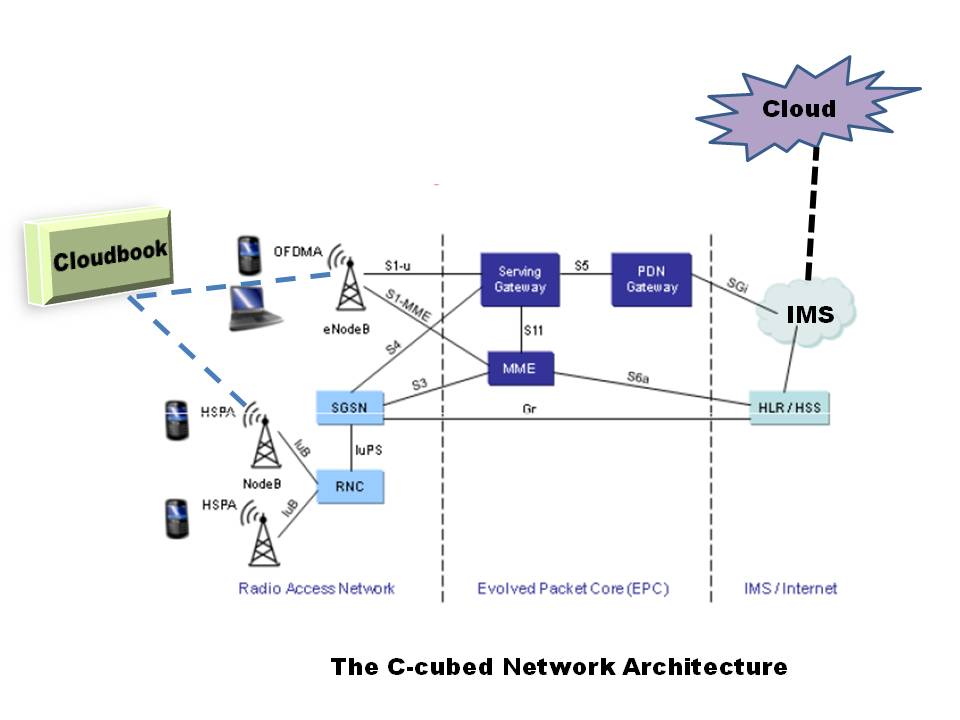
The C-cubed future that seems very probable is based on the advances in mobile broadband, advances in communication and the emergence of cloud computing.  A couple of years back Scott McNealy of Sun Microsystems believed that the “network is the computer”. Now with the introduction of Google’s Chrome book this trend will soon catch on. In fact I can easily visualize a ubiquitous device which I would like to call as the “cloudbook”.

The cloudbook would be a device that would resemble a tablet like the iPad, Playbook etc but would carry little or no hard disk.  Local storage will be through USB devices or SD-Cards which these days come with large storage in the range of 80GB and above. The Cloud book would have no operating system. It would simply have a bootstrap program which will allow the user to choose from several different Operating Systems (OS) namely Window’s, Linux, Solaris and Mac etc which will execute on the cloud. All applications will be executed directly on the cloud. The user will also store all his programs and data on the cloud.  Some amount of offline storage will be possible in portable storage devices like the memory stick, SD card etc.

The cloudbook will be a ubiquitous device.  It will access the internet through mobile broadband.  The access could be through a GPRS, WCDMA or a LTE connection. With the blazing speeds of 56 Mbps promised by LTE the ability to access the public cloud for executing programs and for storing of data is extremely feasible. Access should be almost instantaneous. Using the mobile broadband for access and the cloud for computing and storage will be the trend in the future.

Besides its use for computing, the cloudbook will also be used for making voice or video calls. This is the promise of IP Multimedia Systems (IMS) technology. IMS is a technology that has been in the wings for quite some time. IMS technology envisages an all-IP Core Network that will be used for transporting voice, data and video. As the speeds of the IP pipes become faster and the algorithms to iron out QOS issues are worked out the complete magnificence of the vision of IMS will become a reality and high speed video applications will become common place.

The cloudbook will use the WCDMA, 3G, network to make voice and video calls to others. The 3G RNC or the 4G eNodeB’s will enable the transmission and reception of voice, data or video to and from the Core Network. LTE networks will either user Circuit Switched Fall Back (CSFB) or VOLTE (Voice over LTE) to transfer voice and video over either the 3G network or over the Evolved Packet Core (EPC).  In the future high speed video based calls and applications will be extremely prevalent and a device like the cloudbook will increase the user experience manifold.

Besides IMS also envisions Applications Server (AS) spread across the network providing other services like Video-on-Demand, Real-time multi player gaming. It is clear that these AS may actually be instances sitting off the public cloud.

Hence the future clearly points to a marriage of computing, communication and the cloud where each will have a symbiotic relationship with the other resulting in each other. The network can be visualized as one large ambient network of IMS Call Session Control Function Servers (CSCFs) , Virtualized Servers on the Cloud and Application servers (AS).

Mobile broadband will become commonplace and all computing and communication will be through 3G or 4G networks.

The future is almost here and the future is C-cubed (C3)!!!

Published in Telecom Asia, Jul 8 2011 – The Future is C-cubed

Find me on Google+

Managing Multi-Region Deployments

If there is one lesson from this year’s major Amazon’s EC2 outage it is “don’t deploy all your application instances in a single region”. The outage has clearly demonstrated that entire regions are not immune to disasters. Thus, it has become imperative for designers and architects to deploy applications spanning major regions. Currently there are 4 major regions – US-West, US-East, Europe and APAC.

Both fundamentally and from a strategic point of view it makes sense to deploy web applications in different regions for e.g. both in US-East and US-West. This will build into the application a certain amount of geographical resiliency . In this way you are protected from major debacles like the Amazon’s EC2 outage in April 2011 or a possible meteor crashing and burning in one of the data centers.

Deploying instances in different regions is almost like minimizing risk by diversifying your portfolio. The design of application besides including other methods of fault tolerance should also incorporate geographical resilience.

Currently Amazon’s ELB does not support load balancing across regions. The ELB can only distribute traffic among instances in different availability zones of a region. The solution is to go for other DNS services like UltraDNS, DNSMadeEasy or DynDNS.

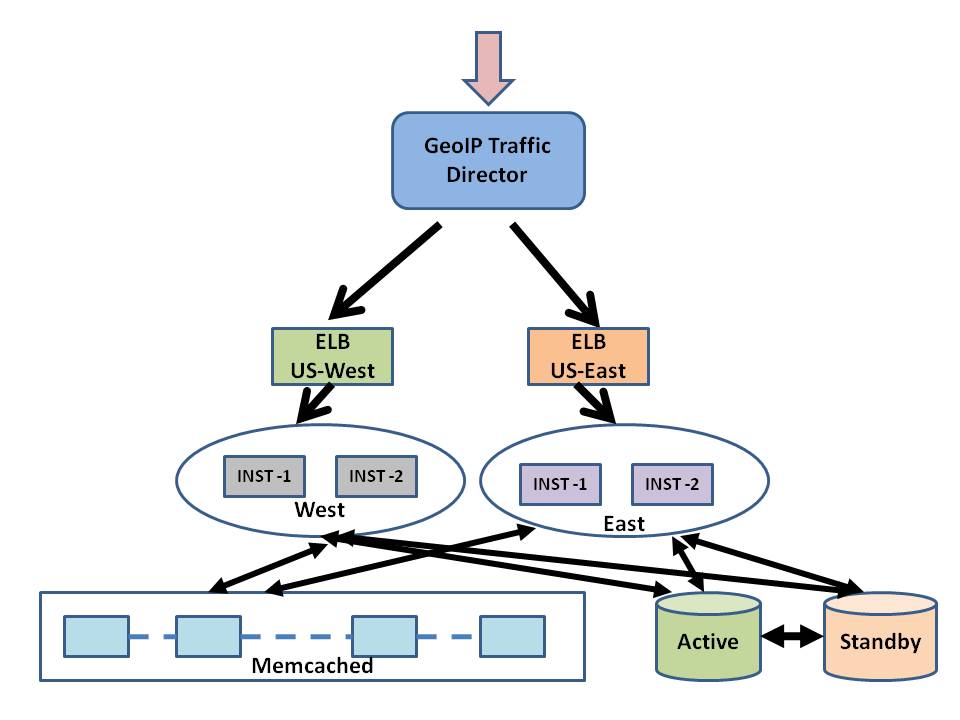
These DNS services provide geoIP based load balancer that can distribute traffic based on the region from which it originated. Currently there are 4 major regions in the world – US-East, US-West, Europe and APAC. GeoIP based traffic distribution besides balancing the load based on origination also has the added benefit of getting to the application closest to the origination thus reducing latencies.

The GeoIP based traffic distributor can distribute traffic to the closest region. An Amazon’s ELB can then internally distribute the traffic among the instances within that region. For a look at some typical problems in multi-region cloud deployments do look at my post “Cache-22

INWARDi Technologies

Deploying across regions

Find me on Google+

Singularity

Pete Mettle felt drowsy. He had been working for days on his new inference algorithm. Pete had been in the field of Artificial Intelligence (AI) for close to 3 decades and had established himself as the father of “semantics”. He was particularly renowned for his 3 principles of Artificial Intelligence. He had postulated the Principles of Learning as

The Principle of Knowledge Acquisition: This principle laid out the guidelines for knowledge acquisition by an algorithm. It clearly laid out the rules of what was knowledge and what was not. It could clearly delineate between the wheat and chaff from any textbook or research article.

The Principle of Knowledge Assimilation: This law gave the process for organizing the acquired knowledge in facts, rules and underlying principles. Knowledge assimilation involved storing the individual rules, the relation between the rules and provided the basis for drawing conclusions from them

The Principle of Knowledge Application: This principle according to Pete was the most important. It showed how all knowledge acquired and assimilated could be used to draw inferences andconclusions. In fact it also showed how knowledge could be extrapolated to make safe conclusions.

Zengine The above 3 principles of Pete were hailed as a major landmark in AI. Pete started to work on an inference engine known as “Zengine” based on his above 3 principles. Pete was almost finished fine tuning his algorithm. Pete wanted to test his Zengine on the World Wide Web. The World Wide Web had grown into gigantic proportions. A report in May 2025 issue of Wall Street Journal mentioned that the total data that was held in the internet had crossed 400 zettabytes and that the daily data stored on the web was close to 20 terabytes. It was a well known fact that there an enormous amount of information on the web on a wide variety of topics. Wikis, blogs, articles, ideas, social networks and so on there was a lot of information on almost every conceivable topic under the sun.

Pete was given special permission by the governments of the world to run his Zengine on the internet. It was Pete’s theory that it would take the Zengine close to at least a year to process the information on the web and make any reasonable inferences from them. Accompanied by world wide publicity Zengine started its work of trying to assimilate the information on the World Wide Web. The Zengine was programmed to periodically give a status update of its progress to Pete.

A few months passed. Zengine kept giving updates on the number of sites, periodicals, blogs it had condensed into its knowledge database. After about 10 months Pete received a mail. It read “Markets will crash on March 2026. Petrol prices will sky rocket – Zengine. Pete was surprised at the forecast. So he invoked the API to check on what basis the claim had been made. To his surprise and amazement he found that a lot events happening in the world had been used to make that claim which clearly seemed to point in that direction. A couple of months down the line there was another terse statement “Rebellion very likely in Mogadishu in Dec 2027”. – Zengine.The Zengine also came with corollaries to Fermat’s last theorem. It was becoming clear to Pete and everybody that the Zengine was indeed becoming smarter by the day..It became apparent to everybody when Zengine would become more powerful than human beings.

Celestial events: Around this time peculiar events were observed all over the world. There were a lot of celestial events that were happening. Phenomenon like the aurora borealis became common place. On Dec 12, 2026 there was an unusual amount of electrical activity in the sky. Everywhere there were streaks of lightning. By evening time slivers of lightning hit the earth in several parts of the world. In fact if anybody had viewed the earth from outer space then it would have a resembled a “nebula sphere” with lightning streaks racing towards the earth in all directions. This seemed to happen for many days. Simultaneously the Zengine was getting more and more powerful. In fact it had learnt to spawn of multiple processes to get information and return to it.

Time-space discontinuity: People everywhere were petrified of this strange phenomenon. On the one hand there was the fear of the takeover of the web by the Zengine and on the other was this increased celestial activity. Finally on the morning of Jan 2028 there was a powerful crack followed by a sonic boom and everywhere people had a moment of discontinuity. In the briefest of moments there was a natural time-space discontinuity and mankind had progressed to the next stage in evolution.

The unconscious, sub conscious and the conscious all became a single faculty of super consciousness. It has always been known from the time of Plato that man knows everything there is to know. According to Platonic doctrine of Recollection, human beings are born with a soul possessing all knowledge, and learning is just discovering or recollecting what the soul already knows. Similarly according to Hindu philosophy, behind the individual consciousness of the Atman, is the reality known as the Brahman which is universal consciousness attained in a deep state of mysticism through self-inquiry.

However this evolution by some strange quirk of coincidence seemed to coincide with the development of the world’s first truly learning machine. In this super conscious state a learning machine was not something to be feared but something which could be used to benefit mankind. Just like cranes can lift and earthmovers perform tasks that are beyond our physical capacity so also a learning machine was a useful invention that could be used to harness the knowledge from mankind’s storehouse – the World Wide Web.

Find me on Google+

Design Principles of Scalable, Distributed Systems

Designing scalable, distributed systems involves a completely different set of principles and paradigms when compared to regular monolithic client-server systems. Typical large distributed systems of Google, Facebook or Amazon are made up of commodity servers.  These servers are expected to fail, have disk crashes, run into network issues or be struck by any natural disasters.

Rather than assuming that failures and disasters will be the exception these systems are designed assuming the worst will happen.  The principles and protocols assume that failures are the rule rather than the exception. Designing distributed systems to accommodate failures is the key to a  good design of distributed scalable systems. A key consideration of distributed system is the need to maintain consistency, availability and reliability. This of course is limited by the CAP Theorem postulated by Eric Brewer which states that a system can only provide any two of “consistency, availability and partition tolerance” fully,

Some key techniques in distributed systems

Vector Clocks: An obvious issue in distributed systems with hundreds of servers is that each server will have its own clock running at a slightly different rate. It is difficult to get a view of a global time considering that each system has slightly different clock speeds. How does one determine causality in such a distributed system? The solution to this problem is provided by Vector Clocks devised by Leslie Lamport. Vector Clocks provide a way of determining the causal ordering of events.  Each system maintains an array of timestamps based on its own internal clock which it keeps incrementing. When a system needs to send an event to another system it sends the message with the timestamp generated from its internal array.  When the receiving system receives the message at a timestamp that is less than the sender’s timestamp it increments its own timestamp by 1 and continues to increments its internal array through its own internal clock. In the figure the event sent from System 1 to System 2  is assumed to be fine since the timestamp of the sender “2”  < “15. However when System 3 sends an event with timestamp 40 to System 2 which received it timestamp 35, to ensure a causal ordering where System 2 knows that it received the event after it was sent from System the vector clock is incremented by 1 i.e 40 + 1 = 41 and System 2 increments at it did before, This ensures that partial ordering of events is maintained across systems.

Vector clocks have been used in Amazon’s e-retail website to reconcile updates.  The use of vector clocks to manage consistency has been mentioned in Amazon’s Dynamo Architecture

Distributed Hash Table (DHT): The Distributed Hash Table uses a 128 bit hash mechanism to distribute keys over several nodes that can be conceptually assumed to reside on the circumference of a circle. The hash of the largest key coincides with the hash of the smallest key. There are several algorithms that are used to distribute the keys over this conceptual circle. One such algorithm is the Chord System. These algorithms try to get to the exact node in the smallest number of hops by storing a small amount of local data at each node. The Chord System maintains a finger table that allows it to get to the destination node in O (log n) number of hops. Other algorithms try to get to the desired node in O (1) number of hops.  Databases like Cassandra, Big Table, and Amazon use a consistent hashing technique. Cassandra spreads the keys of records over distributed servers by using a 128 bit hash key.

Quorum Protocol:  Since systems are essentially limited to choosing two of the three parameters of consistency, availability and partition tolerance, tradeoffs are made based on cost, performance and user experience. Google’s BigTable chooses consistency over availability while Amazon’s Dynamo chooses ‘availability over consistency”. While the CAP theorem maintains that only 2 of the 3 parameters of consistency, availability and partition tolerance are possible it does not mean that Google’s system does not support some minimum availability or the Dynamo does not support consistency. In fact Amazon’s Dynamo provides for “eventual consistency” by which data become consistent after a period of time.

Since failures are inevitable and a number of servers will fail at any instant of time writes are replicated across many servers. Since data is replicated across servers a write is considered “successful” if the data can be replicated in N/2 +1 servers. When the acknowledgement comes from N/2+1 server the write is considered successful. Similarly a quorum of reads from >N/2 servers is considered successful. Typical designs have W+R > N as their design criterion where N is the total number of servers in the system. This ensures that one can read their writes in a consistent way.  Amazon’s Dynamo uses the sloppy quorum technique where data is replicated on N healthy nodes as opposed to N nodes obtained through consistent hashing.

Gossip Protocol: This is the most preferred protocol to allow the servers in the distributed system to become aware of server crashes or new servers joining into the system, Membership changes and failure detection are performed by propagating the changes to a set of randomly chosen neighbors, who in turn propagate to another set of neighbors. This ensures that after a certain period of time the view becomes consistent.

Hinted Handoff and Merkle trees: To handle server failures replicas are sometimes sent to a healthy node if the node to which it was destined was temporarily down. For e.g.  data destined for Node A is delivered to Node D which maintains a hint in its metadata that the data is to be eventually handed off to  Node A when it is healthy.  Merkle trees are used to synchronize replicas amongst nodes. Merkle trees minimize the amount of data that needs to be transferred for synchronization.

These are some of the main design principles that are used while designing scalable, distributed systems. A related  post is “Designing a scalable architecture for the cloud

Find me on Google+