The emergence of Social Software as a Service (SSaaS)

Published in Telecom Asia-17 Feb 2012 as – The dawn of Social Software as a Service

We are in the midst of a Social Networking revolution as we progress to the next decade. As technology becomes more complex in a flatter world, cooperating and collaborating will not only be necessary but also essentially imperative. McKinsey in its recent report “Wiring the Open Source Enterprise” talks of the future of a “networked enterprise” which will require the enterprise to integrate Web 2.0 technologies into its enterprise computing fabric.

Another McKinsey report  “The rise of the networked enterprise: Web 2.0 finds its payday” states “that Web 2.0 payday could be arriving faster than expected”. It goes on to add that “a new class of company is emerging—one that uses collaborative Web 2.0 technologies intensively to connect the internal efforts of employees and to extend the organization’s reach to customers, partners, and suppliers”

Social Software utilizing Web 2.0 technologies will soon become the new reality if organizations want to stay agile. Social Software includes those technologies that enable the enterprise to collaborate through blogs, wikis, podcasts, and communities. A collaborative environment will unleash greater fusion of ideas and can trigger enormous creative processes in the organization.

According to Prof. Clay Shirky ofNew YorkUniversitythe underused human potential at companies represents an immense “cognitive surplus” which can be tapped by participatory tools such as Social Software.

A fully operational social network in the organization will enable quicker decision making, trigger creative collaboration and bring together a faster ROI for the enterprise. A shared knowledge pool enables easier access to key information from across the enterprise and facilitates faster decision making.

Enterprise Social Software enables to access a shared knowledge pool across the organization. Employees can share ideas, seek out expert opinion and arrive at solutions much faster.  Social collaboration tools can truly unleash a profusion of creative ideas and thought across the organization and enable better problem solving abilities.

Clearly the social network paradigm is new concept which needs to be adopted by any organization which wants a greater marker share and a faster time to market. In today’s knowledge intensive world the need for an enterprise strategy that is focused on enabling collaboration through the use of Web 2.0 becomes obvious.

However enterprises which would like to embrace Social Technologies would face the twin challenges of i) developing the application and ii) secondly deploying it on their own data center.

Enterprises would be faced with the typical “build-vs.-buy” quandary. Organizations that want to benefit quickly from Web 2.0 technologies would prefer a buy rather than a build option.

Besides, the deployment of a Social Computing platform would require the commissioning of large data centers to allow for simultaneous access by the platform users. But the attendant problems of maintaining a large data center can be very intimidating.  The top 3 challenges of large data centers typically center around the

a)      The problems of data growth
b)      The challenges of performance and scalability
c)      And the sticky issue of network congestion and connectivity

It is against this backdrop of relevance of Social Software vis-à-vis the enterprises’ need for collaboration tools that Social Software as a Service (SSaaS) makes eminent sense.

If SSaaS could be provided as a service to enterprises with the option of either deploying it on a public or a private cloud it would make the service very attractive.

Enterprises would not have to go through the software development lifecycle of developing the social collaboration tools besides also saving them the upfront capital expenditures of creating the associated data centers. In addition the enterprise would also not have to face the technical challenges of maintaining the data centers.

Enterprises could either license the SSaaS tools only for the organization’s internal use among its employees or it could open it to its employees, suppliers and partners enabling a greater collaboration of ideas and thoughts.

The SSaaS & cloud service provider would charge the enterprise on a pay-per-use policy based on the number of users of its compute, storage and its network.

An SSaaS service would be a win-win for both the service provider and also the enterprise which can tap the creative potential of its employees.

Social Software as a Service (SSaaS) will be extremely attractive as we move to a flatter and a more knowledge intensive world.

Find me on Google+

The Anomaly

Dreamcap: Vish could feel the cool spray as he water skied in the Mediterranean. He leant back against the cable as the boat arced across the water sending a shimmering spray in its wake. It was a bright, sunny day and it was exhilarating to feel the cool warmth of the sea.

Rrrrring…Rrrrring. He woke up with the start and involuntarily wiped his face expecting it to be wet. He then realized that he had been asleep and had been dreaming. He took off the ‘dreamcap’ from his head. He had recently bought the latest version of the dreamcap from Illusions Unlimited, Inc. which boasted of near life dream experiences. The dreamcap allowed one to visit and experience places in one’s dream based on personalized choices. “I must download the mountain climbing dream experience” he thought to himself.

The Message: He took a look at his cellphone. There was a brief message “Urgent: Threat of a dangerous net freeze within the next 24 hours. Please check your Wallbook for details. Vish snapped his fingers as he sat in his bed. A screen in the wall across him slid smoothly to the top revealing a LCD screen which came to life on his Wallbook. He closed his fist and opened the index finger and pointed it upward. His email utility opened and displayed a list of messages. Vish pointed his index finger on the screen and followed the cursor as it moved across the messages in his Inbox. There were several messages marked Urgent: Need immediate attention. He pointed his finger at the earliest message of the day, dated 14 Jun 2028, 12:18 am and unpinched his thumb and index finger. The message opened. It was sent by his boss at the Intelligence Bureau (IB). “We have received several anonymous tips about a possible net blackout targeting the entire World Wide Web. We have been informed that a start will be made in the city of New Delhi tomorrow at 2.00 pm and will continue to lockout the entire web within the subsequent 24 hours. I need not tell how serious this threat is and the damage it can cause” Sd. Ravi. He pinched his fingers and re-scanned the other messages. Finally he snapped his fingers and the screen slid back across the wall.

Several thoughts raced through Vish’s mind all at once. A net blackout was the worst possible terrorist threat. The damage, loss of money and the mental agony would be immeasurable. He remembered reading a report in the media which claimed that the number of connected devices on the internet had exceeded 542 billion. The world was so connected that the internet was the umbilical cord for the world. To sever the umbilical cord was almost tantamount to murder. The terrorists might as well “press a reset button and send everybody back to the Stone Age” thought Vish.

GNS: Vish belonged to a unit which held the most important position in his bureau. He was the head of the “Special force for Global Net Security (GNS)”. His team specialized in all forms of counter measures to hacking, information stealing and net spying  and denial-of-service attacks

Vish quickly gave orders to his deputies to start a search for suspicious activity in the internet and in the mobile network in the last week or so. “Start search agents across the net” he ordered his team. Search agents were specialized and automated software code which could scour the net – SMTP servers, messages, and web pages for key words that give away information. The software agents would crunch terabytes of data and detect key patterns to determine the level of threat.

Vish meanwhile contacted Interpol to see if he could get any more information from. The Interpol also mentioned to him that software search agents were underway and they had not as yet turned up any further information.

A few hours later the only information they were able to get was a re-confirmation that the initial attack would be at New Delhi. The latest information found out that the net black out in New Delhi would happen around 8.00 am instead of 2.00 pm. Vish knew that he was really racing against time and he had to crack this as soon as possible.

Messages and calls later only contributed to further frustration. Around 6.30 pm, his chief Ravi called him and said that he had received orders from Research and Analysis Wing (RAW), on advice from the Prime Minister’s Office, to take the services of “The Council”.

The Council: Vish had heard of “The Council” on a couple of occasions during his career. He knew it was more powerful than the highest Intelligence Unit in the country and its word was final and binding on all matters. However there were many said that “The Council” never really existed. He got the address of the office of The Council from his boss and made the way to his car.

Vish got into his car and punched the address of The Council in his GPS unit– No: 8, 5th Cross, Mahatma Gandhi Road, GreenPark, New Delhi-2.  He also set the car on “auto” and pressed the ignition button.  The speaker in his car came to life and said “We will arrive at the destination in approximately 45 minutes and 25 secs through the fastest route. Kindly confirm route” and the display showed the route”. Vish said “OK” and the car smoothly eased itself out of the parking lot and made its way to the highway. Meanwhile Vish checked with his team to see whether any progress was made. He asked his team to ensure that anti-virus and and net sniffers in New Delhi were upgraded to latest version. While he was in the midst of a discussion with his subordinate the speaker of his car came alive again and said “There is an accident at the crossing of 25th Cross and 2nd Street. Need to take a diversion. We will arrive 12 minutes and 22 seconds later. Kindly confirm”. Vish cursed and muttered ‘OK.”.

Finally Vish arrived at 8, 5th Cross onMahatma Gandhi Road. It was house in a rather dilapidated condition. He opened the door and entered into what seemed like a small hall. On the opposite end was a slot which said “Insert identity card”. Vish inserted his plastic identity card and the screen flashed “Vish Aadvik, Special Agent, Intelligence Bureau” followed by a command “You may now enter”. The door ahead of him swung open and Vish entered into a large room which seemed to be empty. As soon as he stepped inside the room he heard announcement “Please say your name and purpose”. Vish said ‘Agent Vish Aadvik. To meet the chief of The Council” he said to no one in particular. “Thank You” the voice said. “They must be using voice recognition” Vish thought to himself.

As Vish walked across the room he was unaware of several horizontal beams scanning him. The beams scanned his iris pattern besides scanning and analyzing his gait as he walked across as the room. Behind the scenes powerful algorithms were analyzing his bio-metric signatures and analyzing the unique pattern of his walk as he shifted his weight from one foot to other. When he reached the other end of the room a door opened accompanied by the announcement ‘Verification successful. Welcome, Agent Vish Aadvik! The chief will meet you shortly”. When Vish stepped to the other side he was surprised to see that he had entered into what seemed to be a small open settlement with several huts spread across among garden that was well maintained.

Every now and then he noticed a few people walk across with golden ochre robes. “This looks like an ashram” Vish thought. Presently, a short but cheerful man, in golden ochre robes,  walked over to Vish with a watering can and said “Vish, I will be with you shortly” and proceeded to water some flowers.  The man later announced “I am Sadhu Arthatma and I am the chief of the Indian wing of “The Council”  he said.

The Ashram: After some time, the Sadhu invited Vish to his hut. They sat cross legged on a mat in the floor inside his hut. Vish said “I expected to see a lot more gadgetry and electronic wizardry here. This appears to be just an ashram”. The sadhu smiled.

Vish fought down the surging skepticism he felt inside but proceeded to relate the facts “Swamiji we are faced disaster. We have received an alert of a possible complete internet blackout within the next 24 hours. We need any help you can provide, though I am not sure how you can help” he added.

The Way: The sadhu then proceeded to explain The Council was a psychical connection between the sadhus of India, Taoists, Zen monks, the abbots and nuns spread across the globe. He said that the ancient concept of attainment of Nirvana or  the ability to experience the Infinite had been perfected by the psychics of the world. They could through intense meditation attain the Brahman also referred to as the Tao by the ancient Chinese or Satori in Zen Buddhism. The Brahman was the collective conscious of all mankind.

Sadhu Arthatma said “The Brahman is an infinite database that contains all the past and present human experiences, ideas and thoughts. It is infinitely more comprehensive than all the information the World Wide Web will ever have in centuries to come. The trick is to be able to tap the right intelligence from this infinite and changeless phenomenon.”  He further added “the difficulty in  plumbing this Brahman or Tao is that a lot of the information in it is non-verbal. It is extremely difficult to decipher the thought process behind these non-verbal insights. In fact we undergo specialized training in cracking this non-verbal code in the Brahman”

“Oh, is this what is also referred as the collective unconscious by Carl Jung, the 19th century Swiss psychiatrist?” asked Vish.

“Yes, that’s right. We go through an entire life of training and practice to be able to scratch the surface of this infinite collective conscious. It requires extreme levels of mental and physical discipline” the sadhu said. “There are only a handful of us who have really made any inroads into this discipline”.

“What is the Tao like?” asked Vish.

The Swamiji replied “The Brahman cannot be expressed in words. The Brahman or the Tao can only be experienced.”

“Swamiji isn’t the ability to experience the Brahman equivalent to obtaining enlightenment or in other words complete freedom from the tyranny of existence” Vish asked.

The sadhu grinned and said “Haven’t you heard the saying – Clean and wash vessels before nirvana. After nirvana, clean and wash the vessels.”

“Life continues as before” he added. Anyway let me communicate with psychical medium with my brothers and find out what they know about the threat you just mentioned” sadhu Arthatma said and closed his eyes and started to meditate.

After a couple of minutes the Swamiji opened his eyes and said “I am  sensing deep pain in several parts of the globe. This appears to be a remnant of the recent flood in Afghanistanand and the enormous loss of lives. We need to probe deeper and identify the areas where the deception is strong. We need to all collectively zone in that area and scour the psychical medium to get more details.”

“I will be probing deeper into the collective unconscious. I just need to muster all my energy as this probe is bound to mentally and physically exhausting” the sadhu said.

At this point Vish got a message in his smart phone that the New Delhi WAN network had been completely paralyzed. The message also mentioned that next target in 3 hours would be New York, Beijing, Tokyo, London and Paris.

Vish urged the Swamiji “Could you please get me the information in the next hour Swamiji. The New Delhi network has already experienced a blackout. The next possible attack is on 5 of world’s major cities”.

The Swamiji calmly replied “The descent into the Unconscious is beyond Space and Time. In this medium there is no real measure of time as we know it. It could take me 5 secs to more than a day depending on my physical stamina” he said.

“But Swamiji, this is really urgent” Vish pleaded. “Let’s see” the Swamiji said and closed his eyes to meditate again.

The minutes seemed like hours to Vish. He was extremely restless and watched with growing impatience at the immobile Swamiji who was lost in a trance.

After about 42 minutes the Swamiji finally opened his eyes and said “Vish with help of my brothers we have located that threat is originating from Sicily. We do not fully understand the technicalities of the threat resulting in the net blackout. However we found that the threat was based on certain patterns of ideas around the following words namely “clock, idle pattern, anomaly, skew. I am afraid to get further information may take us more than a couple of days”.

Vish pondered over the words “clock, idle pattern, skew and anomaly” and wondered how it could be used to bring down the network. Vish said “Thank you” and left the ashram.

Back at his office Vish discussed the transactions with the Swamiji. The IB worked feverishly and threw a lot of ideas around the Swamji’s information

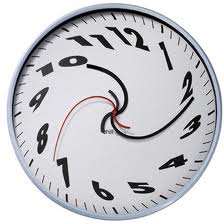
The Anomaly: After about an hour they discovered that the threat was based on a truly ingenious scheme to infiltrate virus code into servers. The modus operandi was to infiltrate virus code into servers by skewing the clocks of the servers.

The chief technologist of the IB explained to team “The data links between servers normally send an idle pattern consisting of the following bit pattern “0111 1110” from both ends to indicate that the link between the servers is healthy. However to detect the pattern the clock frequency on the servers on either end of the link should be perfectly synchronized. The clock’s frequency should allow the servers to check whether a bit is ‘0’ or ‘1’. For this to happen the the clock should allow the bit to be sampled  or checked at  exactly  the middle of the bit to be able to correctly determine whether the bit  is “1” or “0”. The synchronization is based on a centralized view of the time which is based on a protocol called Network Time Protocol (NTP). By skewing the clock frequency of the servers the hackers were able to infiltrate malicious code” the chief technologist continued.

Vish understood that the net hackers were able to cleverly corrupt the NTP protocol and trick the clocks on the servers to run at slightly slower frequency. In between the slower clock cycles the net hackers infiltrated malicious virus code. So while the server assumed it was detecting the idle pattern it was also downloading harmful virus that brought the server down.

No sooner than they cracked the problem, Vish sent urgent messages to Interpol on the scheme and to ensure that a clock was prevented. Simultaneously a crack team tracked the evil perpetrators inSicily.

A serious catastrophe had been averted and Vish felt extremely pleased with himself.

The next day, Vish decided to visit the Swamiji and convey his gratitude. He drove to No: 8, 5th Cross Street,Mahatma Gandhi Road. He entered the house and went through the same process. He quickly walked across the large hall. As before, the door swung open.

When he stepped through the door he was completely taken by surprise.

For on the other side of the door was a large park with neatly manicured gardens. There was no sign of the ashram he had seen just a day before. “Could my experience of the ashram have to do with Augmented Reality (AR)? Possibly a projection of an ashram  was superimposed on the garden” he thought.

He then realized that it was imperative that the coordinates of “The Council” must be protected at all costs and hence the illusion of his having visited The Council.

He shook his head and walked back to his car.

Find me on Google+

Technological hurdles: 2012 and beyond

Published in Telecom Asia, Jan 11,2012 – Technological hurdles – 2012 and beyond

You must have heard it all by now – the technological trends for 2012 and the future. The predictions range over BigData, cloud computing, internet of things, LTE, semantic web, social commerce and so on.

In this post, I thought I should focus on what seems to be significant hurdles as we advance to the future. So for a change, I wanted to play the doomsayer rather than a soothsayer. The positive trends are bound to continue and in our exuberance we may lose sight of the hurdles before us. Besides, “problems are usually opportunities in disguise”. So here is my list of the top issues that is facing the industry now.

Bandwidth shortage: A key issue of the computing infrastructure of today is data affinity, which is the result of the dual issues of data latency and the economics of data transfer. Jim Gray (Turing award in 1998) whose paper on “Distributed Computing Economics” states that that programs need to be migrated to the data on which they operate rather than transferring large amounts of data to the programs. In this paper Jim Gray tells us that the economics of today’s computing depends on four factors namely computation, networking, database storage and database access. He then equates $1 as follows

One dollar equates to

= 1 $

≈ 1 GB sent over the WAN

≈ 10 Tops (tera cpu operations)

≈ 8 hours of cpu time

≈ 1 GB disk space

≈ 10 M database accesses

≈ 10 TB of disk bandwidth

≈ 10 TB of LAN bandwidth

As can be seen from above breakup, there is a disproportionate contribution by the WAN bandwidth in comparison to the others.  In others words while the processing power of CPUs and the storage capacities have multiplied accompanied by dropping prices, the cost of bandwidth has been high. Moreover the available bandwidth is insufficient to handle the explosion of data traffic.

In fact it has been found that  the “cheapest and fastest way to move a Terabyte cross country is sneakernet (i.e. the transfer of electronic information, especially computer files, by physically carrying removable media such as magnetic tape, compact discs, DVDs, USB flash drives, or external drives from one computer to another).

With the burgeoning of bandwidth hungry applications it is obvious that we are going to face a bandwidth shortage. The industry will have to come with innovative solutions to provide what I would like to refer as “bandwidth-on-demand”.

The Spectrum Crunch: Powerful smartphones, extremely fast networks, content-rich applications, and increasing user awareness, have together resulted in a virtual explosion of mobile broadband data usage. There are 2 key drivers behind this phenomenal growth in mobile data. One is the explosion of devices-smartphones, tablet PCs, e-readers, laptops with wireless access. The second is video. Over 30% of overall mobile data traffic is video streaming, which is extremely bandwidth hungry. All these devices deliver high-speed content and web browsing on the move. The second is video. Over 30% of overall mobile data traffic is video streaming, which is extremely bandwidth hungry. The rest of the traffic is web browsing, file downloads, and email

The growth in mobile data traffic has been exponential. According to a report by Ericsson, mobile data is expected to double annually till 2015. Mobile broadband will see a billion subscribers this year (2011), and possibly touch 5 billion by 2015.

In an IDATE (a consulting firm) report,  the total mobile data will exceed 127 exabytes (an exabyte is 1018 bytes, or 1 mn terabytes) by 2020, an increase of over 33% from 2010).

Given the current usage trends, coupled with the theoretical limits of available spectrum, the world will run out of available spectrum for the growing army of mobile users. The current spectrum availability cannot support the surge in mobile data traffic indefinitely, and demand for wireless capacity will outstrip spectrum availability by the middle of this decade or by 2014.

This is a really serious problem. In fact, it is a serious enough issue to have the White House raise a memo titled “Unleashing the Wireless Broadband Revolution”. Now the US Federal Communication Commission (FCC) has taken the step to meet the demand by letting wireless users access content via unused airwaves on the broadcast spectrum known as “White Spaces”. Google and Microsoft are already working on this technology which will allow laptops, smartphones and other wireless devices to transfer in GB instead of MB thro Wi-Fi.

But spectrum shortage is an immediate problem that needs to be addressed immediately.

IPv4 exhaustion: IPv4 address space exhaustion has been around for quite some time and warrants serious attention in the not too distant future.  This problem may be even more serious than the Y2K problem. The issue is that IPv4 can address only 2^32 or 4.3 billion devices. Already the pool has been exhausted because of new technologies like IMS which uses an all IP Core and the Internet of things with more devices, sensors connected to the internet – each identified by an IP address. The solution to this problem has been addressed long back and requires that the Internet adopt IPv6 addressing scheme. IPv6 uses 128-bit long address and allows 3.4 x 1038 or 340 trillion, trillion, trillion unique addresses. However the conversion to IPv6 is not happening at the required pace and pretty soon will have to be adopted on war footing. It is clear that while the transition takes place, both IPv4 and IPv6 will co-exist so there will be an additional requirement of devices on the internet to be able to convert from one to another.

We are bound to run into a wall if organizations and enterprises do not upgrade their devices to be able to handle IPv6.

Conclusion: These are some of the technological hurdles that confront the computing industry.  Given mankind’s ability to come up with innovative solutions we may find new industries being spawned in solving these bottlenecks.

Find me on Google+

Sea shells on the seashore

Ritvik stayed a few feet away from where the receding waves left a wet mark. He had taken his early morning walk to the Marina beach in Chennai. He loved to watch the sun appear from the edge of the water and turn the sea to a shimmering golden glow. He enjoyed hearing the rhythmic roar of the waves, and following the sea gulls in early morning flight. His eyes wandered over the sea-shells that came with each advance of a wave front. It was time to go back. He had to get back and get ready to go to school.

Just as he was about to leave a small, shiny black piece of stone caught his attention. It glinted in the early morning rays. He bent down to pick it.  When he touched the stone, he felt a sharp stinging electric shock. For a moment he was confused whether it was just the sensation of pins and needles which occurs when we move from a stationary position. He looked curiously at the rock. To his amazement, the color had now changed and it was a dull brown color. He put the stone in his pocket and took it home without any further thought.

In his hurry to get to school, he absent mindedly left the stone on his window sill and rushed off to school. Late at night the stone on the window sill again caught his eye. It was now a deeper shade of shiny black. He picked it thoughtlessly only to drop it yelling as it again sent a shock through his hand. His father, who happened to be close by, was alarmed and asked him what happened. Ritvik recounted the incident and showed the stone to his father which had again turned dull brown. The curiosity of his father, who was a material science Professor at Madras IIT, was deeply aroused. His father took the stone to the institute the next day. It did not take Mr. Mukundan long  to realize that the stone had the property of storing solar energy which could be tapped at will later. His father quietly performed the research on the stone and published the results in “The Journal of Science” and “Nature”.

This discovery was a major landmark in our world which could not get itself out of the stranglehold of the “fuels of hell” namely coal, petroleum and the like.  Pretty soon India and other governments of the world got together and decided to run expeditions to mine for this miracle material appropriately named “solarium”

A few months later it was found that the Bay of Bengal had abundant deposits of solarium. It was discovered that 1 kg of solarium could store 100 KW of power enough to power a single house for a month.

The find of solarium marked a new era in technological progress for mankind. Further advances were made in increasing the storage potential of solarium by performing certain chemical processes of refining it coupled with placing it in a strong electro-magnetic field.

Automobiles, domestic power, industrial power were all replaced using solarium.

Fast forward to 2026. The first space vehicle powered entirely by solarium designed by a joint venture of NASA, ISRO and ESA were created. The first unmanned flight “Quark” to star Sirius was proposed based on a trajectory that combined accumulated solar energy from solarium and the gravity of heavenly bodies.

Do read my other short story (science-fiction) – Singularity.

Find me on Google+

Towards an auction-based Internet

The post below was quoted and discussed extensively in (see the link) GigaOM, 14 Jan 2011 – Software Defined Networks could create an auction-based bazaar.

Published in Telecom Asia, Jan 13,2012 – Towards an auction-based internet

Are we headed to an auction-based Internet? This train of thought (no pun intended), which struck me while I was travelling from Chennai to Bangalorelast evening, was the result of the synthesis  of different ideas and technologies which I had read  in the recent past.

The current state of technology and the technology trends do seem to indicate such a possibility.  An auction-based internet would be a business model in which bandwidth would be allocated to different data traffic on the internet based on dynamic bidding by different network elements. Such an eventuality is a distinct possibility considering the economics and latencies involved in data transfer, the evolution of the smart grid concept and the emergence of the promising technology known as the OpenFlow protocol.  This is further elaborated below

Firstly, in the book “Grids, cloud and virtualization”, by Massimo Caforo and Giovanni Aloisio, the authors highlight a typical problem of the computing infrastructure of today. In the book, the authors contend that a key issue in large scale computing is data affinity, which is the result of the dual issues of data latency and the economics of data transfer. They quote, Jim Gray (Turing award in 1998) whose paper on “Distributed Computing Economics” states that that programs need to be migrated to the data on which they operate rather than transferring large amounts of data to the programs.  This is in fact used in the Hadoop paradigm, where the principle of locality is maintained by keeping the programs close to the data on which they operate.

The book highlights another interesting fact. It says “cheapest and fastest way to move a Terabyte cross country is sneakernet (i.e. the transfer of electronic information, especially computer files, by physically carrying removable media such as magnetic tape, compact discs, DVDs, USB flash drives, or external drives from one computer to another). Google used sneakernet to transfer 120 TB of data. The SETI@home also used sneakernet to transfer data recorded by their telescopes inArecibo, Puerto Rico stored in magnetic tapes toBerkeley,California.

It is now a well known fact that mobile and fixed line data has virtually exploded clogging the internet. YouTube, video downloads and other streaming data choke the data pipes of the internet and Service Providers have not found a good way to monetize this data explosion. While there has been a tremendous advancement in CPU processing power (CPU horsepower in the range of petaflops) and enormous increases in storage capacity(of the order of petabytes) coupled with dropping prices,  there has been no corresponding drop in bandwidth prices in relation to the bandwidth capacity.

Secondly, in the book “Hot, flat and crowded” Thomas L. Friedman  describes the “Smart Homes” of the future in which all the home appliances will have sensors and will participate in the energy auction in real time as a part of the Smart Grid.  The price of energy in the Energy Grid fluctuates like stock prices since enterprises are bidding for energy during the day. In his Smart Home, Friedman envisions a situation in which the washing machine will turn on during off-peak hours when the prices of energy in the energy grid is low. In this way all the appliances in the homes of the future will minimize energy consumption by adjusting the cycles accordingly.

Why could not the internet also behave in a similar fashion? The internet pipes get crowded at different periods of the day, during seasons and during popular sporting events. Why cannot we have an intelligent network in place in which price of different data transfer rates vary depending on the time of the day, the type of traffic and the quality of service required.  Could the internet be based on an auction-mechanism in which different devices bid for bandwidth based on the urgency, speed and quality of services required? Is this possible with the routers, switches of today?

The answer is yes. This can be achieved by the new, path breaking innovation known as Software Defined Networks (SDNs) based on the OpenFlow protocol. SDN is the result of pioneering effort by Stanford University and University of California, Berkeley and is based on the Open Flow Protocol and represents a paradigm shift to the way networking elements operate.  Do read my post Software Defined Networks : A glimpse of tomorrow   for a more detailed look at SDNs. SDNs can be made to dynamically route traffic flows based on decisions in real time.  The flow of data packets through the network can be controlled in a programmatic manner through the OpenFlow protocol. In order to dynamically allocate smaller or fatter pipes for different flows, it necessary for the logic in the Flow Controller to be updated dynamically based on the bid price.

For e.g. we could assume that a corporate has 3 different flows namely, immediate, (ASAP), price below $x. Based on the upper ceiling for the bid price, the OpenFlow controller will allocate a flow for the immediate traffic of the corporation. For the ASAP flow, the corporate would have requested that the flow be arranged when the bid price falls between a range $a – $b. The OpenFlow Controller will ensure that it can arrange for such a flow. The last type of traffic which is not important it will be send during non-peak hours. This will require that the OpenFlow controller be able to allocate different flows dynamically based on winning the auction process that happens in this scheme. The current protocols of the internet of today namely RSVP, DiffServ allocate pipes based on the traffic type & class which is static once allocated. This strategy enables OpenFlow to dynamically adjust the traffic flows based on the current bid price prevailing in that part of the network.

The ability of the OpenFlow protocol to be able to dynamically allocate different flows will once and for all solve the problem of being able to monetize mobile and fixed line data.  Users can decide the type of service they are interested and choose appropriately. This will be a win-win for both the Service Providers and the consumer. The Service Provider will be able to get a ROI for the infrastructure based on the traffic flowing through his network. The consumer rather than paying a fixed access charge could have a smaller charge because of low bandwidth usage.

An auction-based internet is not just a possibility but would also be a worthwhile business model to pursue. The ability to route traffic dynamically based on an auction mechanism in the internet enables the internet infrastructure to be utilized optimally. It will serve the dual purpose of solving traffic congestion, as highest bidders will get the pipe but will also monetize data traffic based on its importance to the end user.

An auction based internet is a very distinct possibility in our future given the promise of the OpenFlow protocol.

All  thoughts, ideas or counter opinions are welcome!

Find me on Google+

The story of virtualization

The journey from the early days of batch processing to these days of virtualized computing has been truly an exciting march of progress. The innovations and ideas have truly transformed the computing landscape as we know it which promises of still more breathtaking changes to come.

Batch processing: Programs written on the computers of those days used punch cards also known as Hollerith cards. A separate terminal would be used to edit and create the program which would result in a stack of punched card. The different stacks of user programs would be loaded into a card reader which would then queue the programs for processing by the computers of those days. Each program would be executed in sequential order.

Imagine if our days were structured sequentially where would need a particular task to complete fully before we start another one. That would be a true waste of time. While each task progresses we could focus on other tasks.

The inefficiencies of batch processing soon became obvious and led to the development of multi-tasked systems in which each user’s applications is granted a slice of the CPU cycles for use. The Operating System (OS) would cycle through the list of processes granting then a specific number of cycles to compute each time. Soon this development led to different operating systems including Windows, Unix, Linux and so on.

Multitasking: Mutitasking evolved because designers realized that the Central Processor Unit (CPU) cycles were wasted when programs waited for input/output to arrive or complete. Hence the computer’s operating system(OS) or the central nervous system would swap the user’s program out of the CPU and grant the CPU to other user applications. This way the CPU is utilized efficiently.

The pen analogy : For this analogy let us consider a fountain pen to be the CPU. While Joe is writing a document, he uses the fountain pen. Now, lets assume that Joe needs to print a document. While Joe saunters to pick up his printout, the fountain pen is given to Kartik who needs his tax report. Kartik soon gets tired and takes a coffee break. Now the pen is given to Jane who needs to fill up a form. When Jane completes her form the pen is handed over to Joe who just returned with his print out. The pen (CPU) is thus used efficiently among the many users.

While multi-tasking was a major breakthrough it did lead to an organization’s applications being developed in different OS flavors. Hence a large organization would be left with software silos each with its own unique OS. This was a problem when the organization wanted to consolidate all its relevant software under a common umbrella. For e.g. A telecom operator may have payroll applications that run on Windows, accounting on Linux and human resources on Unix. It thus became difficult for the organization to get a holistic view of what happened in the Finance department as a whole. Enter ‘virtualization’. Virtualization enables applications created for different OS’es to run over a layer known as the “hypervisor” that abstracts the raw hardware.

Virtualization: Virtualization in essence abstracts the raw hardware through a software application called the Hypervisor. The Hypervisor runs on a bare metal of the CPU. Applications that run over the Hypervisor can choose the operating systems of their choice namely Windows, Linux, Unix etc. The Hypervisor would effectively translate the different OS instructions to the machine instructions of the underlying processor

The car analogy: Imagine that you got into a car. Once inside the car you had a button which when pressed would convert the car either into a roaring Ferrari, Lamborghini or a smooth Mercedes, BMW. The dashboard, the seats, engine all magically transformed into the car of your dreams. This is exactly what virtualization tries to achieve.

Server Pooling: However, virtualization went further than just enabling applications created on different OS to run on a single server loaded with the hypervisor. Virtualization also enabled consolidation of server farms. Virtualization brings together the different elements of an enterprise namely the servers each with its memory, processors and different storage options (disk attached storage (DAS), fiber channel storage access network (FC SAN), Network Access Storage (NAS)) and networking elements. Virtualization consolidates the compute, storage and networking elements together and provides an illusion where appropriate compute, storage and network are provided to applications on demand. The applications are provided with virtual machines with the necessary computing, storage and network units as required. Virtualization also took care of providing high availability(HA), mobility and security to the applications besides enabling an illusion of shared resources. Besides if the any of the servers on which an application is executing goes down for any reason the application is migrated seamlessly to another server.

The train analogy: Assume that there was train with ‘n’ number of wagons. Commuters can get on and get off at any station. When they get on the train they are automatically allocated a seat, a berth and so on. The train keeps track of how occupied the train is and provides the appropriate seating dynamically. If the wheels of any wagon gets stuck the passenger is lifted and shifted,seamlessly, to another wagon while the stuck wagon is safely de-linked from the train.

Virtualization has many applications. It is the dominant technology that is used in the creation of public, private or a hybrid cloud thus creating providing an on-demand scalable computing environment. Virtualization is also used in consolidation of server farms enabling optimum usage of the servers.

Find me on Google+

Big Data – Getting bigger!

Published in Telecom Asia – Big Data is getting bigger

There are two very significant ways that our world has changed in the past decade. Firstly, we are more “connected”. Secondly we are “awash with data.” In a planet with 7 billion people there are now 2 billion PCs and upward of 6 billion mobile connections. Besides the connection which we as human beings have there are now numerous connections to the internet from devices, sensors and actuators. In other words the world is getting more and more instrumented. There are in excess of 30 billion RFID tags which enable tracking of goods as they move from warehouse, to retail store, sensors on cars and bridges besides cardiac implants in the human body that are constantly sending a stream of data to the network (do look at my post The Internet of Things” . In addition we have the emergence of the Smart Grid with its millions and millions of smart meters that are capable of sensing power loads and appropriately redistributing power and drawing less power during peak hours.

All these devices be it laptops, cell phones, sensors, RFIDs or smart meters are sending enormous amounts of data to the network. In other words there is an enormous data overload happening in the networks of today. According to a Cisco report the projected increase in data traffic between 2014 and 2015 is of the order of 200 exabytes (10^18)). In addition the report states that the total number of connected to the network will be twice the world population or around 15 billion).

Fortunately the explosion in data has been accompanied by falling prices in storage and extraordinary increases in processing capacity. The data that is generated by the devices by the devices, cell phones, PC etc by themselves are useless. However if processed they can provide insights into trends and patterns which can be used to make key decisions. For e.g. the data exhaust that comes from a user’s browsing trail, click stream provide important insight into user behavior which can be mined to make important decisions. Similarly inputs from social media like Twitter, Facebook provide businesses with key inputs which can be used for making business decisions. Call Detail records that are created for mobile calls can also be a source of user behavior. Data from retail store provide insights into consumer choices. For all these to happen the enormous amounts of data has to be analyzed using algorithms to determine statistical trends, patterns and tendencies in the data.

It is here that Big Data enters the picture. Big Data enables the management of the 3 V’s of data , namely volume, velocity and variety. As mentioned above the volume of data is growing at an exponential rate and should exceed 200 exabytes by 2015. The rate at which the data is generated, or the velocity, is also growing phenomenally given the variety and the number of devices that are connected to the network. Besides there is a tremendous variety to the data. Data is both structured, semi-structured and unstructured. Logs could be in plain text, CSV,XML, JSON and so on. The issue of 3 V’s of data makes Big Data most suited for crunching this enormous proliferation of data at the velocity at which it is generated.

Big Data : Big Data or Analytics (see my post “The Rise of Analytics” ) deals with the algorithms that analyze petabytes (10^15)of data and identify key patterns in them. The patterns that are so identified can be used to make important predictions in the future. For example Big Data has been used by energy companies in identifying key locations for positioning their wind turbines. To identify the precise location requires that petabytes of data be crunched rapidly and appropriate patterns be identified. There are several applications of Big Data including identifying brand sentiment from social media, to customer behavior from click exhaust to identifying optimal power usage by consumers.

The key difference between Big Data and traditional processing methods are that the volume of data that has be processed and the speed with which it has to be processed. As mentioned before the 3 V’s of volume, velocity and variety make traditional methods unsuitable for handling this data. In this context, besides the key algorithms of analytics another player is extremely important in Big Data – that is Hadoop. Hadoop is a processing technique that involves tremendous parallelization of the task (for details look at To Hadoop, or not to Hadoop)

The Hadoop Ecosystem – Hadoop had its origins at Google during its work with the Google’s File System (GFS) and the Map Reduce programming paradigm.

HDFS and Map-Reduce : Hadoop in essence is the Hadoop Distributed File System (HDFS) and the Map Reduce paradigm. The Hadoop System is made up of thousands of distributed commodity servers. The data is stored in the HDFS in blocks of 64 MB or 128 MB. The data is replicated among two or more servers to maintain redundancy. Since Hadoop is made of regular commodity servers which are prone to failures, fault tolerance is included by design. The Map Reduce Paradigm essentially breaks a job into multiple tasks which are executed in parallel. Initially the “Map” part processes the input data and outputs a pair of tuples. The “Reduce” part then scans the pair of tuples and generates a consolidated output. For e.g. The “map” part could count the number of occurrences of different words in different sets of files and output the words and their count as pairs. The “reduce” would then sum up the counts of the word from the individual ‘map’ parts and provide the total occurrences of the words in multiple files.

Pig and PigLatin : This is a programming language developed at Yahoo to relieve programmers of the intricacies of programming the Map-Reduce and assigning tasks to individual parts. Pig is made up of two parts namely PigLatin, the language and the environment in which it will execute.

Hive: Hive is a Hadoop run-time support structure that was developed by Facebook. Hive has a distinct SQL flavor to it and also simplifies the task of Hadoop programming.

JAQL : JAQL is a declarative query language developed by IBM for handling JSON objects. JAQL is another programming paradigm that is used to programming Hadoop.

Conclusion: It is a foregone conclusion that Big Data and Hadoop will take center stage in the not too distant future given the explosion of data and the dire need of being able to glean useful business insights from them. Big Data and its algorithms provide the way for identifying useful pearls of wisdom from otherwise useless data. Big Data is bound to become mission critical in the enterprises of the future.

Find me on Google+

De-blurring revisited with Wiener filter using OpenCV

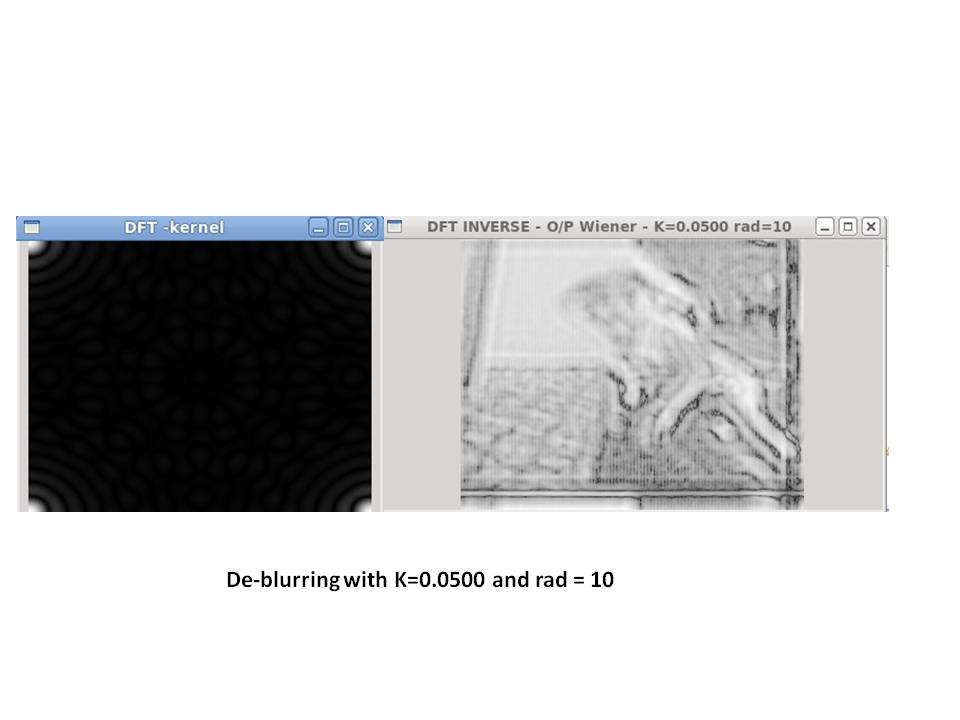
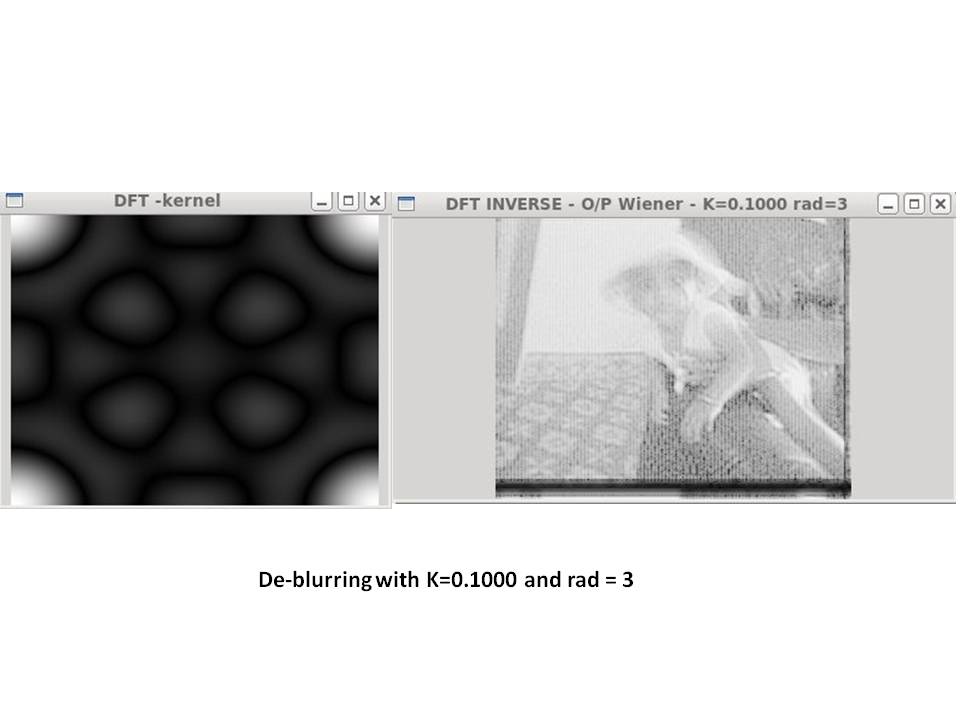
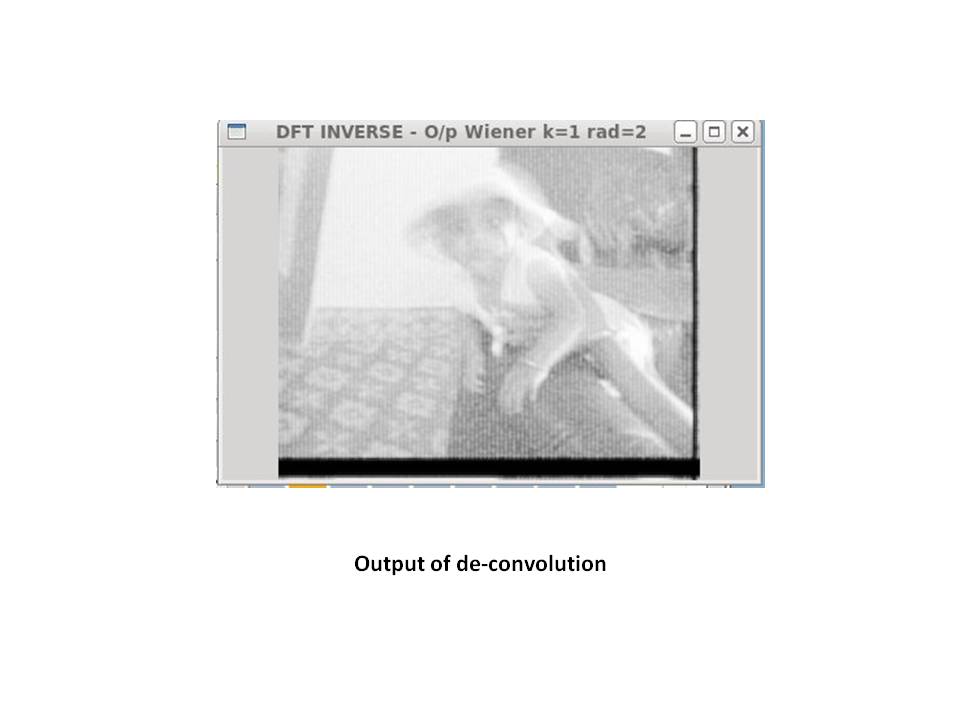
In this post I continue to experiment with the de-blurring of images using the Wiener filter. For details on the Wiener filter, please look at my earlier post “Dabbling with Wiener filter using OpenCV”.  Thanks to Egli Simon, Switzerland for pointing out a bug in the earlier post which I have now fixed.  The Wiener filter attempts to de-blur by assuming that the source signal is convolved with a blur kernel in the presence of noise.   I have also included the blur kernel as estimated by E. Simon in the code. I am including the de-blurring with 3 different blur kernel radii and different values for the Wiener constant K.  While the de-blurring is still a long way off there is some success.

One of the reasons I have assumed a non-blind blur kernel and try to de-convolve with that. The Wiener filter tries to minimize the Mean Square Error (MSE)  which can be expressed as
e(f) = E[X(f) – X1(f)]^2                                – (1)

where e(f) is the Mean Square Error(MSE) in the frequency domain, X(f) is the original image and X1(f) is the estimated signal which we get by de-convolving the Wiener filter with the observed blurred image i.e. and E[] is the expectation

X1(f) = G(f) * Y(f)                                        -(2)
where G(f) is the Wiener de-convolution filter and Y(f) is the observed blurred image
Substituting (2) in (1) we get
e(f) = E[X(f) – G(f) *Y(f)]^2

If the above equation is solved we can effectively remove the blur.
Feel free to post comments, opinions or ideas.

Watch this space …
I will be back! Hasta la Vista!


Note: You can clone the code below from Git Hib – Another implementation of Weiner filter in OpenCV

The complete code is included below and should work as is

/*
============================================================================
Name : deblur_wiener.c
Author : Tinniam V Ganesh & Egli Simon
Version :
Copyright :
Description : Implementation of Wiener filter in OpenCV
============================================================================
*/

#include <stdio.h>
#include <stdlib.h>
#include “cxcore.h”
#include “cv.h”
#include “highgui.h”

#define kappa 10.0
#define rad 8

int main(int argc, char ** argv)
{
int height,width,step,channels,depth;
uchar* data1;

CvMat *dft_A;
CvMat *dft_B;

CvMat *dft_C;
IplImage* im;
IplImage* im1;

IplImage* image_ReB;
IplImage* image_ImB;

IplImage* image_ReC;
IplImage* image_ImC;
IplImage* complex_ImC;
CvScalar val;

IplImage* k_image_hdr;
int i,j,k;
char str[80];
FILE *fp;
fp = fopen(“test.txt”,”w+”);

int dft_M,dft_N;
int dft_M1,dft_N1;

CvMat* cvShowDFT1(IplImage*, int, int,char*);
void cvShowInvDFT1(IplImage*, CvMat*, int, int,char*);

im1 = cvLoadImage( “kutty-1.jpg”,1 );
cvNamedWindow(“Original-color”, 0);
cvShowImage(“Original-color”, im1);
im = cvLoadImage( “kutty-1.jpg”, CV_LOAD_IMAGE_GRAYSCALE );
if( !im )
return -1;

cvNamedWindow(“Original-gray”, 0);
cvShowImage(“Original-gray”, im);

// Create a random noise matrix
fp = fopen(“test.txt”,”w+”);
int val_noise[357*383];
for(i=0; i <im->height;i++){
for(j=0;j<im->width;j++){
fprintf(fp, “%d “,(383*i+j));
val_noise[383*i+j] = rand() % 128;
}
fprintf(fp, “\n”);
}

CvMat noise = cvMat(im->height,im->width, CV_8UC1,val_noise);

// Add the random noise matric to the image
cvAdd(im,&noise,im, 0);

cvNamedWindow(“Original + Noise”, 0);
cvShowImage(“Original + Noise”, im);

cvSmooth( im, im, CV_GAUSSIAN, 7, 7, 0.5, 0.5 );
cvNamedWindow(“Gaussian Smooth”, 0);
cvShowImage(“Gaussian Smooth”, im);

// Create a blur kernel
IplImage* k_image;
float r = rad;
float radius=((int)(r)*2+1)/2.0;

int rowLength=(int)(2*radius);
printf(“rowlength %d\n”,rowLength);
float kernels[rowLength*rowLength];
printf(“rowl: %i”,rowLength);
int norm=0; //Normalization factor
int x,y;
CvMat kernel;
for(x = 0; x < rowLength; x++)
for (y = 0; y < rowLength; y++)
if (sqrt((x – (int)(radius) ) * (x – (int)(radius) ) + (y – (int)(radius))* (y – (int)(radius))) <= (int)(radius))
norm++;
// Populate matrix
for (y = 0; y < rowLength; y++) //populate array with values
{
for (x = 0; x < rowLength; x++) {
if (sqrt((x – (int)(radius) ) * (x – (int)(radius) ) + (y – (int)(radius))
* (y – (int)(radius))) <= (int)(radius)) {
//kernels[y * rowLength + x] = 255;
kernels[y * rowLength + x] =1.0/norm;
printf(“%f “,1.0/norm);
}
else{
kernels[y * rowLength + x] =0;
}
}
}

/*for (i=0; i < rowLength; i++){
for(j=0;j < rowLength;j++){
printf(“%f “, kernels[i*rowLength +j]);
}
}*/

kernel= cvMat(rowLength, // number of rows
rowLength, // number of columns
CV_32FC1, // matrix data type
&kernels);
k_image_hdr = cvCreateImageHeader( cvSize(rowLength,rowLength), IPL_DEPTH_32F,1);
k_image = cvGetImage(&kernel,k_image_hdr);

height = k_image->height;
width = k_image->width;
step = k_image->widthStep/sizeof(float);
depth = k_image->depth;

channels = k_image->nChannels;
//data1 = (float *)(k_image->imageData);
data1 = (uchar *)(k_image->imageData);
cvNamedWindow(“blur kernel”, 0);
cvShowImage(“blur kernel”, k_image);

dft_M = cvGetOptimalDFTSize( im->height – 1 );
dft_N = cvGetOptimalDFTSize( im->width – 1 );

//dft_M1 = cvGetOptimalDFTSize( im->height+99 – 1 );
//dft_N1 = cvGetOptimalDFTSize( im->width+99 – 1 );

dft_M1 = cvGetOptimalDFTSize( im->height+3 – 1 );
dft_N1 = cvGetOptimalDFTSize( im->width+3 – 1 );

printf(“dft_N1=%d,dft_M1=%d\n”,dft_N1,dft_M1);

// Perform DFT of original image
dft_A = cvShowDFT1(im, dft_M1, dft_N1,”original”);
//Perform inverse (check)
//cvShowInvDFT1(im,dft_A,dft_M1,dft_N1, “original”); – Commented as it overwrites the DFT

// Perform DFT of kernel
dft_B = cvShowDFT1(k_image,dft_M1,dft_N1,”kernel”);
//Perform inverse of kernel (check)
//cvShowInvDFT1(k_image,dft_B,dft_M1,dft_N1, “kernel”);- Commented as it overwrites the DFT

// Multiply numerator with complex conjugate
dft_C = cvCreateMat( dft_M1, dft_N1, CV_64FC2 );

printf(“%d %d %d %d\n”,dft_M,dft_N,dft_M1,dft_N1);

// Multiply DFT(blurred image) * complex conjugate of blur kernel
cvMulSpectrums(dft_A,dft_B,dft_C,CV_DXT_MUL_CONJ);
//cvShowInvDFT1(im,dft_C,dft_M1,dft_N1,”blur1″);

// Split Fourier in real and imaginary parts
image_ReC = cvCreateImage( cvSize(dft_N1, dft_M1), IPL_DEPTH_64F, 1);
image_ImC = cvCreateImage( cvSize(dft_N1, dft_M1), IPL_DEPTH_64F, 1);
complex_ImC = cvCreateImage( cvSize(dft_N1, dft_M1), IPL_DEPTH_64F, 2);
printf(“%d %d %d %d\n”,dft_M,dft_N,dft_M1,dft_N1);

//cvSplit( dft_C, image_ReC, image_ImC, 0, 0 );
cvSplit( dft_C, image_ReC, image_ImC, 0, 0 );

// Compute A^2 + B^2 of denominator or blur kernel
image_ReB = cvCreateImage( cvSize(dft_N1, dft_M1), IPL_DEPTH_64F, 1);
image_ImB = cvCreateImage( cvSize(dft_N1, dft_M1), IPL_DEPTH_64F, 1);

// Split Real and imaginary parts
cvSplit( dft_B, image_ReB, image_ImB, 0, 0 );
cvPow( image_ReB, image_ReB, 2.0);
cvPow( image_ImB, image_ImB, 2.0);
cvAdd(image_ReB, image_ImB, image_ReB,0);
val = cvScalarAll(kappa);
cvAddS(image_ReB,val,image_ReB,0);

//Divide Numerator/A^2 + B^2
cvDiv(image_ReC, image_ReB, image_ReC, 1.0);
cvDiv(image_ImC, image_ReB, image_ImC, 1.0);

// Merge Real and complex parts
cvMerge(image_ReC, image_ImC, NULL, NULL, complex_ImC);
sprintf(str,”O/P Wiener – K=%6.4f rad=%d”,kappa,rad);

// Perform Inverse
cvShowInvDFT1(im, (CvMat *)complex_ImC,dft_M1,dft_N1,str);

cvWaitKey(-1);
return 0;
}

CvMat* cvShowDFT1(IplImage* im, int dft_M, int dft_N,char* src)
{
IplImage* realInput;
IplImage* imaginaryInput;
IplImage* complexInput;
CvMat* dft_A, tmp;
IplImage* image_Re;
IplImage* image_Im;
char str[80];
double m, M;
realInput = cvCreateImage( cvGetSize(im), IPL_DEPTH_64F, 1);
imaginaryInput = cvCreateImage( cvGetSize(im), IPL_DEPTH_64F, 1);
complexInput = cvCreateImage( cvGetSize(im), IPL_DEPTH_64F, 2);
cvScale(im, realInput, 1.0, 0.0);
cvZero(imaginaryInput);
cvMerge(realInput, imaginaryInput, NULL, NULL, complexInput);

dft_A = cvCreateMat( dft_M, dft_N, CV_64FC2 );
image_Re = cvCreateImage( cvSize(dft_N, dft_M), IPL_DEPTH_64F, 1);
image_Im = cvCreateImage( cvSize(dft_N, dft_M), IPL_DEPTH_64F, 1);

// copy A to dft_A and pad dft_A with zeros
cvGetSubRect( dft_A, &tmp, cvRect(0,0, im->width, im->height));
cvCopy( complexInput, &tmp, NULL );
if( dft_A->cols > im->width )
{
cvGetSubRect( dft_A, &tmp, cvRect(im->width,0, dft_A->cols – im->width, im->height));
cvZero( &tmp );
}

// no need to pad bottom part of dft_A with zeros because of
// use nonzero_rows parameter in cvDFT() call below
cvDFT( dft_A, dft_A, CV_DXT_FORWARD, complexInput->height );
strcpy(str,”DFT -“);
strcat(str,src);
cvNamedWindow(str, 0);

// Split Fourier in real and imaginary parts
cvSplit( dft_A, image_Re, image_Im, 0, 0 );

// Compute the magnitude of the spectrum Mag = sqrt(Re^2 + Im^2)
cvPow( image_Re, image_Re, 2.0);
cvPow( image_Im, image_Im, 2.0);
cvAdd( image_Re, image_Im, image_Re, NULL);
cvPow( image_Re, image_Re, 0.5 );

// Compute log(1 + Mag)
cvAddS( image_Re, cvScalarAll(1.0), image_Re, NULL ); // 1 + Mag
cvLog( image_Re, image_Re ); // log(1 + Mag)

cvMinMaxLoc(image_Re, &m, &M, NULL, NULL, NULL);
cvScale(image_Re, image_Re, 1.0/(M-m), 1.0*(-m)/(M-m));
cvShowImage(str, image_Re);
return(dft_A);
}

void cvShowInvDFT1(IplImage* im, CvMat* dft_A, int dft_M, int dft_N,char* src)
{
IplImage* realInput;
IplImage* imaginaryInput;
IplImage* complexInput;
IplImage * image_Re;
IplImage * image_Im;
double m, M;
char str[80];
realInput = cvCreateImage( cvGetSize(im), IPL_DEPTH_64F, 1);
imaginaryInput = cvCreateImage( cvGetSize(im), IPL_DEPTH_64F, 1);
complexInput = cvCreateImage( cvGetSize(im), IPL_DEPTH_64F, 2);
image_Re = cvCreateImage( cvSize(dft_N, dft_M), IPL_DEPTH_64F, 1);
image_Im = cvCreateImage( cvSize(dft_N, dft_M), IPL_DEPTH_64F, 1);

//cvDFT( dft_A, dft_A, CV_DXT_INV_SCALE, complexInput->height );
cvDFT( dft_A, dft_A, CV_DXT_INV_SCALE, dft_M);
strcpy(str,”DFT INVERSE – “);
strcat(str,src);
cvNamedWindow(str, 0);

// Split Fourier in real and imaginary parts
cvSplit( dft_A, image_Re, image_Im, 0, 0 );

// Compute the magnitude of the spectrum Mag = sqrt(Re^2 + Im^2)
cvPow( image_Re, image_Re, 2.0);
cvPow( image_Im, image_Im, 2.0);
cvAdd( image_Re, image_Im, image_Re, NULL);
cvPow( image_Re, image_Re, 0.5 );

// Compute log(1 + Mag)
cvAddS( image_Re, cvScalarAll(1.0), image_Re, NULL ); // 1 + Mag
cvLog( image_Re, image_Re ); // log(1 + Mag)

cvMinMaxLoc(image_Re, &m, &M, NULL, NULL, NULL);
cvScale(image_Re, image_Re, 1.0/(M-m), 1.0*(-m)/(M-m));
//cvCvtColor(image_Re, image, CV_GRAY2RGBA);
cvShowImage(str, image_Re);
}
See also
– De-blurring revisited with Wiener filter using OpenCV
–  Dabbling with Wiener filter using OpenCV
– Deblurring with OpenCV: Wiener filter reloaded
– Re-working the Lucy-Richardson Algorithm in OpenCV

You may also like
1.  What’s up Watson? Using IBM Watson’s QAAPI with Bluemix, NodeExpress – Part 1
2.  Bend it like Bluemix, MongoDB with autoscaling – Part 1
3. Informed choices through Machine Learning : Analyzing Kohli, Tendulkar and Dravid
4. A crime map of India in R: Crimes against women

Find me on Google+

Dabbling with Wiener filter using OpenCV

The technique of reduction of blur and restoration of images is an extremely important field of study and finds numerous applications in medical imaging and astronomy.  One such technique is Wiener filter named after the originator of the technique Prof. Norbert Wiener (1894-1964).  It is usually important to consider these techniques in the frequency domain.

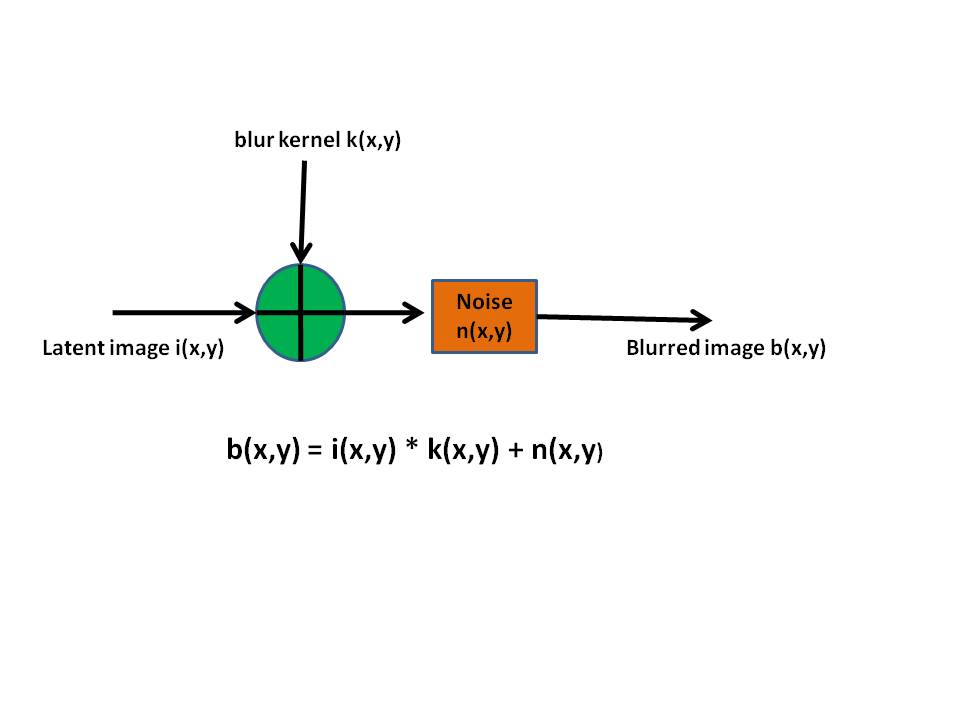
This can be represented diagrammatically as follows

Given that we have
b(x,y) = i(x,y) * k(x,y) + n(x,y)                                       – (1)
where b(x,y) is the blurred image, i(x,y) is the latent image, k(x,y) is the blur kernel and n(x,y) is random noise.
The above in frequency domain can be written as
B(u,v) = I(u,v) * K(u,v) + N(u,v)                                     –  (2)
Inv K(u,v) represents the inverse of the blur kernel and can be determined  from equation (2) by disregarding the noise.  However the inverse filter has high gain at low frequencies and hence tends to amplify noise at these low frequencies.
Wiener filter and Butterworth filter try to minimize these
Wiener filter attempts to minimize the Mean Squared Error (MSE) of the following equation
e^2 = E[( i(x,y)   – mean (i (x,y))^2]

The frequency domain expression for this
T(u,v)           =
K*(u,v)
——–                                                   -(3)
| K(u,v)|^2 + Sn(u,v)/Sf(u,v)
Where T(u,v) is the Wiener filter
K*(u,v) is the complex conjugate of the blur kernel
|K(u,v)|^2  = k^2 + m^2 where k and m are the coefficients of the real and imaginary parts of the blur kernel
Sn(u,v) is the power spectra of noise
Sf(u,v) is the power spectra of the signal
Equation (3) can be represented as
T(u,v)            =
K*(u,v)
——–                                                   –   (4)
| K(u,v)|^2 +  L
Where L is a small positive value
Eqn(4) represents Wiener filter

The lecture  “Image deblurring by Frequency Domain Operations” by Prof. Harvey Rhody is worth a read.
One thing that puzzles me is the Wiener filter is the inverse of the blur kernel with the additional factor of ‘L’ in the denominator. The contribution of the factor ‘L’ will be small, so the Wiener filter appears to be the same as a regular inverse filter. I am probably missing something here(??).

You can clone the code below from Git Hub – Weiner filter with OpenCV

The steps to create the Wiener filter were as follow

1. Create the gray image of the blurred original

2. Add additive noise to the blurred original

      // Add the random noise matric to the image
	cvAdd(im,&noise,im, 0);
3.Gaussian smooth the noisy blurred image
   cvSmooth( im, im, CV_GAUSSIAN, 7, 7, 0.5, 0.5 );
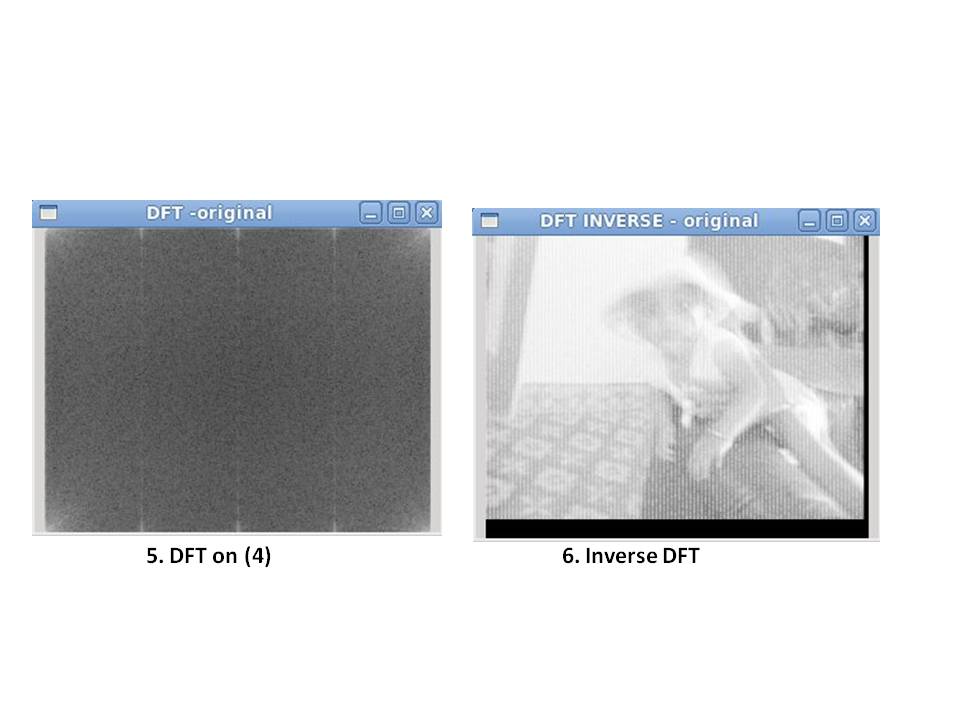
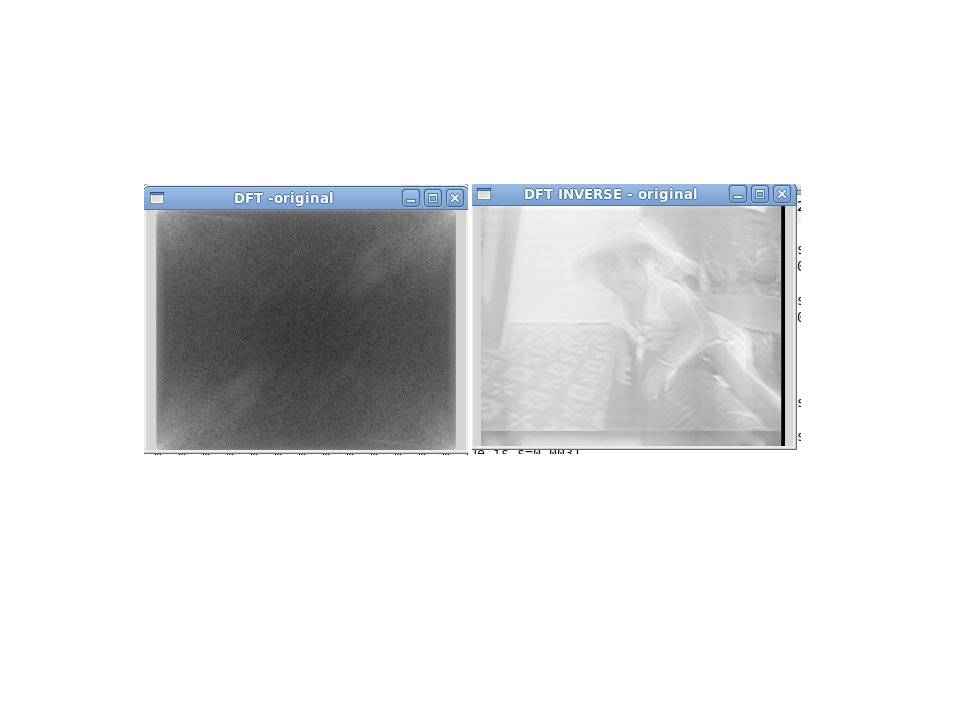
4.Perform DFT and inverse DFT (to check) of the original image (noisy, blurred image)
  // Perform DFT of original image
  dft_A = cvShowDFT1(im, dft_M1, dft_N1,"original");
  //Perform inverse (check)
  cvShowInvDFT1(im,dft_A,dft_M1,dft_N1, "original");
5.Perform DFT and inverse DFT of blur kernel
  // Perform DFT of kernel
  dft_B = cvShowDFT1(k_image,dft_M1,dft_N1,"kernel");
  //Perform inverse of kernel (check)
  cvShowInvDFT1(k_image,dft_B,dft_M1,dft_N1, "kernel");

6.Multiply DFT of original with complex conjugate of blur kernel
   // Multiply numerator with complex conjugate
  dft_C = cvCreateMat( dft_M1, dft_N1, CV_64FC2 );
7.Calculate modulus of blur kernel (denominator)
  // Split Real and imaginary parts
  cvSplit( dft_B, image_ReB, image_ImB, 0, 0 );
  cvPow( image_ReB, image_ReB, 2.0);
  cvPow( image_ImB, image_ImB, 2.0);
  cvAdd(image_ReB, image_ImB, image_ReB,0);
8.Add Wiener constant to modulus of blur kernel (denominator)
 val = cvScalarAll(0.00001);
  cvAddS(image_ReB,val,image_ReB,0);
9.Divide the numerator with the denominator
 //Divide Numerator/A^2 + B^2
  cvDiv(image_ReC, image_ReB, image_ReC, 1.0);
  cvDiv(image_ImC, image_ReB, image_ImC, 1.0);
10.Perform inverse DFT of the filtered signal

// Perform Inverse

 cvShowInvDFT1(im, (CvMat *)complex_ImC,dft_M1,dft_N1,"Output - Wiener filter");

There is still a residual amount of blur (do also read De-blurring revisited with Wiener filter using OpenCV). This can be tried for different values of the Wiener introduced noise.
Note: I would like to give special thanks to Egli Simon who identified the bug in my previous version of the code. The line to display the inverse DFT of the original image & the blur kernel overwrote the DFT contents and I was not getting the Wiener filter to work
Note: You can clone the code below from Git Hub – Weiner filter with OpenCV
The complete code is given below (re-worked and should work as is)
/*
============================================================================
Name : wiener1.c
Author : Tinniam V Ganesh & Egli Simon
Version :
Copyright :
Description : Wiener filter implementation in OpenCV (22 Nov 2011)
============================================================================
*/
#include <stdio.h>
#include <stdlib.h>
#include “cxcore.h”
#include “cv.h”
#include “highgui.h”

#define kappa 1
#define rad 2
int main(int argc, char ** argv)
{
int height,width,step,channels,depth;
uchar* data1;
CvMat *dft_A;
CvMat *dft_B;
CvMat *dft_C;
IplImage* im;
IplImage* im1;
IplImage* image_ReB;
IplImage* image_ImB;
IplImage* image_ReC;
IplImage* image_ImC;
IplImage* complex_ImC;
CvScalar val;
IplImage* k_image_hdr;
int i,j,k;

FILE *fp;
fp = fopen(“test.txt”,”w+”);

int dft_M,dft_N;
int dft_M1,dft_N1;
CvMat* cvShowDFT1(IplImage*, int, int,char*);
void cvShowInvDFT1(IplImage*, CvMat*, int, int,char*);
im1 = cvLoadImage( “kutty-1.jpg”,1 );
cvNamedWindow(“Original-color”, 0);
cvShowImage(“Original-color”, im1);
im = cvLoadImage( “kutty-1.jpg”, CV_LOAD_IMAGE_GRAYSCALE );
if( !im )
return -1;
cvNamedWindow(“Original-gray”, 0);
cvShowImage(“Original-gray”, im);

// Create a random noise matrix
fp = fopen(“test.txt”,”w+”);
int val_noise[357*383];
for(i=0; i <im->height;i++){
for(j=0;j<im->width;j++){
fprintf(fp, “%d “,(383*i+j));
val_noise[383*i+j] = rand() % 128;
}
fprintf(fp, “\n”);
}

CvMat noise = cvMat(im->height,im->width, CV_8UC1,val_noise);

// Add the random noise matric to the image
cvAdd(im,&noise,im, 0);
cvNamedWindow(“Original + Noise”, 0);
cvShowImage(“Original + Noise”, im);
cvSmooth( im, im, CV_GAUSSIAN, 7, 7, 0.5, 0.5 );
cvNamedWindow(“Gaussian Smooth”, 0);
cvShowImage(“Gaussian Smooth”, im);

// Create a blur kernel
IplImage* k_image;
float r = rad;
float radius=((int)(r)*2+1)/2.0;
int rowLength=(int)(2*radius);
printf(“rowlength %d\n”,rowLength);
float kernels[rowLength*rowLength];
printf(“rowl: %i”,rowLength);
int norm=0; //Normalization factor
int x,y;
CvMat kernel;
for(x = 0; x < rowLength; x++)
for (y = 0; y < rowLength; y++)
if (sqrt((x – (int)(radius) ) * (x – (int)(radius) ) + (y – (int)(radius))* (y – (int)(radius))) <= (int)(radius))
norm++;
// Populate matrix
for (y = 0; y < rowLength; y++) //populate array with values
{
for (x = 0; x < rowLength; x++) {
if (sqrt((x – (int)(radius) ) * (x – (int)(radius) ) + (y – (int)(radius))
* (y – (int)(radius))) <= (int)(radius)) {
//kernels[y * rowLength + x] = 255;
kernels[y * rowLength + x] =1.0/norm;
printf(“%f “,1.0/norm);
}
else{
kernels[y * rowLength + x] =0;
}
}
}

/*for (i=0; i < rowLength; i++){
for(j=0;j < rowLength;j++){
printf(“%f “, kernels[i*rowLength +j]);
}
}*/

kernel= cvMat(rowLength, // number of rows
rowLength, // number of columns
CV_32FC1, // matrix data type
&kernels);
k_image_hdr = cvCreateImageHeader( cvSize(rowLength,rowLength), IPL_DEPTH_32F,1);
k_image = cvGetImage(&kernel,k_image_hdr);

height = k_image->height;
width = k_image->width;
step = k_image->widthStep/sizeof(float);
depth = k_image->depth;

channels = k_image->nChannels;
//data1 = (float *)(k_image->imageData);
data1 = (uchar *)(k_image->imageData);
cvNamedWindow(“blur kernel”, 0);
cvShowImage(“blur kernel”, k_image);

dft_M = cvGetOptimalDFTSize( im->height – 1 );
dft_N = cvGetOptimalDFTSize( im->width – 1 );

//dft_M1 = cvGetOptimalDFTSize( im->height+99 – 1 );
//dft_N1 = cvGetOptimalDFTSize( im->width+99 – 1 );

dft_M1 = cvGetOptimalDFTSize( im->height+3 – 1 );
dft_N1 = cvGetOptimalDFTSize( im->width+3 – 1 );

printf(“dft_N1=%d,dft_M1=%d\n”,dft_N1,dft_M1);

// Perform DFT of original image
dft_A = cvShowDFT1(im, dft_M1, dft_N1,”original”);
//Perform inverse (check)
//cvShowInvDFT1(im,dft_A,dft_M1,dft_N1, “original”); – Commented as it overwrites the DFT

// Perform DFT of kernel
dft_B = cvShowDFT1(k_image,dft_M1,dft_N1,”kernel”);
//Perform inverse of kernel (check)
//cvShowInvDFT1(k_image,dft_B,dft_M1,dft_N1, “kernel”);- Commented as it overwrites the DFT

// Multiply numerator with complex conjugate
dft_C = cvCreateMat( dft_M1, dft_N1, CV_64FC2 );

printf(“%d %d %d %d\n”,dft_M,dft_N,dft_M1,dft_N1);

// Multiply DFT(blurred image) * complex conjugate of blur kernel
cvMulSpectrums(dft_A,dft_B,dft_C,CV_DXT_MUL_CONJ);
//cvShowInvDFT1(im,dft_C,dft_M1,dft_N1,”blur1″);

// Split Fourier in real and imaginary parts
image_ReC = cvCreateImage( cvSize(dft_N1, dft_M1), IPL_DEPTH_64F, 1);
image_ImC = cvCreateImage( cvSize(dft_N1, dft_M1), IPL_DEPTH_64F, 1);
complex_ImC = cvCreateImage( cvSize(dft_N1, dft_M1), IPL_DEPTH_64F, 2);

printf(“%d %d %d %d\n”,dft_M,dft_N,dft_M1,dft_N1);

//cvSplit( dft_C, image_ReC, image_ImC, 0, 0 );
cvSplit( dft_C, image_ReC, image_ImC, 0, 0 );

// Compute A^2 + B^2 of denominator or blur kernel
image_ReB = cvCreateImage( cvSize(dft_N1, dft_M1), IPL_DEPTH_64F, 1);
image_ImB = cvCreateImage( cvSize(dft_N1, dft_M1), IPL_DEPTH_64F, 1);

// Split Real and imaginary parts
cvSplit( dft_B, image_ReB, image_ImB, 0, 0 );
cvPow( image_ReB, image_ReB, 2.0);
cvPow( image_ImB, image_ImB, 2.0);
cvAdd(image_ReB, image_ImB, image_ReB,0);

val = cvScalarAll(kappa);
cvAddS(image_ReB,val,image_ReB,0);

//Divide Numerator/A^2 + B^2
cvDiv(image_ReC, image_ReB, image_ReC, 1.0);
cvDiv(image_ImC, image_ReB, image_ImC, 1.0);

// Merge Real and complex parts
cvMerge(image_ReC, image_ImC, NULL, NULL, complex_ImC);

// Perform Inverse
cvShowInvDFT1(im, (CvMat *)complex_ImC,dft_M1,dft_N1,”O/p Wiener k=1 rad=2″);

cvWaitKey(-1);
return 0;
}

CvMat* cvShowDFT1(IplImage* im, int dft_M, int dft_N,char* src)
{
IplImage* realInput;
IplImage* imaginaryInput;
IplImage* complexInput;

CvMat* dft_A, tmp;

IplImage* image_Re;
IplImage* image_Im;

char str[80];

double m, M;

realInput = cvCreateImage( cvGetSize(im), IPL_DEPTH_64F, 1);
imaginaryInput = cvCreateImage( cvGetSize(im), IPL_DEPTH_64F, 1);
complexInput = cvCreateImage( cvGetSize(im), IPL_DEPTH_64F, 2);
cvScale(im, realInput, 1.0, 0.0);
cvZero(imaginaryInput);
cvMerge(realInput, imaginaryInput, NULL, NULL, complexInput);
dft_A = cvCreateMat( dft_M, dft_N, CV_64FC2 );
image_Re = cvCreateImage( cvSize(dft_N, dft_M), IPL_DEPTH_64F, 1);
image_Im = cvCreateImage( cvSize(dft_N, dft_M), IPL_DEPTH_64F, 1);
// copy A to dft_A and pad dft_A with zeros
cvGetSubRect( dft_A, &tmp, cvRect(0,0, im->width, im->height));
cvCopy( complexInput, &tmp, NULL );
if( dft_A->cols > im->width )
{
cvGetSubRect( dft_A, &tmp, cvRect(im->width,0, dft_A->cols – im->width, im->height));
cvZero( &tmp );
}

// no need to pad bottom part of dft_A with zeros because of
// use nonzero_rows parameter in cvDFT() call below

cvDFT( dft_A, dft_A, CV_DXT_FORWARD, complexInput->height );

strcpy(str,”DFT -“);
strcat(str,src);
cvNamedWindow(str, 0);

// Split Fourier in real and imaginary parts
cvSplit( dft_A, image_Re, image_Im, 0, 0 );
// Compute the magnitude of the spectrum Mag = sqrt(Re^2 + Im^2)
cvPow( image_Re, image_Re, 2.0);
cvPow( image_Im, image_Im, 2.0);
cvAdd( image_Re, image_Im, image_Re, NULL);
cvPow( image_Re, image_Re, 0.5 );

// Compute log(1 + Mag)
cvAddS( image_Re, cvScalarAll(1.0), image_Re, NULL ); // 1 + Mag
cvLog( image_Re, image_Re ); // log(1 + Mag)

cvMinMaxLoc(image_Re, &m, &M, NULL, NULL, NULL);
cvScale(image_Re, image_Re, 1.0/(M-m), 1.0*(-m)/(M-m));
cvShowImage(str, image_Re);
return(dft_A);
}

void cvShowInvDFT1(IplImage* im, CvMat* dft_A, int dft_M, int dft_N,char* src)
{

IplImage* realInput;
IplImage* imaginaryInput;
IplImage* complexInput;
IplImage * image_Re;
IplImage * image_Im;
double m, M;
char str[80];

realInput = cvCreateImage( cvGetSize(im), IPL_DEPTH_64F, 1);
imaginaryInput = cvCreateImage( cvGetSize(im), IPL_DEPTH_64F, 1);
complexInput = cvCreateImage( cvGetSize(im), IPL_DEPTH_64F, 2);

image_Re = cvCreateImage( cvSize(dft_N, dft_M), IPL_DEPTH_64F, 1);
image_Im = cvCreateImage( cvSize(dft_N, dft_M), IPL_DEPTH_64F, 1);

//cvDFT( dft_A, dft_A, CV_DXT_INV_SCALE, complexInput->height );
cvDFT( dft_A, dft_A, CV_DXT_INV_SCALE, dft_M);
strcpy(str,”DFT INVERSE – “);
strcat(str,src);
cvNamedWindow(str, 0);

// Split Fourier in real and imaginary parts
cvSplit( dft_A, image_Re, image_Im, 0, 0 );

// Compute the magnitude of the spectrum Mag = sqrt(Re^2 + Im^2)
cvPow( image_Re, image_Re, 2.0);
cvPow( image_Im, image_Im, 2.0);
cvAdd( image_Re, image_Im, image_Re, NULL);
cvPow( image_Re, image_Re, 0.5 );

// Compute log(1 + Mag)
cvAddS( image_Re, cvScalarAll(1.0), image_Re, NULL ); // 1 + Mag
cvLog( image_Re, image_Re ); // log(1 + Mag)

cvMinMaxLoc(image_Re, &m, &M, NULL, NULL, NULL);
cvScale(image_Re, image_Re, 1.0/(M-m), 1.0*(-m)/(M-m));
//cvCvtColor(image_Re, image_Re, CV_GRAY2RGBA);

cvShowImage(str, image_Re);

}
Checkout my book ‘Deep Learning from first principles Second Edition- In vectorized Python, R and Octave’.  My book is available on Amazon  as paperback ($18.99) and in kindle version($9.99/Rs449).

You may also like my companion book “Practical Machine Learning with R and Python:Second Edition- Machine Learning in stereo” available in Amazon in paperback($12.99) and Kindle($9.99/Rs449) versions.

See also
– Experiments with deblurring using OpenCV
–  Dabbling with Wiener filter using OpenCV
– Deblurring with OpenCV: Wiener filter reloaded
– Re-working the Lucy-Richardson Algorithm in OpenCV


Find me on Google+

Experiments with deblurring using OpenCV

Deblurring refers to the removal of the blur from blurred images.  The removal of blur is extremely important in the fields of medical imaging, astronomy etc. In medical imaging this is also known as denoising and finds extensive applications in ultra sonic and CT images.  Similarly in astronomy there is a need to denoise and deblur images that are taken by space telescopes for e.g. the Hubble telescope.

Deblurring is really a tough problem to solve though it has been around for ages. While going through some of the white papers on deblurring I have been particularly fascinated by the results. The blurred images are restored back to its pristine, original sharp image. It is almost magical and is amazing to know that a computer program is able to detect and remove patches, almost bordering on “computer perception”.

However the solution to the problem is very involved. Almost every white paper I read in deblurring techniques involves abstruse mathematical concepts, enough to make one break into ‘cold sweat’ as I did several times. There are several well known methods of removing blur from images. The chief among them are the Richardson-Lucy method, the Weiner filter (do read my post “Dabbling with Wiener filter using OpenCV“), Radon transform or some form Bayesian filtering etc. All of these methods perform the converse of convolution known as de-convolution.  Almost all approaches are based on the following equation

b(x) = k(x) * i(x) + n(x)                           – (1)

Where b(x) – is the blurred image, i(x) is the latent (good) image, k(x) is the blur kernel also known as the Point Spread Function (PSF) and n(x) is random noise.

The key fact to note in the above equation is that the blurred image (b) is a convolution of a good latent image with a blur kernel plus some additive noise. So the good latent image is convolved by a blurring function or the points spread function and results in the blurred image.

Now there are 2 unknowns in the above equation, both the blur kernel and the latent image. To obtain the latent image a process known as de-convolution has to be performed.

If equation (1) is converted to the frequency domain using the Fourier transform on equation (1) we have

B(w) =  K(w) * I(w) + N(w)
Ignoring noise we have
I(w)  = B(w)/K(w)
or
I(w)  = DFT [B(w)]/DFT[K(w)]
Or i(t) = Inverse DFT {[DFT B(w)]/DFT[K(w)]}
If DFT[K(w)] can be represented as A+iB then the above can be represented as
i(t) = Inverse DFT { DFT [B(w)] * (A – iB)}
—————————
A**2 + B**2
where A-iB is the complex conjugate of the DFT of the blur kernel

This is known as de-convolution. There are two types of de-convolution blind and non-blind. In the non-blind de-convolution method an initial blur kernel is assumed and is used to de-blur the image. In the blind convolution an initial estimate of the blur kernel is made and the latent image is successively iterated to obtain the best image. This is based on a method known as maximum-a-posteriori (MAP) to iterate through successive estimations of better and better blur kernels. The Richardson-Lucy algorithm also tries to estimate the blur kernel from the blurred image.

In this post I  perform de-convolution using an estimated blur kernel. As can be seen there is a slight reduction of the blur. By choosing a large kernel probably a 100 x 100 matrix would give a better result.

You can clone this code from GitHub at “Deblurring by deconvolution in OpenCV

Kindly do share any thoughts, ideas that you have. I have included the full code for this. Feel free to use the code and tweak it as you see fit and please share any findings you come across.

Steps in the de-convolution process

  1. Perform DFT on blurred image. Also perform Inverse DFT to verify whether the process of DFT is correct or not. Make sure that the line for performing the inverse is commented out as it overwrites the DFT array.
           // Perform DFT of original image
		dft_A = cvShowDFT(im, dft_M1, dft_N1,"original");
		//Perform inverse (check)
		cvShowInvDFT(im,dft_A,dft_M1,dft_N1,fp, "original");

2. Perform DFT on blur kernel. Also perform inverse DFT to get back original contents. Make sure that the line for performing the inverse is commented out as it overwrites the DFT array.

		// Perform DFT of kernel
		dft_B = cvShowDFT(k_image,dft_M1,dft_N1,"kernel");
		//Perform inverse of kernel (check)
		cvShowInvDFT(k_image,dft_B,dft_M1,dft_N1,fp, "kernel");


    3. Multiply the DFT of image with the complex conjugate of the DFT of the blur kernel
		// Multiply numerator with complex conjugate
		dft_C = cvCreateMat( dft_M1, dft_N1, CV_64FC2 );
     4. Compute A**2 + B**2
		// Split Real and imaginary parts
		cvSplit( dft_B, image_ReB, image_ImB, 0, 0 );
    	        cvPow( image_ReB, image_ReB, 2.0);
		cvPow( image_ImB, image_ImB, 2.0);
		cvAdd(image_ReB, image_ImB, image_ReB,0);
     5. Divide numerator with A**2 + B**2
		//Divide Numerator/A^2 + B^2
		cvDiv(image_ReC, image_ReB, image_ReC, 1.0);
		cvDiv(image_ImC, image_ReB, image_ImC, 1.0);
                  6.Merge real and imaginary parts
		// Merge Real and complex parts
		cvMerge(image_ReC, image_ImC, NULL, NULL, complex_ImC);
         7.Finally perform Inverse DFT
		cvShowInvDFT(im, complex_ImC,dft_M1,dft_N1,fp,"deblur");

I have included the complete re-worked code below for the process of de-convolution. There was a small bug in the initial version. This has been fixed and the code below should work as is.

Note: You can clone this code from GitHub at “Deblurring by deconvolution in OpenCV
Do also take a look at my post “Reworking the Lucy Richardson algorithm in OpenCV
/*
============================================================================
Name : deconv.c
Author : Tinniam V Ganesh
Version :
Copyright :
Description : Deconvolution in OpenCV
============================================================================
*/

#include
#include
#include “cxcore.h”
#include “cv.h”
#include “highgui.h”

int main(int argc, char ** argv)
{
int height,width,step,channels;
uchar* data;
uchar* data1;
int i,j,k;
float s;

CvMat *dft_A;
CvMat *dft_B;
CvMat *dft_C;
IplImage* im;
IplImage* im1;
IplImage* image_ReB;
IplImage* image_ImB;
IplImage* image_ReC;
IplImage* image_ImC;
IplImage* complex_ImC;

IplImage* image_ReDen;
IplImage* image_ImDen;

FILE *fp;
fp = fopen(“test.txt”,”w+”);

int dft_M,dft_N;
int dft_M1,dft_N1;
CvMat* cvShowDFT();
void cvShowInvDFT();

im1 = cvLoadImage( “kutty-1.jpg”,1 );
cvNamedWindow(“original-color”, 0);
cvShowImage(“original-color”, im1);
im = cvLoadImage( “kutty-1.jpg”, CV_LOAD_IMAGE_GRAYSCALE );
if( !im )
return -1;

cvNamedWindow(“original-gray”, 0);
cvShowImage(“original-gray”, im);
// Create blur kernel (non-blind)
//float vals[]={.000625,.000625,.000625,.003125,.003125,.003125,.000625,.000625,.000625};
//float vals[]={-0.167,0.333,0.167,-0.167,.333,.167,-0.167,.333,.167};

float vals[]={.055,.055,.055,.222,.222,.222,.055,.055,.055};
CvMat kernel = cvMat(3, // number of rows
3, // number of columns
CV_32FC1, // matrix data type
vals);
IplImage* k_image_hdr;
IplImage* k_image;

k_image_hdr = cvCreateImageHeader(cvSize(3,3),IPL_DEPTH_64F,2);
k_image = cvCreateImage(cvSize(3,3),IPL_DEPTH_64F,1);
k_image = cvGetImage(&kernel,k_image_hdr);

/*IplImage* k_image;
k_image = cvLoadImage( “kernel4.bmp”,0 );*/
cvNamedWindow(“blur kernel”, 0);

height = k_image->height;
width = k_image->width;
step = k_image->widthStep;

channels = k_image->nChannels;
//data1 = (float *)(k_image->imageData);
data1 = (uchar *)(k_image->imageData);

cvShowImage(“blur kernel”, k_image);

dft_M = cvGetOptimalDFTSize( im->height – 1 );
dft_N = cvGetOptimalDFTSize( im->width – 1 );

//dft_M1 = cvGetOptimalDFTSize( im->height+99 – 1 );
//dft_N1 = cvGetOptimalDFTSize( im->width+99 – 1 );

dft_M1 = cvGetOptimalDFTSize( im->height+3 – 1 );
dft_N1 = cvGetOptimalDFTSize( im->width+3 – 1 );

// Perform DFT of original image
dft_A = cvShowDFT(im, dft_M1, dft_N1,”original”);
//Perform inverse (check & comment out) – Commented as it overwrites dft_A
//cvShowInvDFT(im,dft_A,dft_M1,dft_N1,fp, “original”);

// Perform DFT of kernel
dft_B = cvShowDFT(k_image,dft_M1,dft_N1,”kernel”);
//Perform inverse of kernel (check & comment out) – commented as it overwrites dft_B
//cvShowInvDFT(k_image,dft_B,dft_M1,dft_N1,fp, “kernel”);

// Multiply numerator with complex conjugate
dft_C = cvCreateMat( dft_M1, dft_N1, CV_64FC2 );

printf(“%d %d %d %d\n”,dft_M,dft_N,dft_M1,dft_N1);

// Multiply DFT(blurred image) * complex conjugate of blur kernel
cvMulSpectrums(dft_A,dft_B,dft_C,CV_DXT_MUL_CONJ);

// Split Fourier in real and imaginary parts
image_ReC = cvCreateImage( cvSize(dft_N1, dft_M1), IPL_DEPTH_64F, 1);
image_ImC = cvCreateImage( cvSize(dft_N1, dft_M1), IPL_DEPTH_64F, 1);
complex_ImC = cvCreateImage( cvSize(dft_N1, dft_M1), IPL_DEPTH_64F, 2);

printf(“%d %d %d %d\n”,dft_M,dft_N,dft_M1,dft_N1);

//cvSplit( dft_C, image_ReC, image_ImC, 0, 0 );
cvSplit( dft_C, image_ReC, image_ImC, 0, 0 );

// Compute A^2 + B^2 of denominator or blur kernel
image_ReB = cvCreateImage( cvSize(dft_N1, dft_M1), IPL_DEPTH_64F, 1);
image_ImB = cvCreateImage( cvSize(dft_N1, dft_M1), IPL_DEPTH_64F, 1);

// Split Real and imaginary parts
cvSplit( dft_B, image_ReB, image_ImB, 0, 0 );
cvPow( image_ReB, image_ReB, 2.0);
cvPow( image_ImB, image_ImB, 2.0);
cvAdd(image_ReB, image_ImB, image_ReB,0);

//Divide Numerator/A^2 + B^2
cvDiv(image_ReC, image_ReB, image_ReC, 1.0);
cvDiv(image_ImC, image_ReB, image_ImC, 1.0);

// Merge Real and complex parts
cvMerge(image_ReC, image_ImC, NULL, NULL, complex_ImC);

// Perform Inverse
cvShowInvDFT(im, complex_ImC,dft_M1,dft_N1,fp,”deblur”);
cvWaitKey(-1);
return 0;
}

CvMat* cvShowDFT(im, dft_M, dft_N,src)
IplImage* im;
int dft_M, dft_N;
char* src;
{
IplImage* realInput;
IplImage* imaginaryInput;
IplImage* complexInput;

CvMat* dft_A, tmp;

IplImage* image_Re;
IplImage* image_Im;

char str[80];

double m, M;

realInput = cvCreateImage( cvGetSize(im), IPL_DEPTH_64F, 1);
imaginaryInput = cvCreateImage( cvGetSize(im), IPL_DEPTH_64F, 1);
complexInput = cvCreateImage( cvGetSize(im), IPL_DEPTH_64F, 2);

cvScale(im, realInput, 1.0, 0.0);
cvZero(imaginaryInput);
cvMerge(realInput, imaginaryInput, NULL, NULL, complexInput);

dft_A = cvCreateMat( dft_M, dft_N, CV_64FC2 );
image_Re = cvCreateImage( cvSize(dft_N, dft_M), IPL_DEPTH_64F, 1);
image_Im = cvCreateImage( cvSize(dft_N, dft_M), IPL_DEPTH_64F, 1);

// copy A to dft_A and pad dft_A with zeros
cvGetSubRect( dft_A, &tmp, cvRect(0,0, im->width, im->height));
cvCopy( complexInput, &tmp, NULL );
if( dft_A->cols > im->width )
{
cvGetSubRect( dft_A, &tmp, cvRect(im->width,0, dft_A->cols – im->width, im->height));
cvZero( &tmp );
}

// no need to pad bottom part of dft_A with zeros because of
// use nonzero_rows parameter in cvDFT() call below

cvDFT( dft_A, dft_A, CV_DXT_FORWARD, complexInput->height );

strcpy(str,”DFT -“);
strcat(str,src);
cvNamedWindow(str, 0);

// Split Fourier in real and imaginary parts
cvSplit( dft_A, image_Re, image_Im, 0, 0 );

// Compute the magnitude of the spectrum Mag = sqrt(Re^2 + Im^2)
cvPow( image_Re, image_Re, 2.0);
cvPow( image_Im, image_Im, 2.0);
cvAdd( image_Re, image_Im, image_Re, NULL);
cvPow( image_Re, image_Re, 0.5 );

// Compute log(1 + Mag)
cvAddS( image_Re, cvScalarAll(1.0), image_Re, NULL ); // 1 + Mag
cvLog( image_Re, image_Re ); // log(1 + Mag)

cvMinMaxLoc(image_Re, &m, &M, NULL, NULL, NULL);
cvScale(image_Re, image_Re, 1.0/(M-m), 1.0*(-m)/(M-m));
cvShowImage(str, image_Re);
return(dft_A);
}

void cvShowInvDFT(im, dft_A, dft_M, dft_N,fp, src)
IplImage* im;
CvMat* dft_A;
int dft_M,dft_N;
FILE *fp;
char* src;
{

IplImage* realInput;
IplImage* imaginaryInput;
IplImage* complexInput;

IplImage * image_Re;
IplImage * image_Im;

double m, M;
char str[80];

realInput = cvCreateImage( cvGetSize(im), IPL_DEPTH_64F, 1);
imaginaryInput = cvCreateImage( cvGetSize(im), IPL_DEPTH_64F, 1);
complexInput = cvCreateImage( cvGetSize(im), IPL_DEPTH_64F, 2);

image_Re = cvCreateImage( cvSize(dft_N, dft_M), IPL_DEPTH_64F, 1);
image_Im = cvCreateImage( cvSize(dft_N, dft_M), IPL_DEPTH_64F, 1);

//cvDFT( dft_A, dft_A, CV_DXT_INV_SCALE, complexInput->height );
cvDFT( dft_A, dft_A, CV_DXT_INV_SCALE, dft_M);
strcpy(str,”DFT INVERSE – “);
strcat(str,src);
cvNamedWindow(str, 0);

// Split Fourier in real and imaginary parts
cvSplit( dft_A, image_Re, image_Im, 0, 0 );

// Compute the magnitude of the spectrum Mag = sqrt(Re^2 + Im^2)
cvPow( image_Re, image_Re, 2.0);
cvPow( image_Im, image_Im, 2.0);
cvAdd( image_Re, image_Im, image_Re, NULL);
cvPow( image_Re, image_Re, 0.5 );

// Compute log(1 + Mag)
cvAddS( image_Re, cvScalarAll(1.0), image_Re, NULL ); // 1 + Mag
cvLog( image_Re, image_Re ); // log(1 + Mag)

cvMinMaxLoc(image_Re, &m, &M, NULL, NULL, NULL);
cvScale(image_Re, image_Re, 1.0/(M-m), 1.0*(-m)/(M-m));
//cvCvtColor(image_Re, image_Re, CV_GRAY2RGBA);

cvShowImage(str, image_Re);
}


Checkout my book ‘Deep Learning from first principles Second Edition- In vectorized Python, R and Octave’.  My book is available on Amazon  as paperback ($18.99) and in kindle version($9.99/Rs449).

You may also like my companion book “Practical Machine Learning with R and Python:Second Edition- Machine Learning in stereo” available in Amazon in paperback($12.99) and Kindle($9.99/Rs449) versions.

See also

My book ‘Practical Machine Learning with R and Python’ on Amazon
– De-blurring revisited with Wiener filter using OpenCV
–  Dabbling with Wiener filter using OpenCV
– Deblurring with OpenCV: Wiener filter reloaded
– Re-working the Lucy-Richardson Algorithm in OpenCV
You may also like
1.  What’s up Watson? Using IBM Watson’s QAAPI with Bluemix, NodeExpress – Part 1
2.  Bend it like Bluemix, MongoDB with autoscaling – Part 1
3. Informed choices through Machine Learning : Analyzing Kohli, Tendulkar and Dravid
4. A crime map of India in R: Crimes against women

Find me on Google+