The mechanics of Convolutional Neural Networks in Tensorflow and Keras

Convolutional Neural Networks (CNNs), have been very popular in the last decade or so. CNNs have been used in multiple applications like image recognition, image classification, facial recognition, neural style transfer etc. CNN’s have been extremely successful in handling these kind of problems. How do they work? What makes them so successful? What is the principle behind CNN’s ?

Note: this post is based on two Coursera courses I did, namely namely Deep Learning specialisation by Prof Andrew Ng and Tensorflow Specialisation by  Laurence Moroney.

In this post I show you how CNN’s work. To understand how CNNs work, we need to understand the concept behind machine learning algorithms. If you take a simple machine learning algorithm in which you are trying to do multi-class classification using softmax or binary classification with the sigmoid function, for a set of for a set of input features against a target variable we need to create an objective function of the input features versus the target variable. Then we need to minimise this objective function, while performing gradient descent, such that the cost  is the lowest. This will give the set of weights for the different variables in the objective function.

The central problem in ML algorithms is to do feature selection, i.e.  we need to find the set of features that actually influence the target.  There are various methods for doing features selection – best fit, forward fit, backward fit, ridge and lasso regression. All these methods try to pick out the predictors that influence the output most, by making the weights of the other features close to zero. Please look at my post – Practical Machine Learning in R and Python – Part 3, where I show you the different methods for doing features selection.

In image classification or Image recognition we need to find the important features in the image. How do we do that? Many years back, have played around with OpenCV.  While working with OpenCV I came across are numerous filters like the Sobel ,the Laplacian, Canny, Gaussian filter et cetera which can be used to identify key features of the image. For example the Canny filter feature can be used for edge detection, Gaussian for smoothing, Sobel for determining the derivative and we have other filters for detecting vertical or horizontal edges. Take a look at my post Computer Vision: Ramblings on derivatives, histograms and contours So for handling images we need to apply these filters to pick  out the key features of the image namely the edges and other features. So rather than using the entire image’s pixels against the target class we can pick out the features from the image and use that as predictors of the target output.

Note: that in Convolutional Neural Network, fixed filter values like the those shown above  are not used directly. Rather the filter values are learned through back propagation and gradient descent as shown below.

In CNNs the filter values are considered to be weights which are then learned and updated in each forward/backward propagation cycle much like the way a fully connected Deep Learning Network learns the weights of the network.

Here is a short derivation of the most important parts of how a CNNs work

The convolution of a filter F with the input X can be represented as.


Convolving we get


This the forward propagation as it passes through a non-linear function like Relu


To go through back propagation we need to compute the \partial L  at every node of Convolutional Neural network


The loss with respect to the output is \partial L/\partial O. \partial O/\partial X & \partial O/\partial F are the local derivatives

We need these local derivatives because we can learn the filter values using gradient descent

where \alpha is the learning rate. Also \partial L/\partial X is the loss which is back propagated to the previous layers. You can see the detailed derivation of back propagation in my post Deep Learning from first principles in Python, R and Octave – Part 3 in a L-layer, multi-unit Deep Learning network.

In the fully connected layers the weights associated with each connection is computed in every cycle of forward and backward propagation using gradient descent. Similarly, the filter values are also computed and updated in each forward and backward propagation cycle. This is done so as to minimize the loss at the output layer.

By using the chain rule and simplifying the back propagation for the Convolutional layers we get these 2 equations. The first equation is used to learn the filter values and the second is used pass the loss to layers before

(for the detailed derivation see Convolutions and Backpropagations

An important aspect of performing convolutions is to reduce the size of  the flattened image that is passed into the fully connected DL network. Successively convolving with 2D filters and doing a max pooling helps to reduce the size of the features that we can use for learning the images. Convolutions also enable a sparsity of connections  as you can see in the diagram below. In the LeNet-5 Convolution Neural Network of Yann Le Cunn, successive convolutions reduce the image size from 28 x 28=784 to 120 flattened values.

Here is an interesting Deep Learning problem. Convolutions help in picking out important features of images and help in image classification/ detection. What would be its equivalent if we wanted to identify the Carnatic ragam of a song? A Carnatic ragam is roughly similar to Western scales (major, natural, melodic, blues) with all its modes Lydian, Aeolion, Phyrgian etc. Except in the case of the ragams, it is more nuanced, complex and involved. Personally, I can rarely identify a ragam on which a carnatic song is based (I am tone deaf when it comes to identifying ragams). I have come to understand that each Carnatic ragam has its own character, which is made up of several melodic phrases which are unique to that flavor of a ragam. What operation like convolution would be needed so that we can pick out these unique phrases in a Carnatic ragam? Of course, we would need to use it in Recurrent Neural Networks with LSTMs as a song is a time sequence of notes to identify sequences. Nevertheless, if there was some operation with which we can pick up the distinct, unique phrases from a song and then run it through a classifier, maybe we would be able to identify the ragam of the song.

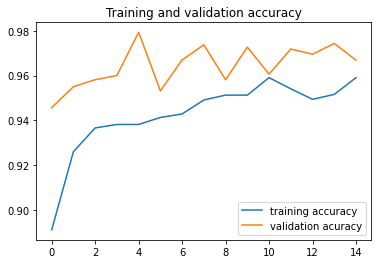
Below I implement 3 simple CNN using the Dogs vs Cats Dataset from Kaggle. The first CNN uses regular Convolutions a Fully connected network to classify the images. The second approach uses Image Augmentation. For some reason, I did not get a better performance with Image Augumentation. Thirdly I use the pre-trained Inception v3 network.


1. Basic Convolutional Neural Network in Tensorflow & Keras

You can view the Colab notebook here – Cats_vs_dogs_1.ipynb

Here some important parts of the notebook

Create CNN Model

  • Use 3 Convolution + Max pooling layers with 32,64 and 128 filters respectively
  • Flatten the data
  • Have 2 Fully connected layers with 128, 512 neurons with relu activation
  • Use sigmoid for binary classification
In [0]:
model = tf.keras.models.Sequential([
    tf.keras.layers.Conv2D(32,(3,3),activation='relu',input_shape=(150,150,3)),
    tf.keras.layers.MaxPooling2D(2,2),
    tf.keras.layers.Conv2D(64,(3,3),activation='relu'),
    tf.keras.layers.MaxPooling2D(2,2),
    tf.keras.layers.Conv2D(128,(3,3),activation='relu'),
    tf.keras.layers.MaxPooling2D(2,2),
    tf.keras.layers.Flatten(),
    tf.keras.layers.Dense(128,activation='relu'),
    tf.keras.layers.Dense(512,activation='relu'),
    tf.keras.layers.Dense(1,activation='sigmoid')
])

Print model summary

In [13]:
model.summary()
Model: "sequential"
_________________________________________________________________
Layer (type)                 Output Shape              Param #   
=================================================================
conv2d (Conv2D)              (None, 148, 148, 32)      896       
_________________________________________________________________
max_pooling2d (MaxPooling2D) (None, 74, 74, 32)        0         
_________________________________________________________________
conv2d_1 (Conv2D)            (None, 72, 72, 64)        18496     
_________________________________________________________________
max_pooling2d_1 (MaxPooling2 (None, 36, 36, 64)        0         
_________________________________________________________________
conv2d_2 (Conv2D)            (None, 34, 34, 128)       73856     
_________________________________________________________________
max_pooling2d_2 (MaxPooling2 (None, 17, 17, 128)       0         
_________________________________________________________________
flatten (Flatten)            (None, 36992)             0         
_________________________________________________________________
dense (Dense)                (None, 128)               4735104   
_________________________________________________________________
dense_1 (Dense)              (None, 512)               66048     
_________________________________________________________________
dense_2 (Dense)              (None, 1)                 513       
=================================================================
Total params: 4,894,913
Trainable params: 4,894,913
Non-trainable params: 0
_________________________________________________________________

Use the Adam Optimizer with binary cross entropy

model.compile(optimizer='adam',
             loss='binary_crossentropy',
             metrics=['accuracy'])

Perform Gradient Descent

  • Do Gradient Descent for 15 epochs
history=model.fit(train_generator,
                 validation_data=validation_generator,
                 steps_per_epoch=100,
                 epochs=15,
                 validation_steps=50,
                 verbose=2)
Epoch 1/15
100/100 - 13s - loss: 0.6821 - accuracy: 0.5425 - val_loss: 0.6484 - val_accuracy: 0.6131
Epoch 2/15
100/100 - 13s - loss: 0.6227 - accuracy: 0.6456 - val_loss: 0.6161 - val_accuracy: 0.6394
Epoch 3/15
100/100 - 13s - loss: 0.5975 - accuracy: 0.6719 - val_loss: 0.5558 - val_accuracy: 0.7206
Epoch 4/15
100/100 - 13s - loss: 0.5480 - accuracy: 0.7241 - val_loss: 0.5431 - val_accuracy: 0.7138
Epoch 5/15
100/100 - 13s - loss: 0.5182 - accuracy: 0.7447 - val_loss: 0.4839 - val_accuracy: 0.7606
Epoch 6/15
100/100 - 13s - loss: 0.4773 - accuracy: 0.7781 - val_loss: 0.5029 - val_accuracy: 0.7506
Epoch 7/15
100/100 - 13s - loss: 0.4466 - accuracy: 0.7972 - val_loss: 0.4573 - val_accuracy: 0.7912
Epoch 8/15
100/100 - 13s - loss: 0.4395 - accuracy: 0.7997 - val_loss: 0.4252 - val_accuracy: 0.8119
Epoch 9/15
100/100 - 13s - loss: 0.4314 - accuracy: 0.8019 - val_loss: 0.4931 - val_accuracy: 0.7481
Epoch 10/15
100/100 - 13s - loss: 0.4309 - accuracy: 0.7969 - val_loss: 0.4203 - val_accuracy: 0.8109
Epoch 11/15
100/100 - 13s - loss: 0.4329 - accuracy: 0.7916 - val_loss: 0.4189 - val_accuracy: 0.8069
Epoch 12/15
100/100 - 13s - loss: 0.4248 - accuracy: 0.8050 - val_loss: 0.4476 - val_accuracy: 0.7925
Epoch 13/15
100/100 - 13s - loss: 0.3868 - accuracy: 0.8306 - val_loss: 0.3900 - val_accuracy: 0.8236
Epoch 14/15
100/100 - 13s - loss: 0.3710 - accuracy: 0.8328 - val_loss: 0.4520 - val_accuracy: 0.7900
Epoch 15/15
100/100 - 13s - loss: 0.3654 - accuracy: 0.8353 - val_loss: 0.3999 - val_accuracy: 0.8100


Plot results

    • Plot training and validation accuracy


  • Plot training and validation loss


#-----------------------------------------------------------
# Retrieve a list of list results on training and test data
# sets for each training epoch
#-----------------------------------------------------------
acc      = history.history[     'accuracy' ]
val_acc  = history.history[ 'val_accuracy' ]
loss     = history.history[    'loss' ]
val_loss = history.history['val_loss' ]

epochs   = range(len(acc)) # Get number of epochs

#------------------------------------------------
# Plot training and validation accuracy per epoch
#------------------------------------------------
plt.plot  ( epochs,     acc,label="training accuracy" )
plt.plot  ( epochs, val_acc, label='validation acuracy' )
plt.title ('Training and validation accuracy')
plt.legend()

plt.figure()

#------------------------------------------------
# Plot training and validation loss per epoch
#------------------------------------------------
plt.plot  ( epochs,     loss , label="training loss")
plt.plot  ( epochs, val_loss,label="validation loss" )
plt.title ('Training and validation loss'   )
plt.legend()


2. CNN with Image Augmentation

You can check the Cats_vs_Dogs_2.ipynb

Including the important parts of this implementation below

Use Image Augumentation

Use Image Augumentation to improve performance

  • Use the same model parameters as before
  • Perform the following image augmentation
    • width, height shift
    • shear and zoom

    Note: Adding rotation made the performance worse

import tensorflow as tf
from tensorflow import keras
from tensorflow.keras.optimizers import RMSprop
from tensorflow.keras.preprocessing.image import ImageDataGenerator
model = tf.keras.models.Sequential([
    tf.keras.layers.Conv2D(32,(3,3),activation='relu',input_shape=(150,150,3)),
    tf.keras.layers.MaxPooling2D(2,2),
    tf.keras.layers.Conv2D(64,(3,3),activation='relu'),
    tf.keras.layers.MaxPooling2D(2,2),
    tf.keras.layers.Conv2D(128,(3,3),activation='relu'),
    tf.keras.layers.MaxPooling2D(2,2),
    tf.keras.layers.Flatten(),
    tf.keras.layers.Dense(128,activation='relu'),
    tf.keras.layers.Dense(512,activation='relu'),
    tf.keras.layers.Dense(1,activation='sigmoid')
])


train_datagen = ImageDataGenerator(
      rescale=1./255,
      #rotation_range=90,
      width_shift_range=0.2,
      height_shift_range=0.2,
      shear_range=0.2,
      zoom_range=0.2)
      #horizontal_flip=True,
      #fill_mode='nearest')

validation_datagen = ImageDataGenerator(rescale=1./255)
#
train_generator = train_datagen.flow_from_directory(train_dir,
                                                    batch_size=32,
                                                    class_mode='binary',
                                                    target_size=(150, 150))     
# --------------------
# Flow validation images in batches of 20 using test_datagen generator
# --------------------
validation_generator =  validation_datagen.flow_from_directory(validation_dir,
                                                         batch_size=32,
                                                         class_mode  = 'binary',
                                                         target_size = (150, 150))

# Use Adam Optmizer 
model.compile(optimizer='adam',
             loss='binary_crossentropy',
             metrics=['accuracy'])
Found 20000 images belonging to 2 classes.
Found 5000 images belonging to 2 classes.

Perform Gradient Descent

history=model.fit(train_generator,
                 validation_data=validation_generator,
                 steps_per_epoch=100,
                 epochs=15,
                 validation_steps=50,
                 verbose=2)
Epoch 1/15
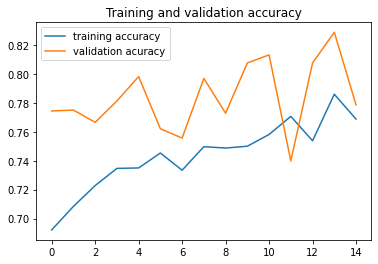
100/100 - 27s - loss: 0.5716 - accuracy: 0.6922 - val_loss: 0.4843 - val_accuracy: 0.7744
Epoch 2/15
100/100 - 27s - loss: 0.5575 - accuracy: 0.7084 - val_loss: 0.4683 - val_accuracy: 0.7750
Epoch 3/15
100/100 - 26s - loss: 0.5452 - accuracy: 0.7228 - val_loss: 0.4856 - val_accuracy: 0.7665
Epoch 4/15
100/100 - 27s - loss: 0.5294 - accuracy: 0.7347 - val_loss: 0.4654 - val_accuracy: 0.7812
Epoch 5/15
100/100 - 27s - loss: 0.5352 - accuracy: 0.7350 - val_loss: 0.4557 - val_accuracy: 0.7981
Epoch 6/15
100/100 - 26s - loss: 0.5136 - accuracy: 0.7453 - val_loss: 0.4964 - val_accuracy: 0.7621
Epoch 7/15
100/100 - 27s - loss: 0.5249 - accuracy: 0.7334 - val_loss: 0.4959 - val_accuracy: 0.7556
Epoch 8/15
100/100 - 26s - loss: 0.5035 - accuracy: 0.7497 - val_loss: 0.4555 - val_accuracy: 0.7969
Epoch 9/15
100/100 - 26s - loss: 0.5024 - accuracy: 0.7487 - val_loss: 0.4675 - val_accuracy: 0.7728
Epoch 10/15
100/100 - 27s - loss: 0.5015 - accuracy: 0.7500 - val_loss: 0.4276 - val_accuracy: 0.8075
Epoch 11/15
100/100 - 26s - loss: 0.5002 - accuracy: 0.7581 - val_loss: 0.4193 - val_accuracy: 0.8131
Epoch 12/15
100/100 - 27s - loss: 0.4733 - accuracy: 0.7706 - val_loss: 0.5209 - val_accuracy: 0.7398
Epoch 13/15
100/100 - 27s - loss: 0.4999 - accuracy: 0.7538 - val_loss: 0.4109 - val_accuracy: 0.8075
Epoch 14/15
100/100 - 27s - loss: 0.4550 - accuracy: 0.7859 - val_loss: 0.3770 - val_accuracy: 0.8288
Epoch 15/15
100/100 - 26s - loss: 0.4688 - accuracy: 0.7688 - val_loss: 0.4764 - val_accuracy: 0.7786

Plot results

  • Plot training and validation accuracy
  • Plot training and validation loss
In [15]:
import matplotlib.pyplot as plt
#-----------------------------------------------------------
# Retrieve a list of list results on training and test data
# sets for each training epoch
#-----------------------------------------------------------
acc      = history.history[     'accuracy' ]
val_acc  = history.history[ 'val_accuracy' ]
loss     = history.history[    'loss' ]
val_loss = history.history['val_loss' ]

epochs   = range(len(acc)) # Get number of epochs

#------------------------------------------------
# Plot training and validation accuracy per epoch
#------------------------------------------------
plt.plot  ( epochs,     acc,label="training accuracy" )
plt.plot  ( epochs, val_acc, label='validation acuracy' )
plt.title ('Training and validation accuracy')
plt.legend()

plt.figure()

#------------------------------------------------
# Plot training and validation loss per epoch
#------------------------------------------------
plt.plot  ( epochs,     loss , label="training loss")
plt.plot  ( epochs, val_loss,label="validation loss" )
plt.title ('Training and validation loss'   )
plt.legend()


Implementation using Inception Network V3

The implementation is in the Colab notebook Cats_vs_Dog_3.ipynb

This is implemented as below

Use Inception V3

import os

from tensorflow.keras import layers
from tensorflow.keras import Model

  
from tensorflow.keras.applications.inception_v3 import InceptionV3
pre_trained_model = InceptionV3(input_shape = (150, 150, 3), 
                                include_top = False, 
                                weights = 'imagenet')


for layer in pre_trained_model.layers:
  layer.trainable = False
  
# pre_trained_model.summary()

last_layer = pre_trained_model.get_layer('mixed7')
print('last layer output shape: ', last_layer.output_shape)
last_output = last_layer.output
Downloading data from https://storage.googleapis.com/tensorflow/keras-applications/inception_v3/inception_v3_weights_tf_dim_ordering_tf_kernels_notop.h5
87916544/87910968 [==============================] - 1s 0us/step
last layer output shape:  (None, 7, 7, 768)

Use Layer 7 of Inception Network

  • Use Image Augumentation
  • Use Adam Optimizer
In [0]:
import tensorflow as tf
from tensorflow import keras
from tensorflow.keras.optimizers import RMSprop
from tensorflow.keras.preprocessing.image import ImageDataGenerator
# Flatten the output layer to 1 dimension
x = layers.Flatten()(last_output)
# Add a fully connected layer with 1,024 hidden units and ReLU activation
x = layers.Dense(1024, activation='relu')(x)
# Add a dropout rate of 0.2
x = layers.Dropout(0.2)(x)                  
# Add a final sigmoid layer for classification
x = layers.Dense  (1, activation='sigmoid')(x)           

model = Model( pre_trained_model.input, x) 
#train_datagen = ImageDataGenerator( rescale = 1.0/255. )
#validation_datagen = ImageDataGenerator( rescale = 1.0/255. )

train_datagen = ImageDataGenerator(
      rescale=1./255,
      #rotation_range=90,
      width_shift_range=0.2,
      height_shift_range=0.2,
      shear_range=0.2,
      zoom_range=0.2)
      #horizontal_flip=True,
      #fill_mode='nearest')

validation_datagen = ImageDataGenerator(rescale=1./255)
#
train_generator = train_datagen.flow_from_directory(train_dir,
                                                    batch_size=32,
                                                    class_mode='binary',
                                                    target_size=(150, 150))     
# --------------------
# Flow validation images in batches of 20 using test_datagen generator
# --------------------
validation_generator =  validation_datagen.flow_from_directory(validation_dir,
                                                         batch_size=32,
                                                         class_mode  = 'binary',
                                                         target_size = (150, 150))


model.compile(optimizer='adam',
             loss='binary_crossentropy',
             metrics=['accuracy'])
Found 20000 images belonging to 2 classes.
Found 5000 images belonging to 2 classes.

Fit model

history=model.fit(train_generator,
                 validation_data=validation_generator,
                 steps_per_epoch=100,
                 epochs=15,
                 validation_steps=50,
                 verbose=2)
Epoch 1/15
100/100 - 31s - loss: 0.5961 - accuracy: 0.8909 - val_loss: 0.1919 - val_accuracy: 0.9456
Epoch 2/15
100/100 - 30s - loss: 0.2002 - accuracy: 0.9259 - val_loss: 0.1025 - val_accuracy: 0.9550
Epoch 3/15
100/100 - 30s - loss: 0.1618 - accuracy: 0.9366 - val_loss: 0.0920 - val_accuracy: 0.9581
Epoch 4/15
100/100 - 29s - loss: 0.1442 - accuracy: 0.9381 - val_loss: 0.0960 - val_accuracy: 0.9600
Epoch 5/15
100/100 - 30s - loss: 0.1402 - accuracy: 0.9381 - val_loss: 0.0703 - val_accuracy: 0.9794
Epoch 6/15
100/100 - 30s - loss: 0.1437 - accuracy: 0.9413 - val_loss: 0.1090 - val_accuracy: 0.9531
Epoch 7/15
100/100 - 30s - loss: 0.1325 - accuracy: 0.9428 - val_loss: 0.0756 - val_accuracy: 0.9670
Epoch 8/15
100/100 - 29s - loss: 0.1341 - accuracy: 0.9491 - val_loss: 0.0625 - val_accuracy: 0.9737
Epoch 9/15
100/100 - 29s - loss: 0.1186 - accuracy: 0.9513 - val_loss: 0.0934 - val_accuracy: 0.9581
Epoch 10/15
100/100 - 29s - loss: 0.1171 - accuracy: 0.9513 - val_loss: 0.0642 - val_accuracy: 0.9727
Epoch 11/15
100/100 - 29s - loss: 0.1018 - accuracy: 0.9591 - val_loss: 0.0930 - val_accuracy: 0.9606
Epoch 12/15
100/100 - 29s - loss: 0.1190 - accuracy: 0.9541 - val_loss: 0.0737 - val_accuracy: 0.9719
Epoch 13/15
100/100 - 29s - loss: 0.1223 - accuracy: 0.9494 - val_loss: 0.0740 - val_accuracy: 0.9695
Epoch 14/15
100/100 - 29s - loss: 0.1158 - accuracy: 0.9516 - val_loss: 0.0659 - val_accuracy: 0.9744
Epoch 15/15
100/100 - 29s - loss: 0.1168 - accuracy: 0.9591 - val_loss: 0.0788 - val_accuracy: 0.9669

Plot results

  • Plot training and validation accuracy
  • Plot training and validation loss
In [14]:
import matplotlib.pyplot as plt
#-----------------------------------------------------------
# Retrieve a list of list results on training and test data
# sets for each training epoch
#-----------------------------------------------------------
acc      = history.history[     'accuracy' ]
val_acc  = history.history[ 'val_accuracy' ]
loss     = history.history[    'loss' ]
val_loss = history.history['val_loss' ]

epochs   = range(len(acc)) # Get number of epochs

#------------------------------------------------
# Plot training and validation accuracy per epoch
#------------------------------------------------
plt.plot  ( epochs,     acc,label="training accuracy" )
plt.plot  ( epochs, val_acc, label='validation acuracy' )
plt.title ('Training and validation accuracy')
plt.legend()

plt.figure()

#------------------------------------------------
# Plot training and validation loss per epoch
#------------------------------------------------
plt.plot  ( epochs,     loss , label="training loss")
plt.plot  ( epochs, val_loss,label="validation loss" )
plt.title ('Training and validation loss'   )
plt.legend()


I intend to do some interesting stuff with Convolutional Neural Networks.

Watch this space!

See also
1. Architecting a cloud based IP Multimedia System (IMS)
2. Exploring Quantum Gate operations with QCSimulator
3. Big Data 6: The T20 Dance of Apache NiFi and yorkpy
4. The Many Faces of Latency
5. The Clash of the Titans in Test and ODI cricket

To see all posts click Index of posts

Getting started with Tensorflow, Keras in Python and R

The Pale Blue Dot

“From this distant vantage point, the Earth might not seem of any particular interest. But for us, it’s different. Consider again that dot. That’s here, that’s home, that’s us. On it everyone you love, everyone you know, everyone you ever heard of, every human being who ever was, lived out their lives. The aggregate of our joy and suffering, thousands of confident religions, ideologies, and economic doctrines, every hunter and forager, every hero and coward, every creator and destroyer of civilization, every king and peasant, every young couple in love, every mother and father, hopeful child, inventor and explorer, every teacher of morals, every corrupt politician, every “superstar,” every “supreme leader,” every saint and sinner in the history of our species lived there—on the mote of dust suspended in a sunbeam.”

Carl Sagan

Tensorflow and Keras are Deep Learning frameworks that really simplify a lot of things to the user. If you are familiar with Machine Learning and Deep Learning concepts then Tensorflow and Keras are really a playground to realize your ideas.  In this post I show how you can get started with Tensorflow in both Python and R


Tensorflow in Python

For tensorflow in Python, I found Google’s Colab an ideal environment for running your Deep Learning code. This is an Google’s research project  where you can execute your code  on GPUs, TPUs etc

Tensorflow in R (RStudio)

To execute tensorflow in R (RStudio) you need to install tensorflow and keras as shown below
In this post I show how to get started with Tensorflow and Keras in R.

# Install Tensorflow in RStudio
#install_tensorflow()
# Install Keras
#install_packages("keras")
library(tensorflow)
libary(keras)

This post takes 3 different Machine Learning problems and uses the
Tensorflow/Keras framework to solve it

Note:
You can view the Google Colab notebook at Tensorflow in Python
The RMarkdown file has been published at RPubs and can be accessed
at Getting started with Tensorflow in R

Checkout my book ‘Deep Learning from first principles: Second Edition – In vectorized Python, R and Octave’. My book starts with the implementation of a simple 2-layer Neural Network and works its way to a generic L-Layer Deep Learning Network, with all the bells and whistles. The derivations have been discussed in detail. The code has been extensively commented and included in its entirety in the Appendix sections. My book is available on Amazon as paperback ($14.99) and in kindle version($9.99/Rs449).

1. Multivariate regression with Tensorflow – Python

This code performs multivariate regression using Tensorflow and keras on the advent of Parkinson disease through sound recordings see Parkinson Speech Dataset with Multiple Types of Sound Recordings Data Set . The clinician’s motorUPDRS score has to be predicted from the set of features

In [0]:
# Import tensorflow
import tensorflow as tf
from tensorflow import keras
In [2]:
#Get the data rom the UCI Machine Learning repository
dataset = keras.utils.get_file("parkinsons_updrs.data", "https://archive.ics.uci.edu/ml/machine-learning-databases/parkinsons/telemonitoring/parkinsons_updrs.data")
Downloading data from https://archive.ics.uci.edu/ml/machine-learning-databases/parkinsons/telemonitoring/parkinsons_updrs.data
917504/911261 [==============================] - 0s 0us/step
In [3]:
# Read the CSV file 
import pandas as pd
parkinsons = pd.read_csv(dataset, na_values = "?", comment='\t',
                      sep=",", skipinitialspace=True)
print(parkinsons.shape)
print(parkinsons.columns)
#Check if there are any NAs in the rows
parkinsons.isna().sum()
(5875, 22)
Index(['subject#', 'age', 'sex', 'test_time', 'motor_UPDRS', 'total_UPDRS',
       'Jitter(%)', 'Jitter(Abs)', 'Jitter:RAP', 'Jitter:PPQ5', 'Jitter:DDP',
       'Shimmer', 'Shimmer(dB)', 'Shimmer:APQ3', 'Shimmer:APQ5',
       'Shimmer:APQ11', 'Shimmer:DDA', 'NHR', 'HNR', 'RPDE', 'DFA', 'PPE'],
      dtype='object')
Out[3]:
subject#         0
age              0
sex              0
test_time        0
motor_UPDRS      0
total_UPDRS      0
Jitter(%)        0
Jitter(Abs)      0
Jitter:RAP       0
Jitter:PPQ5      0
Jitter:DDP       0
Shimmer          0
Shimmer(dB)      0
Shimmer:APQ3     0
Shimmer:APQ5     0
Shimmer:APQ11    0
Shimmer:DDA      0
NHR              0
HNR              0
RPDE             0
DFA              0
PPE              0
dtype: int64
Note: To see how to create dummy variables see my post Practical Machine Learning with R and Python – Part 2
In [4]:
# Drop the columns subject number as it is not relevant
parkinsons1=parkinsons.drop(['subject#'],axis=1)

# Create dummy variables for sex (M/F)
parkinsons2=pd.get_dummies(parkinsons1,columns=['sex'])
parkinsons2.head()

Out[4]
age test_time motor_UPDRS total_UPDRS Jitter(%) Jitter(Abs) Jitter:RAP Jitter:PPQ5 Jitter:DDP Shimmer Shimmer(dB) Shimmer:APQ3 Shimmer:APQ5 Shimmer:APQ11 Shimmer:DDA NHR HNR RPDE DFA PPE sex_0 sex_1
0 72 5.6431 28.199 34.398 0.00662 0.000034 0.00401 0.00317 0.01204 0.02565 0.230 0.01438 0.01309 0.01662 0.04314 0.014290 21.640 0.41888 0.54842 0.16006 1 0
1 72 12.6660 28.447 34.894 0.00300 0.000017 0.00132 0.00150 0.00395 0.02024 0.179 0.00994 0.01072 0.01689 0.02982 0.011112 27.183 0.43493 0.56477 0.10810 1 0
2 72 19.6810 28.695 35.389 0.00481 0.000025 0.00205 0.00208 0.00616 0.01675 0.181 0.00734 0.00844 0.01458 0.02202 0.020220 23.047 0.46222 0.54405 0.21014 1 0
3 72 25.6470 28.905 35.810 0.00528 0.000027 0.00191 0.00264 0.00573 0.02309 0.327 0.01106 0.01265 0.01963 0.03317 0.027837 24.445 0.48730 0.57794 0.33277 1 0
4 72 33.6420 29.187 36.375 0.00335 0.000020 0.00093 0.00130 0.00278 0.01703 0.176 0.00679 0.00929 0.01819 0.02036 0.011625 26.126 0.47188 0.56122 0.19361 1 0

# Create a training and test data set with 80%/20%
train_dataset = parkinsons2.sample(frac=0.8,random_state=0)
test_dataset = parkinsons2.drop(train_dataset.index)

# Select columns
train_dataset1= train_dataset[['age', 'test_time', 'Jitter(%)', 'Jitter(Abs)',
       'Jitter:RAP', 'Jitter:PPQ5', 'Jitter:DDP', 'Shimmer', 'Shimmer(dB)',
       'Shimmer:APQ3', 'Shimmer:APQ5', 'Shimmer:APQ11', 'Shimmer:DDA', 'NHR',
       'HNR', 'RPDE', 'DFA', 'PPE', 'sex_0', 'sex_1']]
test_dataset1= test_dataset[['age','test_time', 'Jitter(%)', 'Jitter(Abs)',
       'Jitter:RAP', 'Jitter:PPQ5', 'Jitter:DDP', 'Shimmer', 'Shimmer(dB)',
       'Shimmer:APQ3', 'Shimmer:APQ5', 'Shimmer:APQ11', 'Shimmer:DDA', 'NHR',
       'HNR', 'RPDE', 'DFA', 'PPE', 'sex_0', 'sex_1']]
In [7]:
# Generate the statistics of the columns for use in normalization of the data
train_stats = train_dataset1.describe()
train_stats = train_stats.transpose()
train_stats
Out[7]:
count mean std min 25% 50% 75% max
age 4700.0 64.792766 8.870401 36.000000 58.000000 65.000000 72.000000 85.000000
test_time 4700.0 93.399490 53.630411 -4.262500 46.852250 93.405000 139.367500 215.490000
Jitter(%) 4700.0 0.006136 0.005612 0.000830 0.003560 0.004900 0.006770 0.099990
Jitter(Abs) 4700.0 0.000044 0.000036 0.000002 0.000022 0.000034 0.000053 0.000396
Jitter:RAP 4700.0 0.002969 0.003089 0.000330 0.001570 0.002235 0.003260 0.057540
Jitter:PPQ5 4700.0 0.003271 0.003760 0.000430 0.001810 0.002480 0.003460 0.069560
Jitter:DDP 4700.0 0.008908 0.009267 0.000980 0.004710 0.006705 0.009790 0.172630
Shimmer 4700.0 0.033992 0.025922 0.003060 0.019020 0.027385 0.039810 0.268630
Shimmer(dB) 4700.0 0.310487 0.231016 0.026000 0.175000 0.251000 0.363250 2.107000
Shimmer:APQ3 4700.0 0.017125 0.013275 0.001610 0.009190 0.013615 0.020562 0.162670
Shimmer:APQ5 4700.0 0.020151 0.016848 0.001940 0.010750 0.015785 0.023733 0.167020
Shimmer:APQ11 4700.0 0.027508 0.020270 0.002490 0.015630 0.022685 0.032713 0.275460
Shimmer:DDA 4700.0 0.051375 0.039826 0.004840 0.027567 0.040845 0.061683 0.488020
NHR 4700.0 0.032116 0.060206 0.000304 0.010827 0.018403 0.031452 0.748260
HNR 4700.0 21.704631 4.288853 1.659000 19.447750 21.973000 24.445250 37.187000
RPDE 4700.0 0.542549 0.100212 0.151020 0.471235 0.543490 0.614335 0.966080
DFA 4700.0 0.653015 0.070446 0.514040 0.596470 0.643285 0.710618 0.865600
PPE 4700.0 0.219559 0.091506 0.021983 0.156470 0.205340 0.264017 0.731730
sex_0 4700.0 0.681489 0.465948 0.000000 0.000000 1.000000 1.000000 1.000000
sex_1 4700.0 0.318511 0.465948 0.000000 0.000000 0.000000 1.000000 1.000000
In [0]:
# Create the target variable
train_labels = train_dataset.pop('motor_UPDRS')
test_labels = test_dataset.pop('motor_UPDRS')
In [0]:
# Normalize the data by subtracting the mean and dividing by the standard deviation
def normalize(x):
  return (x - train_stats['mean']) / train_stats['std']

# Create normalized training and test data
normalized_train_data = normalize(train_dataset1)
normalized_test_data = normalize(test_dataset1)
In [0]:
# Create a Deep Learning model with keras
model = tf.keras.Sequential([
    keras.layers.Dense(6, activation=tf.nn.relu, input_shape=[len(train_dataset1.keys())]),
    keras.layers.Dense(9, activation=tf.nn.relu),
    keras.layers.Dense(6,activation=tf.nn.relu),
    keras.layers.Dense(1)
  ])

# Use the Adam optimizer with a learning rate of 0.01
optimizer=keras.optimizers.Adam(lr=.01, beta_1=0.9, beta_2=0.999, epsilon=None, decay=0.0, amsgrad=False)

# Set the metrics required to be Mean Absolute Error and Mean Squared Error.For regression, the loss is mean_squared_error
model.compile(loss='mean_squared_error',
                optimizer=optimizer,
                metrics=['mean_absolute_error', 'mean_squared_error'])
In [0]:
# Create a model
history=model.fit(
  normalized_train_data, train_labels,
  epochs=1000, validation_data = (normalized_test_data,test_labels), verbose=0)
In [26]:
hist = pd.DataFrame(history.history)
hist['epoch'] = history.epoch
hist.tail()
Out[26]:
loss mean_absolute_error mean_squared_error val_loss val_mean_absolute_error val_mean_squared_error epoch
995 15.773989 2.936990 15.773988 16.980803 3.028168 16.980803 995
996 15.238623 2.873420 15.238622 17.458752 3.101033 17.458752 996
997 15.437594 2.895500 15.437593 16.926016 2.971508 16.926018 997
998 15.867891 2.943521 15.867892 16.950249 2.985036 16.950249 998
999 15.846878 2.938914 15.846880 17.095623 3.014504 17.095625 999
In [30]:
def plot_history(history):
  hist = pd.DataFrame(history.history)
  hist['epoch'] = history.epoch

  plt.figure()
  plt.xlabel('Epoch')
  plt.ylabel('Mean Abs Error')
  plt.plot(hist['epoch'], hist['mean_absolute_error'],
           label='Train Error')
  plt.plot(hist['epoch'], hist['val_mean_absolute_error'],
           label = 'Val Error')
  plt.ylim([2,5])
  plt.legend()

  plt.figure()
  plt.xlabel('Epoch')
  plt.ylabel('Mean Square Error ')
  plt.plot(hist['epoch'], hist['mean_squared_error'],
           label='Train Error')
  plt.plot(hist['epoch'], hist['val_mean_squared_error'],
           label = 'Val Error')
  plt.ylim([10,40])
  plt.legend()
  plt.show()


plot_history(history)

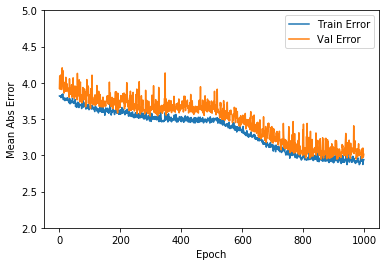
Observation

It can be seen that the mean absolute error is on an average about +/- 4.0. The validation error also is about the same. This can be reduced by playing around with the hyperparamaters and increasing the number of iterations

1a. Multivariate Regression in Tensorflow – R

# Install Tensorflow in RStudio
#install_tensorflow()
# Install Keras
#install_packages("keras")
library(tensorflow)
library(keras)
library(dplyr)
library(dummies)
## dummies-1.5.6 provided by Decision Patterns
library(tensorflow)
library(keras)

Multivariate regression

This code performs multivariate regression using Tensorflow and keras on the advent of Parkinson disease through sound recordings see Parkinson Speech Dataset with Multiple Types of Sound Recordings Data Set. The clinician’s motorUPDRS score has to be predicted from the set of features.

Read the data

# Download the Parkinson's data from UCI Machine Learning repository
dataset <- read.csv("https://archive.ics.uci.edu/ml/machine-learning-databases/parkinsons/telemonitoring/parkinsons_updrs.data")

# Set the column names
names(dataset) <- c("subject","age", "sex", "test_time","motor_UPDRS","total_UPDRS","Jitter","Jitter.Abs",
                 "Jitter.RAP","Jitter.PPQ5","Jitter.DDP","Shimmer", "Shimmer.dB", "Shimmer.APQ3",
                 "Shimmer.APQ5","Shimmer.APQ11","Shimmer.DDA", "NHR","HNR", "RPDE", "DFA","PPE")

# Remove the column 'subject' as it is not relevant to analysis
dataset1 <- subset(dataset, select = -c(subject))

# Make the column 'sex' as a factor for using dummies
dataset1$sex=as.factor(dataset1$sex)
# Add dummy variables for categorical cariable 'sex'
dataset2 <- dummy.data.frame(dataset1, sep = ".")
## Warning in model.matrix.default(~x - 1, model.frame(~x - 1), contrasts =
## FALSE): non-list contrasts argument ignored
dataset3 <- na.omit(dataset2)

Split the data as training and test in 80/20

## Split data 80% training and 20% test
sample_size <- floor(0.8 * nrow(dataset3))

## set the seed to make your partition reproducible
set.seed(12)
train_index <- sample(seq_len(nrow(dataset3)), size = sample_size)

train_dataset <- dataset3[train_index, ]
test_dataset <- dataset3[-train_index, ]

train_data <- train_dataset %>% select(sex.0,sex.1,age, test_time,Jitter,Jitter.Abs,Jitter.PPQ5,Jitter.DDP,
                              Shimmer, Shimmer.dB,Shimmer.APQ3,Shimmer.APQ11,
                              Shimmer.DDA,NHR,HNR,RPDE,DFA,PPE)

train_labels <- select(train_dataset,motor_UPDRS)
test_data <- test_dataset %>% select(sex.0,sex.1,age, test_time,Jitter,Jitter.Abs,Jitter.PPQ5,Jitter.DDP,
                              Shimmer, Shimmer.dB,Shimmer.APQ3,Shimmer.APQ11,
                              Shimmer.DDA,NHR,HNR,RPDE,DFA,PPE)
test_labels <- select(test_dataset,motor_UPDRS)

Normalize the data

 # Normalize the data by subtracting the mean and dividing by the standard deviation
normalize<-function(x) {
  y<-(x - mean(x)) / sd(x)
  return(y)
}

normalized_train_data <-apply(train_data,2,normalize)
# Convert to matrix
train_labels <- as.matrix(train_labels)
normalized_test_data <- apply(test_data,2,normalize)
test_labels <- as.matrix(test_labels)

Create the Deep Learning Model

model <- keras_model_sequential()
model %>% 
  layer_dense(units = 6, activation = 'relu', input_shape = dim(normalized_train_data)[2]) %>% 
  layer_dense(units = 9, activation = 'relu') %>%
  layer_dense(units = 6, activation = 'relu') %>%
  layer_dense(units = 1)

# Set the metrics required to be Mean Absolute Error and Mean Squared Error.For regression, the loss is 
# mean_squared_error
model %>% compile(
  loss = 'mean_squared_error',
  optimizer = optimizer_rmsprop(),
  metrics = c('mean_absolute_error','mean_squared_error')
)

# Fit the model
# Use the test data for validation
history <- model %>% fit(
  normalized_train_data, train_labels, 
  epochs = 30, batch_size = 128, 
  validation_data = list(normalized_test_data,test_labels)
)

Plot mean squared error, mean absolute error and loss for training data and test data

plot(history)

Fig1

2. Binary classification in Tensorflow – Python

This is a simple binary classification problem from UCI Machine Learning repository and deals with data on Breast cancer from the Univ. of Wisconsin Breast Cancer Wisconsin (Diagnostic) Data Set bold text

In [31]:
import tensorflow as tf
from tensorflow import keras
import pandas as pd
# Read the data set from UCI ML site
dataset_path = keras.utils.get_file("breast-cancer-wisconsin.data", "https://archive.ics.uci.edu/ml/machine-learning-databases/breast-cancer-wisconsin/breast-cancer-wisconsin.data")
raw_dataset = pd.read_csv(dataset_path, sep=",", na_values = "?", skipinitialspace=True,)
dataset = raw_dataset.copy()

#Check for Null and drop
dataset.isna().sum()
dataset = dataset.dropna()
dataset.isna().sum()

# Set the column names
dataset.columns = ["id","thickness",	"cellsize",	"cellshape","adhesion","epicellsize",
                    "barenuclei","chromatin","normalnucleoli","mitoses","class"]
dataset.head()
Downloading data from https://archive.ics.uci.edu/ml/machine-learning-databases/breast-cancer-wisconsin/breast-cancer-wisconsin.data
24576/19889 [=====================================] - 0s 1us/step
id	thickness	cellsize	cellshape	adhesion	epicellsize	barenuclei	chromatin	normalnucleoli	mitoses	class
0	1002945	5	4	4	5	7	10.0	3	2	1	2
1	1015425	3	1	1	1	2	2.0	3	1	1	2
2	1016277	6	8	8	1	3	4.0	3	7	1	2
3	1017023	4	1	1	3	2	1.0	3	1	1	2
4	1017122	8	10	10	8	7	10.0	9	7	1	4
# Create a training/test set in the ratio 80/20
train_dataset = dataset.sample(frac=0.8,random_state=0)
test_dataset = dataset.drop(train_dataset.index)

# Set the training and test set
train_dataset1= train_dataset[['thickness','cellsize','cellshape','adhesion',
                'epicellsize', 'barenuclei', 'chromatin', 'normalnucleoli','mitoses']]
test_dataset1=test_dataset[['thickness','cellsize','cellshape','adhesion',
                'epicellsize', 'barenuclei', 'chromatin', 'normalnucleoli','mitoses']]
In [34]:
# Generate the stats for each column to be used for normalization
train_stats = train_dataset1.describe()
train_stats = train_stats.transpose()
train_stats
Out[34]:
count mean std min 25% 50% 75% max
thickness 546.0 4.430403 2.812768 1.0 2.0 4.0 6.0 10.0
cellsize 546.0 3.179487 3.083668 1.0 1.0 1.0 5.0 10.0
cellshape 546.0 3.225275 3.005588 1.0 1.0 1.0 5.0 10.0
adhesion 546.0 2.921245 2.937144 1.0 1.0 1.0 4.0 10.0
epicellsize 546.0 3.261905 2.252643 1.0 2.0 2.0 4.0 10.0
barenuclei 546.0 3.560440 3.651946 1.0 1.0 1.0 7.0 10.0
chromatin 546.0 3.483516 2.492687 1.0 2.0 3.0 5.0 10.0
normalnucleoli 546.0 2.875458 3.064305 1.0 1.0 1.0 4.0 10.0
mitoses 546.0 1.609890 1.736762 1.0 1.0 1.0 1.0 10.0
In [0]:
# Create target variables
train_labels = train_dataset.pop('class')
test_labels = test_dataset.pop('class')
In [0]:
# Set the target variables as 0 or 1
train_labels[train_labels==2] =0 # benign
train_labels[train_labels==4] =1 # malignant

test_labels[test_labels==2] =0 # benign
test_labels[test_labels==4] =1 # malignant
In [0]:
# Normalize by subtracting mean and dividing by standard deviation
def normalize(x):
  return (x - train_stats['mean']) / train_stats['std']

# Convert columns to numeric
train_dataset1 = train_dataset1.apply(pd.to_numeric)
test_dataset1 = test_dataset1.apply(pd.to_numeric)

# Normalize
normalized_train_data = normalize(train_dataset1)
normalized_test_data = normalize(test_dataset1)
In [0]:
# Create a model
model = tf.keras.Sequential([
    keras.layers.Dense(6, activation=tf.nn.relu, input_shape=[len(train_dataset1.keys())]),
    keras.layers.Dense(9, activation=tf.nn.relu),
    keras.layers.Dense(6,activation=tf.nn.relu),
    keras.layers.Dense(1)
  ])

# Use the RMSProp optimizer
optimizer = tf.keras.optimizers.RMSprop(0.01)

# Since this is binary classification use binary_crossentropy
model.compile(loss='binary_crossentropy',
                optimizer=optimizer,
                metrics=['acc'])


# Fit a model
history=model.fit(
  normalized_train_data, train_labels,
  epochs=1000, validation_data=(normalized_test_data,test_labels), verbose=0)
In [55]:
hist = pd.DataFrame(history.history)
hist['epoch'] = history.epoch
hist.tail()
loss acc val_loss val_acc epoch
995 0.112499 0.992674 0.454739 0.970588 995
996 0.112499 0.992674 0.454739 0.970588 996
997 0.112499 0.992674 0.454739 0.970588 997
998 0.112499 0.992674 0.454739 0.970588 998
999 0.112499 0.992674 0.454739 0.970588 999
In [58]:
# Plot training and test accuracy 
plt.plot(history.history['acc'])
plt.plot(history.history['val_acc'])
plt.title('model accuracy')
plt.ylabel('accuracy')
plt.xlabel('epoch')
plt.legend(['train', 'test'], loc='upper left')
plt.ylim([0.9,1])
plt.show()


# Plot training and test loss
plt.plot(history.history['loss'])
plt.plot(history.history['val_loss'])
plt.title('model loss')
plt.ylabel('loss')
plt.xlabel('epoch')
plt.legend(['train', 'test'], loc='upper left')
plt.ylim([0,0.5])
plt.show()


2a. Binary classification in Tensorflow -R

This is a simple binary classification problem from UCI Machine Learning repository and deals with data on Breast cancer from the Univ. of Wisconsin Breast Cancer Wisconsin (Diagnostic) Data Set

# Read the data for Breast cancer (Wisconsin)
dataset <- read.csv("https://archive.ics.uci.edu/ml/machine-learning-databases/breast-cancer-wisconsin/breast-cancer-wisconsin.data")

# Rename the columns
names(dataset) <- c("id","thickness",   "cellsize", "cellshape","adhesion","epicellsize",
                    "barenuclei","chromatin","normalnucleoli","mitoses","class")

# Remove the columns id and class
dataset1 <- subset(dataset, select = -c(id, class))
dataset2 <- na.omit(dataset1)

# Convert the column to numeric
dataset2$barenuclei <- as.numeric(dataset2$barenuclei)

Normalize the data

train_data <-apply(dataset2,2,normalize)
train_labels <- as.matrix(select(dataset,class))

# Set the target variables as 0 or 1 as it binary classification
train_labels[train_labels==2,]=0
train_labels[train_labels==4,]=1

Create the Deep Learning model

model <- keras_model_sequential()
model %>% 
  layer_dense(units = 6, activation = 'relu', input_shape = dim(train_data)[2]) %>% 
  layer_dense(units = 9, activation = 'relu') %>%
  layer_dense(units = 6, activation = 'relu') %>%
  layer_dense(units = 1)

# Since this is a binary classification we use binary cross entropy
model %>% compile(
  loss = 'binary_crossentropy',
  optimizer = optimizer_rmsprop(),
  metrics = c('accuracy')  # Metrics is accuracy
)

Fit the model. Use 20% of data for validation

history <- model %>% fit(
  train_data, train_labels, 
  epochs = 30, batch_size = 128, 
  validation_split = 0.2
)

Plot the accuracy and loss for training and validation data

plot(history)

3. MNIST in Tensorflow – Python

This takes the famous MNIST handwritten digits . It ca be seen that Tensorflow and Keras make short work of this famous problem of the late 1980s

# Download MNIST data
mnist=tf.keras.datasets.mnist
# Set training and test data and labels
(training_images,training_labels),(test_images,test_labels)=mnist.load_data()

print(training_images.shape)
print(test_images.shape)
(60000, 28, 28)
(10000, 28, 28)
In [61]:
# Plot a sample image from MNIST and show contents
import matplotlib.pyplot as plt
plt.imshow(training_images[1])
print(training_images[1])
[[ 0 0 0 0 0 0 0 0 0 0 0 0 0 0 0 0 0 0
0 0 0 0 0 0 0 0 0 0]
[ 0 0 0 0 0 0 0 0 0 0 0 0 0 0 0 0 0 0
0 0 0 0 0 0 0 0 0 0]
[ 0 0 0 0 0 0 0 0 0 0 0 0 0 0 0 0 0 0
0 0 0 0 0 0 0 0 0 0]
[ 0 0 0 0 0 0 0 0 0 0 0 0 0 0 0 0 0 0
0 0 0 0 0 0 0 0 0 0]
[ 0 0 0 0 0 0 0 0 0 0 0 0 0 0 0 51 159 253
159 50 0 0 0 0 0 0 0 0]
[ 0 0 0 0 0 0 0 0 0 0 0 0 0 0 48 238 252 252
252 237 0 0 0 0 0 0 0 0]
[ 0 0 0 0 0 0 0 0 0 0 0 0 0 54 227 253 252 239
233 252 57 6 0 0 0 0 0 0]
[ 0 0 0 0 0 0 0 0 0 0 0 10 60 224 252 253 252 202
84 252 253 122 0 0 0 0 0 0]
[ 0 0 0 0 0 0 0 0 0 0 0 163 252 252 252 253 252 252
96 189 253 167 0 0 0 0 0 0]
[ 0 0 0 0 0 0 0 0 0 0 51 238 253 253 190 114 253 228
47 79 255 168 0 0 0 0 0 0]
[ 0 0 0 0 0 0 0 0 0 48 238 252 252 179 12 75 121 21
0 0 253 243 50 0 0 0 0 0]
[ 0 0 0 0 0 0 0 0 38 165 253 233 208 84 0 0 0 0
0 0 253 252 165 0 0 0 0 0]
[ 0 0 0 0 0 0 0 7 178 252 240 71 19 28 0 0 0 0
0 0 253 252 195 0 0 0 0 0]
[ 0 0 0 0 0 0 0 57 252 252 63 0 0 0 0 0 0 0
0 0 253 252 195 0 0 0 0 0]
[ 0 0 0 0 0 0 0 198 253 190 0 0 0 0 0 0 0 0
0 0 255 253 196 0 0 0 0 0]
[ 0 0 0 0 0 0 76 246 252 112 0 0 0 0 0 0 0 0
0 0 253 252 148 0 0 0 0 0]
[ 0 0 0 0 0 0 85 252 230 25 0 0 0 0 0 0 0 0
7 135 253 186 12 0 0 0 0 0]
[ 0 0 0 0 0 0 85 252 223 0 0 0 0 0 0 0 0 7
131 252 225 71 0 0 0 0 0 0]
[ 0 0 0 0 0 0 85 252 145 0 0 0 0 0 0 0 48 165
252 173 0 0 0 0 0 0 0 0]
[ 0 0 0 0 0 0 86 253 225 0 0 0 0 0 0 114 238 253
162 0 0 0 0 0 0 0 0 0]
[ 0 0 0 0 0 0 85 252 249 146 48 29 85 178 225 253 223 167
56 0 0 0 0 0 0 0 0 0]
[ 0 0 0 0 0 0 85 252 252 252 229 215 252 252 252 196 130 0
0 0 0 0 0 0 0 0 0 0]
[ 0 0 0 0 0 0 28 199 252 252 253 252 252 233 145 0 0 0
0 0 0 0 0 0 0 0 0 0]
[ 0 0 0 0 0 0 0 25 128 252 253 252 141 37 0 0 0 0
0 0 0 0 0 0 0 0 0 0]
[ 0 0 0 0 0 0 0 0 0 0 0 0 0 0 0 0 0 0
0 0 0 0 0 0 0 0 0 0]
[ 0 0 0 0 0 0 0 0 0 0 0 0 0 0 0 0 0 0
0 0 0 0 0 0 0 0 0 0]
[ 0 0 0 0 0 0 0 0 0 0 0 0 0 0 0 0 0 0
0 0 0 0 0 0 0 0 0 0]
[ 0 0 0 0 0 0 0 0 0 0 0 0 0 0 0 0 0 0
0 0 0 0 0 0 0 0 0 0]]


# Normalize the images by dividing by 255.0
training_images = training_images/255.0
test_images = test_images/255.0

# Create a Sequential Keras model
model = tf.keras.models.Sequential([tf.keras.layers.Flatten(),
                                   tf.keras.layers.Dense(1024,activation=tf.nn.relu),
                                   tf.keras.layers.Dense(10,activation=tf.nn.softmax)])
model.compile(optimizer='adam',loss='sparse_categorical_crossentropy',metrics=['accuracy'])
In [68]:
history=model.fit(training_images,training_labels,validation_data=(test_images, test_labels), epochs=5, verbose=1)
Train on 60000 samples, validate on 10000 samples
Epoch 1/5
60000/60000 [==============================] - 17s 291us/sample - loss: 0.0020 - acc: 0.9999 - val_loss: 0.0719 - val_acc: 0.9810
Epoch 2/5
60000/60000 [==============================] - 17s 284us/sample - loss: 0.0021 - acc: 0.9998 - val_loss: 0.0705 - val_acc: 0.9821
Epoch 3/5
60000/60000 [==============================] - 17s 286us/sample - loss: 0.0017 - acc: 0.9999 - val_loss: 0.0729 - val_acc: 0.9805
Epoch 4/5
60000/60000 [==============================] - 17s 284us/sample - loss: 0.0014 - acc: 0.9999 - val_loss: 0.0762 - val_acc: 0.9804
Epoch 5/5
60000/60000 [==============================] - 17s 280us/sample - loss: 0.0015 - acc: 0.9999 - val_loss: 0.0735 - val_acc: 0.9812

Fig 1

Fig 2


MNIST in Tensorflow – R

The following code uses Tensorflow to learn MNIST’s handwritten digits ### Load MNIST data

mnist <- dataset_mnist()
x_train <- mnist$train$x
y_train <- mnist$train$y
x_test <- mnist$test$x
y_test <- mnist$test$y

Reshape and rescale

# Reshape the array
x_train <- array_reshape(x_train, c(nrow(x_train), 784))
x_test <- array_reshape(x_test, c(nrow(x_test), 784))
# Rescale
x_train <- x_train / 255
x_test <- x_test / 255

Convert out put to One Hot encoded format

y_train <- to_categorical(y_train, 10)
y_test <- to_categorical(y_test, 10)

Fit the model

Use the softmax activation for recognizing 10 digits and categorical cross entropy for loss

model <- keras_model_sequential() 
model %>% 
  layer_dense(units = 256, activation = 'relu', input_shape = c(784)) %>% 
  layer_dense(units = 128, activation = 'relu') %>%
  layer_dense(units = 10, activation = 'softmax') # Use softmax

model %>% compile(
  loss = 'categorical_crossentropy',
  optimizer = optimizer_rmsprop(),
  metrics = c('accuracy')
)

Fit the model

Note: A smaller number of epochs has been used. For better performance increase number of epochs

history <- model %>% fit(
  x_train, y_train, 
  epochs = 5, batch_size = 128, 
  validation_data = list(x_test,y_test)
)

Take 4+: Presentations on ‘Elements of Neural Networks and Deep Learning’ – Parts 1-8

“Lights, camera and … action – Take 4+!”

This post includes  a rework of all presentation of ‘Elements of Neural Networks and Deep  Learning Parts 1-8 ‘ since my earlier presentations had some missing parts, omissions and some occasional errors. So I have re-recorded all the presentations.
This series of presentation will do a deep-dive  into Deep Learning networks starting from the fundamentals. The equations required for performing learning in a L-layer Deep Learning network  are derived in detail, starting from the basics. Further, the presentations also discuss multi-class classification, regularization techniques, and gradient descent optimization methods in deep networks methods. Finally the presentations also touch on how  Deep Learning Networks can be tuned.

The corresponding implementations are available in vectorized R, Python and Octave are available in my book ‘Deep Learning from first principles:Second edition- In vectorized Python, R and Octave

1. Elements of Neural Networks and Deep Learning – Part 1
This presentation introduces Neural Networks and Deep Learning. A look at history of Neural Networks, Perceptrons and why Deep Learning networks are required and concluding with a simple toy examples of a Neural Network and how they compute. This part also includes a small digression on the basics of Machine Learning and how the algorithm learns from a data set

2. Elements of Neural Networks and Deep Learning – Part 2
This presentation takes logistic regression as an example and creates an equivalent 2 layer Neural network. The presentation also takes a look at forward & backward propagation and how the cost is minimized using gradient descent


The implementation of the discussed 2 layer Neural Network in vectorized R, Python and Octave are available in my post ‘Deep Learning from first principles in Python, R and Octave – Part 1‘

3. Elements of Neural Networks and Deep Learning – Part 3
This 3rd part, discusses a primitive neural network with an input layer, output layer and a hidden layer. The neural network uses tanh activation in the hidden layer and a sigmoid activation in the output layer. The equations for forward and backward propagation are derived.


To see the implementations for the above discussed video see my post ‘Deep Learning from first principles in Python, R and Octave – Part 2

4. Elements of Neural Network and Deep Learning – Part 4
This presentation is a continuation of my 3rd presentation in which I derived the equations for a simple 3 layer Neural Network with 1 hidden layer. In this video presentation, I discuss step-by-step the derivations for a L-Layer, multi-unit Deep Learning Network, with any activation function g(z)


The implementations of L-Layer, multi-unit Deep Learning Network in vectorized R, Python and Octave are available in my post Deep Learning from first principles in Python, R and Octave – Part 3

5. Elements of Neural Network and Deep Learning – Part 5
This presentation discusses multi-class classification using the Softmax function. The detailed derivation for the Jacobian of the Softmax is discussed, and subsequently the derivative of cross-entropy loss is also discussed in detail. Finally the final set of equations for a Neural Network with multi-class classification is derived.


The corresponding implementations in vectorized R, Python and Octave are available in the following posts
a. Deep Learning from first principles in Python, R and Octave – Part 4
b. Deep Learning from first principles in Python, R and Octave – Part 5

6. Elements of Neural Networks and Deep Learning – Part 6
This part discusses initialization methods specifically like He and Xavier. The presentation also focuses on how to prevent over-fitting using regularization. Lastly the dropout method of regularization is also discussed


The corresponding implementations in vectorized R, Python and Octave of the above discussed methods are available in my post Deep Learning from first principles in Python, R and Octave – Part 6

7. Elements of Neural Networks and Deep Learning – Part 7
This presentation introduces exponentially weighted moving average and shows how this is used in different approaches to gradient descent optimization. The key techniques discussed are learning rate decay, momentum method, rmsprop and adam.

The equivalent implementations of the gradient descent optimization techniques in R, Python and Octave can be seen in my post Deep Learning from first principles in Python, R and Octave – Part 7

8. Elements of Neural Networks and Deep Learning – Part 8
This last part touches on the method to adopt while tuning hyper-parameters in Deep Learning networks

Checkout my book ‘Deep Learning from first principles: Second Edition – In vectorized Python, R and Octave’. My book starts with the implementation of a simple 2-layer Neural Network and works its way to a generic L-Layer Deep Learning Network, with all the bells and whistles. The derivations have been discussed in detail. The code has been extensively commented and included in its entirety in the Appendix sections. My book is available on Amazon as paperback ($18.99) and in kindle version($9.99/Rs449).

This concludes this series of presentations on “Elements of Neural Networks and Deep Learning’

Also
1. My book ‘Practical Machine Learning in R and Python: Third edition’ on Amazon
2. Introducing cricpy:A python package to analyze performances of cricketers
3. Natural language processing: What would Shakespeare say?
4. Big Data-2: Move into the big league:Graduate from R to SparkR
5. Presentation on Wireless Technologies – Part 1
6. Introducing cricketr! : An R package to analyze performances of cricketers

To see all posts click Index of posts

My presentations on ‘Elements of Neural Networks & Deep Learning’ -Parts 6,7,8

This is the final set of presentations in my series ‘Elements of Neural Networks and Deep Learning’. This set follows the earlier 2 sets of presentations namely
1. My presentations on ‘Elements of Neural Networks & Deep Learning’ -Part1,2,3
2. My presentations on ‘Elements of Neural Networks & Deep Learning’ -Parts 4,5

In this final set of presentations I discuss initialization methods, regularization techniques including dropout. Next I also discuss gradient descent optimization methods like momentum, rmsprop, adam etc. Lastly, I briefly also touch on hyper-parameter tuning approaches. The corresponding implementations are available in vectorized R, Python and Octave are available in my book ‘Deep Learning from first principles:Second edition- In vectorized Python, R and Octave

1. Elements of Neural Networks and Deep Learning – Part 6
This part discusses initialization methods specifically like He and Xavier. The presentation also focuses on how to prevent over-fitting using regularization. Lastly the dropout method of regularization is also discusses


The corresponding implementations in vectorized R, Python and Octave of the above discussed methods are available in my post Deep Learning from first principles in Python, R and Octave – Part 6

2. Elements of Neural Networks and Deep Learning – Part 7
This presentation introduces exponentially weighted moving average and shows how this is used in different approaches to gradient descent optimization. The key techniques discussed are learning rate decay, momentum method, rmsprop and adam.


The equivalent implementations of the gradient descent optimization techniques in R, Python and Octave can be seen in my post Deep Learning from first principles in Python, R and Octave – Part 7

3. Elements of Neural Networks and Deep Learning – Part 8
This last part touches upon hyper-parameter tuning in Deep Learning networks


This concludes this series of presentations on “Elements of Neural Networks and Deep Learning’

Important note: Do check out my later version of these videos at Take 4+: Presentations on ‘Elements of Neural Networks and Deep Learning’ – Parts 1-8 . These have more content and also include some corrections. Check it out!

Checkout my book ‘Deep Learning from first principles: Second Edition – In vectorized Python, R and Octave’. My book starts with the implementation of a simple 2-layer Neural Network and works its way to a generic L-Layer Deep Learning Network, with all the bells and whistles. The derivations have been discussed in detail. The code has been extensively commented and included in its entirety in the Appendix sections. My book is available on Amazon as paperback ($18.99) and and in kindle version($9.99/Rs449).
See also
1. My book ‘Practical Machine Learning in R and Python: Third edition’ on Amazon
2. Big Data-1: Move into the big league:Graduate from Python to Pyspark
3. My travels through the realms of Data Science, Machine Learning, Deep Learning and (AI)
4. Revisiting crimes against women in India
5. Introducing cricket package yorkr: Part 1- Beaten by sheer pace!
6. Deblurring with OpenCV: Weiner filter reloaded
7. Taking a closer look at Quantum gates and their operations

To see all posts click Index of posts

My presentations on ‘Elements of Neural Networks & Deep Learning’ -Parts 4,5

This is the next set of presentations on “Elements of Neural Networks and Deep Learning”.  In the 4th presentation I discuss and derive the generalized equations for a multi-unit, multi-layer Deep Learning network.  The 5th presentation derives the equations for a Deep Learning network when performing multi-class classification along with the derivations for cross-entropy loss. The corresponding implementations are available in vectorized R, Python and Octave are available in my book ‘Deep Learning from first principles:Second edition- In vectorized Python, R and Octave

Important note: Do check out my later version of these videos at Take 4+: Presentations on ‘Elements of Neural Networks and Deep Learning’ – Parts 1-8 . These have more content and also include some corrections. Check it out!

1. Elements of Neural Network and Deep Learning – Part 4
This presentation is a continuation of my 3rd presentation in which I derived the equations for a simple 3 layer Neural Network with 1 hidden layer. In this video presentation, I discuss step-by-step the derivations for a L-Layer, multi-unit Deep Learning Network, with any activation function g(z)


The implementations of L-Layer, multi-unit Deep Learning Network in vectorized R, Python and Octave are available in my post Deep Learning from first principles in Python, R and Octave – Part 3

2. Elements of Neural Network and Deep Learning – Part 5
This presentation discusses multi-class classification using the Softmax function. The detailed derivation for the Jacobian of the Softmax is discussed, and subsequently the derivative of cross-entropy loss is also discussed in detail. Finally the final set of equations for a Neural Network with multi-class classification is derived.


The corresponding implementations in vectorized R, Python and Octave are available in the following posts
a. Deep Learning from first principles in Python, R and Octave – Part 4
b. Deep Learning from first principles in Python, R and Octave – Part 5

To be continued. Watch this space!

Checkout my book ‘Deep Learning from first principles: Second Edition – In vectorized Python, R and Octave’. My book starts with the implementation of a simple 2-layer Neural Network and works its way to a generic L-Layer Deep Learning Network, with all the bells and whistles. The derivations have been discussed in detail. The code has been extensively commented and included in its entirety in the Appendix sections. My book is available on Amazon as paperback ($18.99) and in kindle version($9.99/Rs449).

Also see
1. My book ‘Practical Machine Learning in R and Python: Third edition’ on Amazon
2. Big Data-2: Move into the big league:Graduate from R to SparkR
3. Introducing QCSimulator: A 5-qubit quantum computing simulator in R
4. My TEDx talk on the “Internet of Things
5. Rock N’ Roll with Bluemix, Cloudant & NodeExpress
6. GooglyPlus: yorkr analyzes IPL players, teams, matches with plots and tables
7. Literacy in India – A deepR dive
8. Fun simulation of a Chain in Android

To see all posts click Index of Posts

My presentations on ‘Elements of Neural Networks & Deep Learning’ -Part1,2,3

I will be uploading a series of presentations on ‘Elements of Neural Networks and Deep Learning’. In these video presentations I discuss the derivations of L -Layer Deep Learning Networks, starting from the basics. The corresponding implementations are available in vectorized R, Python and Octave are available in my book ‘Deep Learning from first principles:Second edition- In vectorized Python, R and Octave

1. Elements of Neural Networks and Deep Learning – Part 1
This presentation introduces Neural Networks and Deep Learning. A look at history of Neural Networks, Perceptrons and why Deep Learning networks are required and concluding with a simple toy examples of a Neural Network and how they compute

2. Elements of Neural Networks and Deep Learning – Part 2
This presentation takes logistic regression as an example and creates an equivalent 2 layer Neural network. The presentation also takes a look at forward & backward propagation and how the cost is minimized using gradient descent


The implementation of the discussed 2 layer Neural Network in vectorized R, Python and Octave are available in my post ‘Deep Learning from first principles in Python, R and Octave – Part 1

3. Elements of Neural Networks and Deep Learning – Part 3
This 3rd part, discusses a primitive neural network with an input layer, output layer and a hidden layer. The neural network uses tanh activation in the hidden layer and a sigmoid activation in the output layer. The equations for forward and backward propagation are derived.


To see the implementations for the above discussed video see my post ‘Deep Learning from first principles in Python, R and Octave – Part 2

Important note: Do check out my later version of these videos at Take 4+: Presentations on ‘Elements of Neural Networks and Deep Learning’ – Parts 1-8 . These have more content and also include some corrections. Check it out!

To be continued. Watch this space!

Checkout my book ‘Deep Learning from first principles: Second Edition – In vectorized Python, R and Octave’. My book starts with the implementation of a simple 2-layer Neural Network and works its way to a generic L-Layer Deep Learning Network, with all the bells and whistles. The derivations have been discussed in detail. The code has been extensively commented and included in its entirety in the Appendix sections. My book is available on Amazon as paperback ($18.99) and in kindle version($9.99/Rs449).

You may also like
1. My book ‘Practical Machine Learning in R and Python: Third edition’ on Amazon
2. Introducing cricpy:A python package to analyze performances of cricketers
3. Natural language processing: What would Shakespeare say?
4. TWS-4: Gossip protocol: Epidemics and rumors to the rescue
5. Getting started with memcached-libmemcached
6. Simplifying ML: Impact of degree of polynomial degree on bias & variance and other insights

To see all posts click Index of posts

My book ‘Deep Learning from first principles:Second Edition’ now on Amazon

The second edition of my book ‘Deep Learning from first principles:Second Edition- In vectorized Python, R and Octave’, is now available on Amazon, in both paperback ($18.99)  and kindle ($9.99/Rs449/-)  versions. Since this book is almost 70% code, all functions, and code snippets have been formatted to use the fixed-width font ‘Lucida Console’. In addition line numbers have been added to all code snippets. This makes the code more organized and much more readable. I have also fixed typos in the book

Untitled

You can download the PDF version of this book from Github at https://github.com/tvganesh/DeepLearningBook-2ndEd

The book includes the following chapters

Table of Contents
Preface 4
Introduction 6
1. Logistic Regression as a Neural Network 8
2. Implementing a simple Neural Network 23
3. Building a L- Layer Deep Learning Network 48
4. Deep Learning network with the Softmax 85
5. MNIST classification with Softmax 103
6. Initialization, regularization in Deep Learning 121
7. Gradient Descent Optimization techniques 167
8. Gradient Check in Deep Learning 197
1. Appendix A 214
2. Appendix 1 – Logistic Regression as a Neural Network 220
3. Appendix 2 - Implementing a simple Neural Network 227
4. Appendix 3 - Building a L- Layer Deep Learning Network 240
5. Appendix 4 - Deep Learning network with the Softmax 259
6. Appendix 5 - MNIST classification with Softmax 269
7. Appendix 6 - Initialization, regularization in Deep Learning 302
8. Appendix 7 - Gradient Descent Optimization techniques 344
9. Appendix 8 – Gradient Check 405
References 475

Also see
1. My book ‘Practical Machine Learning in R and Python: Second edition’ on Amazon
2. The 3rd paperback & kindle editions of my books on Cricket, now on Amazon
3. De-blurring revisited with Wiener filter using OpenCV
4. TWS-4: Gossip protocol: Epidemics and rumors to the rescue
5. A Cloud medley with IBM Bluemix, Cloudant DB and Node.js
6. Practical Machine Learning with R and Python – Part 6
7. GooglyPlus: yorkr analyzes IPL players, teams, matches with plots and tables
8. Fun simulation of a Chain in Android

To see posts click Index of Posts

My book “Deep Learning from first principles” now on Amazon

Note: The 2nd edition of this book is now available on Amazon

My 4th book(self-published), “Deep Learning from first principles – In vectorized Python, R and Octave” (557 pages), is now available on Amazon in both paperback ($18.99) and kindle ($9.99/Rs449). The book starts with the most primitive 2-layer Neural Network and works  its way to a generic L-layer Deep Learning Network, with all the bells and whistles.  The book includes detailed derivations and vectorized implementations in Python, R and Octave.  The code has been extensively  commented and has been included in the Appendix section.

Pick up your copy today!!!

You can download the PDF version of this book from Github at https://github.com/tvganesh/DeepLearningBook-2ndEd

My other books
1. Practical Machine Learning with R and Python
2. Beaten by sheer pace – Cricket analytics with yorkr
3. Cricket analytics with cricketr

Deep Learning from first principles in Python, R and Octave – Part 8

1. Introduction

You don’t understand anything until you learn it more than one way. Marvin Minsky
No computer has ever been designed that is ever aware of what it’s doing; but most of the time, we aren’t either. Marvin Minsky
A wealth of information creates a poverty of attention. Herbert Simon

This post, Deep Learning from first Principles in Python, R and Octave-Part8, is my final post in my Deep Learning from first principles series. In this post, I discuss and implement a key functionality needed while building Deep Learning networks viz. ‘Gradient Checking’. Gradient Checking is an important method to check the correctness of your implementation, specifically the forward propagation and the backward propagation cycles of an implementation. In addition I also discuss some tips for tuning hyper-parameters of a Deep Learning network based on my experience.

My post in this  ‘Deep Learning Series’ so far were
1. Deep Learning from first principles in Python, R and Octave – Part 1 In part 1, I implement logistic regression as a neural network in vectorized Python, R and Octave
2. Deep Learning from first principles in Python, R and Octave – Part 2 In the second part I implement a simple Neural network with just 1 hidden layer and a sigmoid activation output function
3. Deep Learning from first principles in Python, R and Octave – Part 3 The 3rd part implemented a multi-layer Deep Learning Network with sigmoid activation output in vectorized Python, R and Octave
4. Deep Learning from first principles in Python, R and Octave – Part 4 The 4th part deals with multi-class classification. Specifically, I derive the Jacobian of the Softmax function and enhance my L-Layer DL network to include Softmax output function in addition to Sigmoid activation
5. Deep Learning from first principles in Python, R and Octave – Part 5 This post uses the Softmax classifier implemented to classify MNIST digits using a L-layer Deep Learning network
6. Deep Learning from first principles in Python, R and Octave – Part 6 The 6th part adds more bells and whistles to my L-Layer DL network, by including different initialization types namely He and Xavier. Besides L2 Regularization and random dropout is added.
7. Deep Learning from first principles in Python, R and Octave – Part 7 The 7th part deals with Stochastic Gradient Descent Optimization methods including momentum, RMSProp and Adam
8. Deep Learning from first principles in Python, R and Octave – Part 8 – This post implements a critical function for ensuring the correctness of a L-Layer Deep Learning network implementation using Gradient Checking

Checkout my book ‘Deep Learning from first principles: Second Edition – In vectorized Python, R and Octave’. My book starts with the implementation of a simple 2-layer Neural Network and works its way to a generic L-Layer Deep Learning Network, with all the bells and whistles. The derivations have been discussed in detail. The code has been extensively commented and included in its entirety in the Appendix sections. My book is available on Amazon as paperback ($18.99) and in kindle version($9.99/Rs449).

You can download the PDF version of this book from Github at https://github.com/tvganesh/DeepLearningBook-2ndEd

You may also like my companion book “Practical Machine Learning with R and Python- Machine Learning in stereo” available in Amazon in paperback($9.99) and Kindle($6.99) versions. This book is ideal for a quick reference of the various ML functions and associated measurements in both R and Python which are essential to delve deep into Deep Learning.

Gradient Checking is based on the following approach. One iteration of Gradient Descent computes and updates the parameters \theta by doing
\theta := \theta - \frac{d}{d\theta}J(\theta).
To minimize the cost we will need to minimize J(\theta)
Let g(\theta) be a function that computes the derivative \frac {d}{d\theta}J(\theta). Gradient Checking allows us to numerically evaluate the implementation of the function g(\theta) and verify its correctness.
We know the derivative of a function is given by
\frac {d}{d\theta}J(\theta) = lim->0 \frac {J(\theta +\epsilon) - J(\theta -\epsilon)} {2*\epsilon}
Note: The above derivative is based on the 2 sided derivative. The 1-sided derivative  is given by \frac {d}{d\theta}J(\theta) = lim->0 \frac {J(\theta +\epsilon) - J(\theta)} {\epsilon}
Gradient Checking is based on the 2-sided derivative because the error is of the order O(\epsilon^{2}) as opposed O(\epsilon) for the 1-sided derivative.
Hence Gradient Check uses the 2 sided derivative as follows.
g(\theta) = lim->0 \frac {J(\theta +\epsilon) - J(\theta -\epsilon)} {2*\epsilon}

In Gradient Check the following is done
A) Run one normal cycle of your implementation by doing the following
a) Compute the output activation by running 1 cycle of forward propagation
b) Compute the cost using the output activation
c) Compute the gradients using backpropation (grad)

B) Perform gradient check steps as below
a) Set \theta . Flatten all ‘weights’ and ‘bias’ matrices and vectors to a column vector.
b) Initialize \theta+ by bumping up \theta by adding \epsilon (\theta + \epsilon)
c) Perform forward propagation with \theta+
d) Compute cost with \theta+ i.e. J(\theta+)
e) Initialize  \theta- by bumping down \theta by subtracting \epsilon (\theta - \epsilon)
f) Perform forward propagation with \theta-
g) Compute cost with \theta- i.e.  J(\theta-)
h) Compute \frac {d} {d\theta} J(\theta) or ‘gradapprox’ as\frac {J(\theta+) - J(\theta-) } {2\epsilon} using the 2 sided derivative.
i) Compute L2norm or the Euclidean distance between ‘grad’ and ‘gradapprox’. If the
diference is of the order of 10^{-5} or 10^{-7} the implementation is correct. In the Deep Learning Specialization Prof Andrew Ng mentions that if the difference is of the order of 10^{-7} then the implementation is correct. A difference of 10^{-5} is also ok. Anything more than that is a cause of worry and you should look at your code more closely. To see more details click Gradient checking and advanced optimization

You can clone/download the code from Github at DeepLearning-Part8

After spending a better part of 3 days, I now realize how critical Gradient Check is for ensuring the correctness of you implementation. Initially I was getting very high difference and did not know how to understand the results or debug my implementation. After many hours of staring at the results, I  was able to finally arrive at a way, to localize issues in the implementation. In fact, I did catch a small bug in my Python code, which did not exist in the R and Octave implementations. I will demonstrate this below

1.1a Gradient Check – Sigmoid Activation – Python

import numpy as np
import matplotlib

exec(open("DLfunctions8.py").read())
exec(open("testcases.py").read())
#Load the data
train_X, train_Y, test_X, test_Y = load_dataset()
#Set layer dimensions
layersDimensions = [2,4,1]  
parameters = initializeDeepModel(layersDimensions)
#Perform forward prop
AL, caches, dropoutMat = forwardPropagationDeep(train_X, parameters, keep_prob=1, hiddenActivationFunc="relu",outputActivationFunc="sigmoid")
#Compute cost
cost = computeCost(AL, train_Y, outputActivationFunc="sigmoid") 
print("cost=",cost)
#Perform backprop and get gradients
gradients = backwardPropagationDeep(AL, train_Y, caches, dropoutMat, lambd=0, keep_prob=1,                                   hiddenActivationFunc="relu",outputActivationFunc="sigmoid")

epsilon = 1e-7
outputActivationFunc="sigmoid"

# Set-up variables
# Flatten parameters to a vector
parameters_values, _ = dictionary_to_vector(parameters)
#Flatten gradients to a vector
grad = gradients_to_vector(parameters,gradients)
num_parameters = parameters_values.shape[0]
#Initialize
J_plus = np.zeros((num_parameters, 1))
J_minus = np.zeros((num_parameters, 1))
gradapprox = np.zeros((num_parameters, 1))

# Compute gradapprox using 2 sided derivative
for i in range(num_parameters):
    # Compute J_plus[i]. 
    thetaplus = np.copy(parameters_values)                                   
    thetaplus[i][0] = thetaplus[i][0] + epsilon                                 
    AL, caches, dropoutMat = forwardPropagationDeep(train_X, vector_to_dictionary(parameters,thetaplus), keep_prob=1, 
                                              hiddenActivationFunc="relu",outputActivationFunc=outputActivationFunc)
    J_plus[i] = computeCost(AL, train_Y, outputActivationFunc=outputActivationFunc) 
    
    
    # Compute J_minus[i]. 
    thetaminus = np.copy(parameters_values)                                     
    thetaminus[i][0] = thetaminus[i][0] - epsilon                                     
    AL, caches, dropoutMat  = forwardPropagationDeep(train_X, vector_to_dictionary(parameters,thetaminus), keep_prob=1, 
                                              hiddenActivationFunc="relu",outputActivationFunc=outputActivationFunc)     
    J_minus[i] = computeCost(AL, train_Y, outputActivationFunc=outputActivationFunc)                            
       
    # Compute gradapprox[i]   
    gradapprox[i] = (J_plus[i] - J_minus[i])/(2*epsilon)

# Compare gradapprox to backward propagation gradients by computing difference. 
numerator = np.linalg.norm(grad-gradapprox)                                           
denominator = np.linalg.norm(grad) +  np.linalg.norm(gradapprox)                                         
difference =  numerator/denominator                                        

#Check the difference
if difference > 1e-5:
    print ("\033[93m" + "There is a mistake in the backward propagation! difference = " + str(difference) + "\033[0m")
else:
    print ("\033[92m" + "Your backward propagation works perfectly fine! difference = " + str(difference) + "\033[0m")
print(difference)
print("\n")    
# The technique below can be used to identify 
# which of the parameters are in error
# Covert grad to dictionary
m=vector_to_dictionary2(parameters,grad)
print("Gradients from backprop")
print(m)
print("\n")
# Convert gradapprox to dictionary
n=vector_to_dictionary2(parameters,gradapprox)
print("Gradapprox from gradient check")
print(n)
## (300, 2)
## (300,)
## cost= 0.6931455556341791
## [92mYour backward propagation works perfectly fine! difference = 1.1604150683743381e-06[0m
## 1.1604150683743381e-06
## 
## 
## Gradients from backprop
## {'dW1': array([[-6.19439955e-06, -2.06438046e-06],
##        [-1.50165447e-05,  7.50401672e-05],
##        [ 1.33435433e-04,  1.74112143e-04],
##        [-3.40909024e-05, -1.38363681e-04]]), 'db1': array([[ 7.31333221e-07],
##        [ 7.98425950e-06],
##        [ 8.15002817e-08],
##        [-5.69821155e-08]]), 'dW2': array([[2.73416304e-04, 2.96061451e-04, 7.51837363e-05, 1.01257729e-04]]), 'db2': array([[-7.22232235e-06]])}
## 
## 
## Gradapprox from gradient check
## {'dW1': array([[-6.19448937e-06, -2.06501483e-06],
##        [-1.50168766e-05,  7.50399742e-05],
##        [ 1.33435485e-04,  1.74112391e-04],
##        [-3.40910633e-05, -1.38363765e-04]]), 'db1': array([[ 7.31081862e-07],
##        [ 7.98472399e-06],
##        [ 8.16013923e-08],
##        [-5.71764858e-08]]), 'dW2': array([[2.73416290e-04, 2.96061509e-04, 7.51831930e-05, 1.01257891e-04]]), 'db2': array([[-7.22255589e-06]])}

1.1b Gradient Check – Softmax Activation – Python (Error!!)

In the code below I show, how I managed to spot a bug in your implementation

import numpy as np
exec(open("DLfunctions8.py").read())
N = 100 # number of points per class
D = 2 # dimensionality
K = 3 # number of classes
X = np.zeros((N*K,D)) # data matrix (each row = single example)
y = np.zeros(N*K, dtype='uint8') # class labels
for j in range(K):
  ix = range(N*j,N*(j+1))
  r = np.linspace(0.0,1,N) # radius
  t = np.linspace(j*4,(j+1)*4,N) + np.random.randn(N)*0.2 # theta
  X[ix] = np.c_[r*np.sin(t), r*np.cos(t)]
  y[ix] = j


# Plot the data
#plt.scatter(X[:, 0], X[:, 1], c=y, s=40, cmap=plt.cm.Spectral)
layersDimensions = [2,3,3]
y1=y.reshape(-1,1).T
train_X=X.T
train_Y=y1

parameters = initializeDeepModel(layersDimensions)
#Compute forward prop
AL, caches, dropoutMat = forwardPropagationDeep(train_X, parameters, keep_prob=1, 
                                                hiddenActivationFunc="relu",outputActivationFunc="softmax")
#Compute cost
cost = computeCost(AL, train_Y, outputActivationFunc="softmax") 
print("cost=",cost)
#Compute gradients from backprop
gradients = backwardPropagationDeep(AL, train_Y, caches, dropoutMat, lambd=0, keep_prob=1, 
                                    hiddenActivationFunc="relu",outputActivationFunc="softmax")
# Note the transpose of the gradients for Softmax has to be taken
L= len(parameters)//2
print(L)
gradients['dW'+str(L)]=gradients['dW'+str(L)].T
gradients['db'+str(L)]=gradients['db'+str(L)].T
# Perform gradient check
gradient_check_n(parameters, gradients, train_X, train_Y, epsilon = 1e-7,outputActivationFunc="softmax")

cost= 1.0986187818144022
2
There is a mistake in the backward propagation! difference = 0.7100295155692544
0.7100295155692544


Gradients from backprop
{'dW1': array([[ 0.00050125,  0.00045194],
       [ 0.00096392,  0.00039641],
       [-0.00014276, -0.00045639]]), 'db1': array([[ 0.00070082],
       [-0.00224399],
       [ 0.00052305]]), 'dW2': array([[-8.40953794e-05, -9.52657769e-04, -1.10269379e-04],
       [-7.45469382e-04,  9.49795606e-04,  2.29045434e-04],
       [ 8.29564761e-04,  2.86216305e-06, -1.18776055e-04]]), 
     'db2': array([[-0.00253808],
       [-0.00505508],
       [ 0.00759315]])}


Gradapprox from gradient check
{'dW1': array([[ 0.00050125,  0.00045194],
       [ 0.00096392,  0.00039641],
       [-0.00014276, -0.00045639]]), 'db1': array([[ 0.00070082],
       [-0.00224399],
       [ 0.00052305]]), 'dW2': array([[-8.40960634e-05, -9.52657953e-04, -1.10268461e-04],
       [-7.45469242e-04,  9.49796908e-04,  2.29045671e-04],
       [ 8.29565305e-04,  2.86104473e-06, -1.18776100e-04]]), 
     'db2': array([[-8.46211989e-06],
       [-1.68487446e-05],
       [ 2.53108645e-05]])}

Gradient Check gives a high value of the difference of 0.7100295. Inspecting the Gradients and Gradapprox we can see there is a very big discrepancy in db2. After I went over my code I discovered that I my computation in the function layerActivationBackward for Softmax was

 
   # Erroneous code
   if activationFunc == 'softmax':
        dW = 1/numtraining * np.dot(A_prev,dZ)
        db = np.sum(dZ, axis=0, keepdims=True)
        dA_prev = np.dot(dZ,W)
instead of
   # Fixed code
   if activationFunc == 'softmax':
        dW = 1/numtraining * np.dot(A_prev,dZ)
        db = 1/numtraining *  np.sum(dZ, axis=0, keepdims=True)
        dA_prev = np.dot(dZ,W)

After fixing this error when I ran Gradient Check I get

1.1c Gradient Check – Softmax Activation – Python (Corrected!!)

import numpy as np
exec(open("DLfunctions8.py").read())
N = 100 # number of points per class
D = 2 # dimensionality
K = 3 # number of classes
X = np.zeros((N*K,D)) # data matrix (each row = single example)
y = np.zeros(N*K, dtype='uint8') # class labels
for j in range(K):
  ix = range(N*j,N*(j+1))
  r = np.linspace(0.0,1,N) # radius
  t = np.linspace(j*4,(j+1)*4,N) + np.random.randn(N)*0.2 # theta
  X[ix] = np.c_[r*np.sin(t), r*np.cos(t)]
  y[ix] = j


# Plot the data
#plt.scatter(X[:, 0], X[:, 1], c=y, s=40, cmap=plt.cm.Spectral)
layersDimensions = [2,3,3]
y1=y.reshape(-1,1).T
train_X=X.T
train_Y=y1
#Set layer dimensions
parameters = initializeDeepModel(layersDimensions)
#Perform forward prop
AL, caches, dropoutMat = forwardPropagationDeep(train_X, parameters, keep_prob=1, 
                                                hiddenActivationFunc="relu",outputActivationFunc="softmax")
#Compute cost
cost = computeCost(AL, train_Y, outputActivationFunc="softmax") 
print("cost=",cost)
#Compute gradients from backprop
gradients = backwardPropagationDeep(AL, train_Y, caches, dropoutMat, lambd=0, keep_prob=1, 
                                    hiddenActivationFunc="relu",outputActivationFunc="softmax")
# Note the transpose of the gradients for Softmax has to be taken
L= len(parameters)//2
print(L)
gradients['dW'+str(L)]=gradients['dW'+str(L)].T
gradients['db'+str(L)]=gradients['db'+str(L)].T
#Perform gradient check
gradient_check_n(parameters, gradients, train_X, train_Y, epsilon = 1e-7,outputActivationFunc="softmax")
## cost= 1.0986193170234435
## 2
## [92mYour backward propagation works perfectly fine! difference = 5.268804859613151e-07[0m
## 5.268804859613151e-07
## 
## 
## Gradients from backprop
## {'dW1': array([[ 0.00053206,  0.00038987],
##        [ 0.00093941,  0.00038077],
##        [-0.00012177, -0.0004692 ]]), 'db1': array([[ 0.00072662],
##        [-0.00210198],
##        [ 0.00046741]]), 'dW2': array([[-7.83441270e-05, -9.70179498e-04, -1.08715815e-04],
##        [-7.70175008e-04,  9.54478237e-04,  2.27690198e-04],
##        [ 8.48519135e-04,  1.57012608e-05, -1.18974383e-04]]), 'db2': array([[-8.52190476e-06],
##        [-1.69954294e-05],
##        [ 2.55173342e-05]])}
## 
## 
## Gradapprox from gradient check
## {'dW1': array([[ 0.00053206,  0.00038987],
##        [ 0.00093941,  0.00038077],
##        [-0.00012177, -0.0004692 ]]), 'db1': array([[ 0.00072662],
##        [-0.00210198],
##        [ 0.00046741]]), 'dW2': array([[-7.83439980e-05, -9.70180603e-04, -1.08716369e-04],
##        [-7.70173925e-04,  9.54478718e-04,  2.27690089e-04],
##        [ 8.48520143e-04,  1.57018842e-05, -1.18973720e-04]]), 'db2': array([[-8.52096171e-06],
##        [-1.69964043e-05],
##        [ 2.55162558e-05]])}

1.2a Gradient Check – Sigmoid Activation – R

source("DLfunctions8.R")
z <- as.matrix(read.csv("circles.csv",header=FALSE)) 

x <- z[,1:2]
y <- z[,3]
X <- t(x)
Y <- t(y)
#Set layer dimensions
layersDimensions = c(2,5,1)
parameters = initializeDeepModel(layersDimensions)
#Perform forward prop
retvals = forwardPropagationDeep(X, parameters,keep_prob=1, hiddenActivationFunc="relu",
                                 outputActivationFunc="sigmoid")
AL <- retvals[['AL']]
caches <- retvals[['caches']]
dropoutMat <- retvals[['dropoutMat']]
#Compute cost
cost <- computeCost(AL, Y,outputActivationFunc="sigmoid",
                    numClasses=layersDimensions[length(layersDimensions)])
print(cost)
## [1] 0.6931447
# Backward propagation.
gradients = backwardPropagationDeep(AL, Y, caches, dropoutMat, lambd=0, keep_prob=1, hiddenActivationFunc="relu",
                                    outputActivationFunc="sigmoid",numClasses=layersDimensions[length(layersDimensions)])
epsilon = 1e-07
outputActivationFunc="sigmoid"
#Convert parameter list to vector
parameters_values = list_to_vector(parameters)
#Convert gradient list to vector
grad = gradients_to_vector(parameters,gradients)
num_parameters = dim(parameters_values)[1]
#Initialize
J_plus = matrix(rep(0,num_parameters),
                nrow=num_parameters,ncol=1)
J_minus = matrix(rep(0,num_parameters),
                 nrow=num_parameters,ncol=1)
gradapprox = matrix(rep(0,num_parameters),
                    nrow=num_parameters,ncol=1)

# Compute gradapprox
for(i in 1:num_parameters){
    # Compute J_plus[i]. 
    thetaplus = parameters_values                                   
    thetaplus[i][1] = thetaplus[i][1] + epsilon                                 
    retvals = forwardPropagationDeep(X, vector_to_list(parameters,thetaplus), keep_prob=1, 
                                                hiddenActivationFunc="relu",outputActivationFunc=outputActivationFunc)
    
    AL <- retvals[['AL']]
    J_plus[i] = computeCost(AL, Y, outputActivationFunc=outputActivationFunc) 


   # Compute J_minus[i]. 
    thetaminus = parameters_values                                     
    thetaminus[i][1] = thetaminus[i][1] - epsilon                                     
    retvals  = forwardPropagationDeep(X, vector_to_list(parameters,thetaminus), keep_prob=1, 
                                                 hiddenActivationFunc="relu",outputActivationFunc=outputActivationFunc)     
    AL <- retvals[['AL']]
    J_minus[i] = computeCost(AL, Y, outputActivationFunc=outputActivationFunc)                            

    # Compute gradapprox[i]   
    gradapprox[i] = (J_plus[i] - J_minus[i])/(2*epsilon)
}
# Compare gradapprox to backward propagation gradients by computing difference.
#Compute L2Norm
numerator = L2NormVec(grad-gradapprox)                                           
denominator = L2NormVec(grad) +  L2NormVec(gradapprox)                                         
difference =  numerator/denominator 
if(difference > 1e-5){
    cat("There is a mistake, the difference is too high",difference)
} else{
    cat("The implementations works perfectly", difference)
}
## The implementations works perfectly 1.279911e-06
# This can be used to check
print("Gradients from backprop")
## [1] "Gradients from backprop"
vector_to_list2(parameters,grad)
## $dW1
##               [,1]          [,2]
## [1,] -7.641588e-05 -3.427989e-07
## [2,] -9.049683e-06  6.906304e-05
## [3,]  3.401039e-06 -1.503914e-04
## [4,]  1.535226e-04 -1.686402e-04
## [5,] -6.029292e-05 -2.715648e-04
## 
## $db1
##               [,1]
## [1,]  6.930318e-06
## [2,] -3.283117e-05
## [3,]  1.310647e-05
## [4,] -3.454308e-05
## [5,] -2.331729e-08
## 
## $dW2
##              [,1]         [,2]         [,3]        [,4]         [,5]
## [1,] 0.0001612356 0.0001113475 0.0002435824 0.000362149 2.874116e-05
## 
## $db2
##              [,1]
## [1,] -1.16364e-05
print("Grad approx from gradient check")
## [1] "Grad approx from gradient check"
vector_to_list2(parameters,gradapprox)
## $dW1
##               [,1]          [,2]
## [1,] -7.641554e-05 -3.430589e-07
## [2,] -9.049428e-06  6.906253e-05
## [3,]  3.401168e-06 -1.503919e-04
## [4,]  1.535228e-04 -1.686401e-04
## [5,] -6.029288e-05 -2.715650e-04
## 
## $db1
##               [,1]
## [1,]  6.930012e-06
## [2,] -3.283096e-05
## [3,]  1.310618e-05
## [4,] -3.454237e-05
## [5,] -2.275957e-08
## 
## $dW2
##              [,1]         [,2]         [,3]         [,4]        [,5]
## [1,] 0.0001612355 0.0001113476 0.0002435829 0.0003621486 2.87409e-05
## 
## $db2
##              [,1]
## [1,] -1.16368e-05

1.2b Gradient Check – Softmax Activation – R

source("DLfunctions8.R")
Z <- as.matrix(read.csv("spiral.csv",header=FALSE)) 

# Setup the data
X <- Z[,1:2]
y <- Z[,3]
X <- t(X)
Y <- t(y)
layersDimensions = c(2, 3, 3)
parameters = initializeDeepModel(layersDimensions)
#Perform forward prop
retvals = forwardPropagationDeep(X, parameters,keep_prob=1, hiddenActivationFunc="relu",
                                 outputActivationFunc="softmax")
AL <- retvals[['AL']]
caches <- retvals[['caches']]
dropoutMat <- retvals[['dropoutMat']]
#Compute cost
cost <- computeCost(AL, Y,outputActivationFunc="softmax",
                    numClasses=layersDimensions[length(layersDimensions)])
print(cost)
## [1] 1.098618
# Backward propagation.
gradients = backwardPropagationDeep(AL, Y, caches, dropoutMat, lambd=0, keep_prob=1, hiddenActivationFunc="relu",
                                    outputActivationFunc="softmax",numClasses=layersDimensions[length(layersDimensions)])
# Need to take transpose of the last layer for Softmax
L=length(parameters)/2
gradients[[paste('dW',L,sep="")]]=t(gradients[[paste('dW',L,sep="")]])
gradients[[paste('db',L,sep="")]]=t(gradients[[paste('db',L,sep="")]])
#Perform gradient check
gradient_check_n(parameters, gradients, X, Y, 
                 epsilon = 1e-7,outputActivationFunc="softmax")
## The implementations works perfectly 3.903011e-07[1] "Gradients from backprop"
## $dW1
##              [,1]          [,2]
## [1,] 0.0007962367 -0.0001907606
## [2,] 0.0004444254  0.0010354412
## [3,] 0.0003078611  0.0007591255
## 
## $db1
##               [,1]
## [1,] -0.0017305136
## [2,]  0.0005393734
## [3,]  0.0012484550
## 
## $dW2
##               [,1]          [,2]          [,3]
## [1,] -3.515627e-04  7.487283e-04 -3.971656e-04
## [2,] -6.381521e-05 -1.257328e-06  6.507254e-05
## [3,] -1.719479e-04 -4.857264e-04  6.576743e-04
## 
## $db2
##               [,1]
## [1,] -5.536383e-06
## [2,] -1.824656e-05
## [3,]  2.378295e-05
## 
## [1] "Grad approx from gradient check"
## $dW1
##              [,1]          [,2]
## [1,] 0.0007962364 -0.0001907607
## [2,] 0.0004444256  0.0010354406
## [3,] 0.0003078615  0.0007591250
## 
## $db1
##               [,1]
## [1,] -0.0017305135
## [2,]  0.0005393741
## [3,]  0.0012484547
## 
## $dW2
##               [,1]          [,2]          [,3]
## [1,] -3.515632e-04  7.487277e-04 -3.971656e-04
## [2,] -6.381451e-05 -1.257883e-06  6.507239e-05
## [3,] -1.719469e-04 -4.857270e-04  6.576739e-04
## 
## $db2
##               [,1]
## [1,] -5.536682e-06
## [2,] -1.824652e-05
## [3,]  2.378209e-05

1.3a Gradient Check – Sigmoid Activation – Octave

source("DL8functions.m")
################## Circles
data=csvread("circles.csv");

X=data(:,1:2);
Y=data(:,3);
#Set layer dimensions
layersDimensions = [2 5  1]; #tanh=-0.5(ok), #relu=0.1 best!
[weights biases] = initializeDeepModel(layersDimensions);
#Perform forward prop
[AL forward_caches activation_caches droputMat] = forwardPropagationDeep(X', weights, biases,keep_prob=1, 
                 hiddenActivationFunc="relu", outputActivationFunc="sigmoid");
#Compute cost
cost = computeCost(AL, Y',outputActivationFunc=outputActivationFunc,numClasses=layersDimensions(size(layersDimensions)(2)));
disp(cost);
#Compute gradients from cost
[gradsDA gradsDW gradsDB] = backwardPropagationDeep(AL, Y', activation_caches,forward_caches, droputMat, lambd=0, keep_prob=1, 
                                 hiddenActivationFunc="relu", outputActivationFunc="sigmoid",
                                 numClasses=layersDimensions(size(layersDimensions)(2)));
epsilon = 1e-07;
outputActivationFunc="sigmoid";
# Convert paramter cell array to vector
parameters_values = cellArray_to_vector(weights, biases);
#Convert gradient cell array to vector
grad = gradients_to_vector(gradsDW,gradsDB);
num_parameters = size(parameters_values)(1);
#Initialize
J_plus = zeros(num_parameters, 1);
J_minus = zeros(num_parameters, 1);
gradapprox = zeros(num_parameters, 1);
# Compute gradapprox
for i = 1:num_parameters
    # Compute J_plus[i]. 
    thetaplus = parameters_values;                                   
    thetaplus(i,1) = thetaplus(i,1) + epsilon;      
    [weights1 biases1] =vector_to_cellArray(weights, biases,thetaplus);    
    [AL forward_caches activation_caches droputMat] = forwardPropagationDeep(X', weights1, biases1, keep_prob=1, 
                                              hiddenActivationFunc="relu",outputActivationFunc=outputActivationFunc);
    J_plus(i) = computeCost(AL, Y', outputActivationFunc=outputActivationFunc); 
        
    # Compute J_minus[i]. 
    thetaminus = parameters_values;                                  
    thetaminus(i,1) = thetaminus(i,1) - epsilon ;    
    [weights1 biases1] = vector_to_cellArray(weights, biases,thetaminus);    
    [AL forward_caches activation_caches droputMat]  = forwardPropagationDeep(X',weights1, biases1, keep_prob=1, 
                                              hiddenActivationFunc="relu",outputActivationFunc=outputActivationFunc);     
    J_minus(i) = computeCost(AL, Y', outputActivationFunc=outputActivationFunc);                            
      
    # Compute gradapprox[i]   
    gradapprox(i) = (J_plus(i) - J_minus(i))/(2*epsilon);

endfor

#Compute L2Norm
numerator = L2NormVec(grad-gradapprox);                                           
denominator = L2NormVec(grad) +  L2NormVec(gradapprox);                                         
difference =  numerator/denominator;
disp(difference);
#Check difference
if difference > 1e-04
   printf("There is a mistake in the implementation ");
   disp(difference);
else
   printf("The implementation works perfectly");
      disp(difference);
endif
[weights1 biases1] = vector_to_cellArray(weights, biases,grad);  
printf("Gradients from back propagation"); 
disp(weights1);
disp(biases1); 
[weights2 biases2] = vector_to_cellArray(weights, biases,gradapprox); 
printf("Gradients from gradient check");
disp(weights2);
disp(biases2); 
0.69315
1.4893e-005
The implementation works perfectly 1.4893e-005
Gradients from back propagation
{
[1,1] =
5.0349e-005 2.1323e-005
8.8632e-007 1.8231e-006
9.3784e-005 1.0057e-004
1.0875e-004 -1.9529e-007
5.4502e-005 3.2721e-005
[1,2] =
1.0567e-005 6.0615e-005 4.6004e-005 1.3977e-004 1.0405e-004
}
{
[1,1] =
-1.8716e-005
1.1309e-009
4.7686e-005
1.2051e-005
-1.4612e-005
[1,2] = 9.5808e-006
}
Gradients from gradient check
{
[1,1] =
5.0348e-005 2.1320e-005
8.8485e-007 1.8219e-006
9.3784e-005 1.0057e-004
1.0875e-004 -1.9762e-007
5.4502e-005 3.2723e-005
[1,2] =
[1,2] =
1.0565e-005 6.0614e-005 4.6007e-005 1.3977e-004 1.0405e-004
}
{
[1,1] =
-1.8713e-005
1.1102e-009
4.7687e-005
1.2048e-005
-1.4609e-005
[1,2] = 9.5790e-006
}

1.3b Gradient Check – Softmax Activation – Octave

source("DL8functions.m")
data=csvread("spiral.csv");

# Setup the data
X=data(:,1:2);
Y=data(:,3);
# Set the layer dimensions
layersDimensions = [2 3  3]; 
[weights biases] = initializeDeepModel(layersDimensions);
# Run forward prop
[AL forward_caches activation_caches droputMat] = forwardPropagationDeep(X', weights, biases,keep_prob=1, 
                 hiddenActivationFunc="relu", outputActivationFunc="softmax");
# Compute cost
cost = computeCost(AL, Y',outputActivationFunc=outputActivationFunc,numClasses=layersDimensions(size(layersDimensions)(2)));
disp(cost);
# Perform backward prop
[gradsDA gradsDW gradsDB] = backwardPropagationDeep(AL, Y', activation_caches,forward_caches, droputMat, lambd=0, keep_prob=1, 
                                 hiddenActivationFunc="relu", outputActivationFunc="softmax",
                                 numClasses=layersDimensions(size(layersDimensions)(2)));

#Take transpose of last layer for Softmax                                
L=size(weights)(2);
gradsDW{L}= gradsDW{L}';
gradsDB{L}= gradsDB{L}';   
#Perform gradient check
difference= gradient_check_n(weights, biases, gradsDW,gradsDB, X, Y, epsilon = 1e-7,
                  outputActivationFunc="softmax",numClasses=layersDimensions(size(layersDimensions)(2)));
 1.0986
The implementation works perfectly  2.0021e-005
Gradients from back propagation
{
  [1,1] =
    -7.1590e-005  4.1375e-005
    -1.9494e-004  -5.2014e-005
    -1.4554e-004  5.1699e-005
  [1,2] =
    3.3129e-004  1.9806e-004  -1.5662e-005
    -4.9692e-004  -3.7756e-004  -8.2318e-005
    1.6562e-004  1.7950e-004  9.7980e-005
}
{
  [1,1] =
    -3.0856e-005
    -3.3321e-004
    -3.8197e-004
  [1,2] =
    1.2046e-006
    2.9259e-007
    -1.4972e-006
}
Gradients from gradient check
{
  [1,1] =
    -7.1586e-005  4.1377e-005
    -1.9494e-004  -5.2013e-005
    -1.4554e-004  5.1695e-005
    3.3129e-004  1.9806e-004  -1.5664e-005
    -4.9692e-004  -3.7756e-004  -8.2316e-005
    1.6562e-004  1.7950e-004  9.7979e-005
}
{
  [1,1] =
    -3.0852e-005
    -3.3321e-004
    -3.8197e-004
  [1,2] =
    1.1902e-006
    2.8200e-007
    -1.4644e-006
}

2.1 Tip for tuning hyperparameters

Deep Learning Networks come with a large number of hyper parameters which require tuning. The hyper parameters are

1. \alpha -learning rate
2. Number of layers
3. Number of hidden units
4. Number of iterations
5. Momentum – \beta – 0.9
6. RMSProp – \beta_{1} – 0.9
7. Adam – \beta_{1},\beta_{2} and \epsilon
8. learning rate decay
9. mini batch size
10. Initialization method – He, Xavier
11. Regularization

– Among the above the most critical is learning rate \alpha . Rather than just trying out random values, it may help to try out values on a logarithmic scale. So we could try out values -0.01,0.1,1.0,10 etc. If we find that the cost is between 0.01 and 0.1 we could use a technique similar to binary search or bisection, so we can try 0.01, 0.05. If we need to be bigger than 0.01 and 0.05 we could try 0.25  and then keep halving the distance etc.
– The performance of Momentum and RMSProp are very good and work well with values 0.9. Even with this, it is better to try out values of 1-\beta in the logarithmic range. So 1-\beta could 0.001,0.01,0.1 and hence \beta would be 0.999,0.99 or 0.9
– Increasing the number of hidden units or number of hidden layers need to be done gradually. I have noticed that increasing number of hidden layers heavily does not improve performance and sometimes degrades it.
– Sometimes, I tend to increase the number of iterations if I think I see a steady decrease in the cost for a certain learning rate
– It may also help to add learning rate decay if you see there is an oscillation while it decreases.
– Xavier and He initializations also help in a fast convergence and are worth trying out.

3.1 Final thoughts

As I come to a close in this Deep Learning Series from first principles in Python, R and Octave, I must admit that I learnt a lot in the process.

* Building a L-layer, vectorized Deep Learning Network in Python, R and Octave was extremely challenging but very rewarding
* One benefit of building vectorized versions in Python, R and Octave was that I was looking at each function that I was implementing thrice, and hence I was able to fix any bugs in any of the languages
* In addition since I built the generic L-Layer DL network with all the bells and whistles, layer by layer I further had an opportunity to look at all the functions in each successive post.
* Each language has its advantages and disadvantages. From the performance perspective I think Python is the best, followed by Octave and then R
* Interesting, I noticed that even if small bugs creep into your implementation, the DL network does learn and does generate a valid set of weights and biases, however this may not be an optimum solution. In one case of an inadvertent bug, I was not updating the weights in the final layer of the DL network. Yet, using all the other layers, the DL network was able to come with a reasonable solution (maybe like random dropout, remaining units can still learn the data!)
* Having said that, the Gradient Check method discussed and implemented in this post can be very useful in ironing out bugs.
Feel free to clone/download the code from Github at DeepLearning-Part8

Conclusion

These last couple of months when I was writing the posts and the also churning up the code in Python, R and Octave were  very hectic. There have been times when I found that implementations of some function to be extremely demanding and I almost felt like giving up. Other times, I have spent quite some time on an intractable DL network which would not respond to changes in hyper-parameters. All in all, it was a great learning experience. I would suggest that you start from my first post Deep Learning from first principles in Python, R and Octave-Part 1 and work your way up. Feel free to take the code apart and try out things. That is the only way you will learn.

Hope you had as much fun as I had. Stay tuned. I will be back!!!

Also see
1. My book ‘Practical Machine Learning with R and Python’ on Amazon
2. Revisiting crimes against women in India
3. Literacy in India – A deepR dive
4. Sixer – R package cricketr’s new Shiny avatar
5. Bend it like Bluemix, MongoDB using Auto-scale – Part 1!
6. Computer Vision: Ramblings on derivatives, histograms and contours
7. Introducing QCSimulator: A 5-qubit quantum computing simulator in R
8. A closer look at “Robot Horse on a Trot” in Android

To see all post click Index of Posts

Deep Learning from first principles in Python, R and Octave – Part 7

Artificial Intelligence is the new electricity. – Prof Andrew Ng

Most of human and animal learning is unsupervised learning. If intelligence was a cake, unsupervised learning would be the cake, supervised learning would be the icing on the cake, and reinforcement learning would be the cherry on the cake. We know how to make the icing and the cherry, but we don’t know how to make the cake. We need to solve the unsupervised learning problem before we can even think of getting to true AI.  – Yann LeCun, March 14, 2016 (Facebook)

Introduction

In this post ‘Deep Learning from first principles with Python, R and Octave-Part 7’, I implement optimization methods used in Stochastic Gradient Descent (SGD) to speed up the convergence. Specifically I discuss and implement the following gradient descent optimization techniques

a.Vanilla Stochastic Gradient Descent
b.Learning rate decay
c. Momentum method
d. RMSProp
e. Adaptive Moment Estimation (Adam)

This post, further enhances my generic  L-Layer Deep Learning Network implementations in  vectorized Python, R and Octave to also include the Stochastic Gradient Descent optimization techniques. You can clone/download the code from Github at DeepLearning-Part7

You can view my video  presentation on Gradient Descent Optimization in Neural Networks 7

Incidentally, a good discussion of the various optimizations methods used in Stochastic Gradient Optimization techniques can be seen at Sebastian Ruder’s blog

Note: In the vectorized Python, R and Octave implementations below only a  1024 random training samples were used. This was to reduce the computation time. You are free to use the entire data set (60000 training data) for the computation.

This post is largely based of on Prof Andrew Ng’s Deep Learning Specialization.  All the above optimization techniques for Stochastic Gradient Descent are based on the technique of exponentially weighted average method. So for example if we had some time series data \theta_{1},\theta_{2},\theta_{3}... \theta_{t} then we we can represent the exponentially average value at time ‘t’ as a sequence of the the previous value v_{t-1} and \theta_{t} as shown below
v_{t} = \beta v_{t-1} + (1-\beta)\theta_{t}

Here v_{t} represent the average of the data set over \frac {1}{1-\beta}  By choosing different values of \beta, we can average over a larger or smaller number of the data points.
We can write the equations as follows
v_{t} = \beta v_{t-1} + (1-\beta)\theta_{t}
v_{t-1} = \beta v_{t-2} + (1-\beta)\theta_{t-1}
v_{t-2} = \beta v_{t-3} + (1-\beta)\theta_{t-2}
and
v_{t-k} = \beta v_{t-(k+1))} + (1-\beta)\theta_{t-k}
By substitution we have
v_{t} = (1-\beta)\theta_{t} + \beta v_{t-1}
v_{t} = (1-\beta)\theta_{t} + \beta ((1-\beta)\theta_{t-1}) + \beta v_{t-2}
v_{t} = (1-\beta)\theta_{t} + \beta ((1-\beta)\theta_{t-1}) + \beta ((1-\beta)\theta_{t-2}+ \beta v_{t-3} )

Hence it can be seen that the v_{t} is the weighted sum over the previous values \theta_{k}, which is an exponentially decaying function.

Checkout my book ‘Deep Learning from first principles: Second Edition – In vectorized Python, R and Octave’. My book starts with the implementation of a simple 2-layer Neural Network and works its way to a generic L-Layer Deep Learning Network, with all the bells and whistles. The derivations have been discussed in detail. The code has been extensively commented and included in its entirety in the Appendix sections. My book is available on Amazon as paperback ($18.99) and in kindle version($9.99/Rs449).

You may also like my companion book “Practical Machine Learning with R and Python- Machine Learning in stereo” available in Amazon in paperback($9.99) and Kindle($6.99) versions. This book is ideal for a quick reference of the various ML functions and associated measurements in both R and Python which are essential to delve deep into Deep Learning.

1.1a. Stochastic Gradient Descent (Vanilla) – Python

import numpy as np
import matplotlib
import matplotlib.pyplot as plt
import sklearn.linear_model
import pandas as pd
import sklearn
import sklearn.datasets
exec(open("DLfunctions7.py").read())
exec(open("load_mnist.py").read())

# Read the training data
training=list(read(dataset='training',path=".\\mnist"))
test=list(read(dataset='testing',path=".\\mnist"))
lbls=[]
pxls=[]
for i in range(60000):
       l,p=training[i]
       lbls.append(l)
       pxls.append(p)
labels= np.array(lbls)
pixels=np.array(pxls)       
y=labels.reshape(-1,1)
X=pixels.reshape(pixels.shape[0],-1)
X1=X.T
Y1=y.T

# Create  a list of 1024 random numbers.
permutation = list(np.random.permutation(2**10))
# Subset 16384 from the data
X2 = X1[:, permutation]
Y2 = Y1[:, permutation].reshape((1,2**10))
# Set the layer dimensions  
layersDimensions=[784, 15,9,10] 
# Perform SGD with regular gradient descent
parameters = L_Layer_DeepModel_SGD(X2, Y2, layersDimensions, hiddenActivationFunc='relu', 
                                   outputActivationFunc="softmax",learningRate = 0.01 ,
                                   optimizer="gd",
                                   mini_batch_size =512, num_epochs = 1000, print_cost = True,figure="fig1.png")

1.1b. Stochastic Gradient Descent (Vanilla) – R

source("mnist.R")
source("DLfunctions7.R")
#Load and read MNIST data
load_mnist() 
x <- t(train$x)
X <- x[,1:60000]
y <-train$y
y1 <- y[1:60000]
y2 <- as.matrix(y1)
Y=t(y2)

# Subset 1024 random samples from MNIST 
permutation = c(sample(2^10))
# Randomly shuffle the training data
X1 = X[, permutation]
y1 = Y[1, permutation]
y2 <- as.matrix(y1)
Y1=t(y2)
# Set layer dimensions
layersDimensions=c(784, 15,9, 10) 
# Perform SGD with regular gradient descent
retvalsSGD= L_Layer_DeepModel_SGD(X1, Y1, layersDimensions,
                            hiddenActivationFunc='tanh',
                            outputActivationFunc="softmax",
                            learningRate = 0.05,
                            optimizer="gd",
                            mini_batch_size = 512, 
                            num_epochs = 5000, 
                            print_cost = True)
#Plot the cost vs iterations
iterations <- seq(0,5000,1000)
costs=retvalsSGD$costs
df=data.frame(iterations,costs)
ggplot(df,aes(x=iterations,y=costs)) + geom_point() + geom_line(color="blue") +
 ggtitle("Costs vs no of epochs") + xlab("No of epochss") + ylab("Cost")

1.1c. Stochastic Gradient Descent (Vanilla) – Octave

source("DL7functions.m")
#Load and read MNIST
load('./mnist/mnist.txt.gz'); 
#Create a random permutatation from 1024
permutation = randperm(1024);
disp(length(permutation));

# Use this 1024 as the batch
X=trainX(permutation,:);
Y=trainY(permutation,:);

# Set layer dimensions
layersDimensions=[784, 15, 9, 10];
# Perform SGD with regular gradient descent
[weights biases costs]=L_Layer_DeepModel_SGD(X', Y', layersDimensions,
 hiddenActivationFunc='relu', 
 outputActivationFunc="softmax",
 learningRate = 0.005,
 lrDecay=true, 
 decayRate=1,
 lambd=0,
 keep_prob=1,
 optimizer="gd",
 beta=0.9,
 beta1=0.9,
 beta2=0.999,
 epsilon=10^-8,
 mini_batch_size = 512, 
 num_epochs = 5000);

plotCostVsEpochs(5000,costs);

2.1. Stochastic Gradient Descent with Learning rate decay

Since in Stochastic Gradient Descent,with  each epoch, we use slight different samples, the gradient descent algorithm, oscillates across the ravines and wanders around the minima, when a fixed learning rate is used. In this technique of ‘learning rate decay’ the learning rate is slowly decreased with the number of epochs and becomes smaller and smaller, so that gradient descent can take smaller steps towards the minima.

There are several techniques employed in learning rate decay

a) Exponential decay: \alpha = decayRate^{epochNum} *\alpha_{0}
b) 1/t decay : \alpha = \frac{\alpha_{0}}{1 + decayRate*epochNum}
c) \alpha = \frac {decayRate}{\sqrt(epochNum)}*\alpha_{0}

In my implementation I have used the ‘exponential decay’. The code snippet for Python is shown below

if lrDecay == True:
   learningRate = np.power(decayRate,(num_epochs/1000)) * learningRate

2.1a. Stochastic Gradient Descent with Learning rate decay – Python

import numpy as np
import matplotlib
import matplotlib.pyplot as plt
import sklearn.linear_model
import pandas as pd
import sklearn
import sklearn.datasets
exec(open("DLfunctions7.py").read())
exec(open("load_mnist.py").read())

# Read the MNIST data
training=list(read(dataset='training',path=".\\mnist"))
test=list(read(dataset='testing',path=".\\mnist"))
lbls=[]
pxls=[]
for i in range(60000):
       l,p=training[i]
       lbls.append(l)
       pxls.append(p)
labels= np.array(lbls)
pixels=np.array(pxls)       
y=labels.reshape(-1,1)
X=pixels.reshape(pixels.shape[0],-1)
X1=X.T
Y1=y.T

# Create  a list of random numbers of 1024
permutation = list(np.random.permutation(2**10))
# Subset 16384 from the data
X2 = X1[:, permutation]
Y2 = Y1[:, permutation].reshape((1,2**10))
# Set layer dimensions
layersDimensions=[784, 15,9,10] 
# Perform SGD with learning rate decay
parameters = L_Layer_DeepModel_SGD(X2, Y2, layersDimensions, hiddenActivationFunc='relu', 
                                   outputActivationFunc="softmax",
                                   learningRate = 0.01 , lrDecay=True, decayRate=0.9999,
                                   optimizer="gd",
                                   mini_batch_size =512, num_epochs = 1000, print_cost = True,figure="fig2.png")

2.1b. Stochastic Gradient Descent with Learning rate decay – R

source("mnist.R")
source("DLfunctions7.R")
# Read and load MNIST
load_mnist()
x <- t(train$x)
X <- x[,1:60000]
y <-train$y
y1 <- y[1:60000]
y2 <- as.matrix(y1)
Y=t(y2)

# Subset 1024 random samples from MNIST 
permutation = c(sample(2^10))
# Randomly shuffle the training data
X1 = X[, permutation]
y1 = Y[1, permutation]
y2 <- as.matrix(y1)
Y1=t(y2)
# Set layer dimensions
layersDimensions=c(784, 15,9, 10) 
# Perform SGD with Learning rate decay
retvalsSGD= L_Layer_DeepModel_SGD(X1, Y1, layersDimensions,
                                  hiddenActivationFunc='tanh',
                                  outputActivationFunc="softmax",
                                  learningRate = 0.05,
                                  lrDecay=TRUE,
                                  decayRate=0.9999,
                                  optimizer="gd",
                                  mini_batch_size = 512, 
                                  num_epochs = 5000, 
                                  print_cost = True)
#Plot the cost vs iterations
iterations <- seq(0,5000,1000)
costs=retvalsSGD$costs
df=data.frame(iterations,costs)
ggplot(df,aes(x=iterations,y=costs)) + geom_point() + geom_line(color="blue") +
 ggtitle("Costs vs number of epochs") + xlab("No of epochs") + ylab("Cost")

2.1c. Stochastic Gradient Descent with Learning rate decay – Octave

source("DL7functions.m")
#Load and read MNIST
load('./mnist/mnist.txt.gz'); 
#Create a random permutatation from 1024
permutation = randperm(1024);
disp(length(permutation));

# Use this 1024 as the batch
X=trainX(permutation,:);
Y=trainY(permutation,:);

# Set layer dimensions
layersDimensions=[784, 15, 9, 10];
# Perform SGD with regular Learning rate decay
[weights biases costs]=L_Layer_DeepModel_SGD(X', Y', layersDimensions,
 hiddenActivationFunc='relu', 
 outputActivationFunc="softmax",
 learningRate = 0.01,
 lrDecay=true, 
 decayRate=0.999,
 lambd=0,
 keep_prob=1,
 optimizer="gd",
 beta=0.9,
 beta1=0.9,
 beta2=0.999,
 epsilon=10^-8,
 mini_batch_size = 512, 
 num_epochs = 5000);
plotCostVsEpochs(5000,costs)

3.1. Stochastic Gradient Descent with Momentum

Stochastic Gradient Descent with Momentum uses the exponentially weighted average method discusses above and more generally moves faster into the ravine than across it. The equations are
v_{dW}^l = \beta v_{dW}^l + (1-\beta)dW^{l}
v_{db}^l = \beta v_{db}^l + (1-\beta)db^{l}
W^{l} = W^{l} - \alpha v_{dW}^l
b^{l} = b^{l} - \alpha v_{db}^l where
v_{dW} and v_{db} are the momentum terms which are exponentially weighted with the corresponding gradients ‘dW’ and ‘db’ at the corresponding layer ‘l’ The code snippet for Stochastic Gradient Descent with momentum in R is shown below
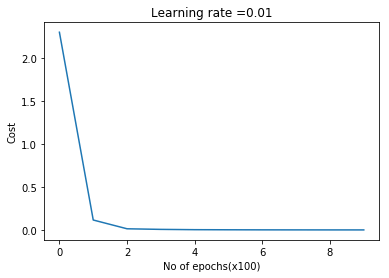
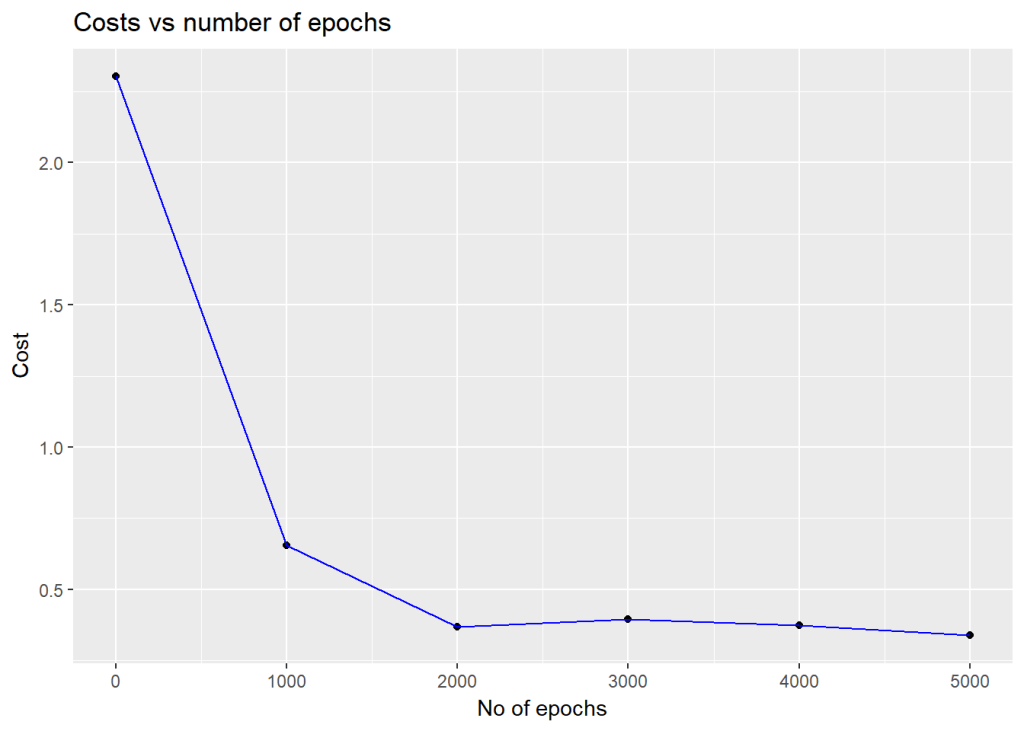
# Perform Gradient Descent with momentum
# Input : Weights and biases
#       : beta
#       : gradients
#       : learning rate
#       : outputActivationFunc - Activation function at hidden layer sigmoid/softmax
#output : Updated weights after 1 iteration
gradientDescentWithMomentum  <- function(parameters, gradients,v, beta, learningRate,outputActivationFunc="sigmoid"){

    L = length(parameters)/2 # number of layers in the neural network    
    # Update rule for each parameter. Use a for loop.
    for(l in 1:(L-1)){
        # Compute velocities
        # v['dWk'] = beta *v['dWk'] + (1-beta)*dWk
        v[[paste("dW",l, sep="")]] = beta*v[[paste("dW",l, sep="")]] + 
                   (1-beta) * gradients[[paste('dW',l,sep="")]]
        v[[paste("db",l, sep="")]] = beta*v[[paste("db",l, sep="")]] + 
            (1-beta) * gradients[[paste('db',l,sep="")]]
        
        parameters[[paste("W",l,sep="")]] = parameters[[paste("W",l,sep="")]] -
            learningRate* v[[paste("dW",l, sep="")]] 
        parameters[[paste("b",l,sep="")]] = parameters[[paste("b",l,sep="")]] -
            learningRate* v[[paste("db",l, sep="")]] 
    }    
    # Compute for the Lth layer
    if(outputActivationFunc=="sigmoid"){
        v[[paste("dW",L, sep="")]] = beta*v[[paste("dW",L, sep="")]] + 
            (1-beta) * gradients[[paste('dW',L,sep="")]]
        v[[paste("db",L, sep="")]] = beta*v[[paste("db",L, sep="")]] + 
            (1-beta) * gradients[[paste('db',L,sep="")]]
        
        parameters[[paste("W",L,sep="")]] = parameters[[paste("W",L,sep="")]] -
            learningRate* v[[paste("dW",l, sep="")]]  
        parameters[[paste("b",L,sep="")]] = parameters[[paste("b",L,sep="")]] -
            learningRate* v[[paste("db",l, sep="")]]
        
    }else if (outputActivationFunc=="softmax"){
        v[[paste("dW",L, sep="")]] = beta*v[[paste("dW",L, sep="")]] + 
            (1-beta) * t(gradients[[paste('dW',L,sep="")]])
        v[[paste("db",L, sep="")]] = beta*v[[paste("db",L, sep="")]] + 
            (1-beta) * t(gradients[[paste('db',L,sep="")]])       
        parameters[[paste("W",L,sep="")]] = parameters[[paste("W",L,sep="")]] -
            learningRate* t(gradients[[paste("dW",L,sep="")]])
        parameters[[paste("b",L,sep="")]] = parameters[[paste("b",L,sep="")]] -
            learningRate* t(gradients[[paste("db",L,sep="")]])
    }
    return(parameters)
}

3.1a. Stochastic Gradient Descent with Momentum- Python

import numpy as np
import matplotlib
import matplotlib.pyplot as plt
import sklearn.linear_model
import pandas as pd
import sklearn
import sklearn.datasets
# Read and load data
exec(open("DLfunctions7.py").read())
exec(open("load_mnist.py").read())
training=list(read(dataset='training',path=".\\mnist"))
test=list(read(dataset='testing',path=".\\mnist"))
lbls=[]
pxls=[]
for i in range(60000):
       l,p=training[i]
       lbls.append(l)
       pxls.append(p)
labels= np.array(lbls)
pixels=np.array(pxls)       
y=labels.reshape(-1,1)
X=pixels.reshape(pixels.shape[0],-1)
X1=X.T
Y1=y.T

# Create  a list of random numbers of 1024
permutation = list(np.random.permutation(2**10))
# Subset 16384 from the data
X2 = X1[:, permutation]
Y2 = Y1[:, permutation].reshape((1,2**10))
layersDimensions=[784, 15,9,10] 
# Perform SGD with momentum
parameters = L_Layer_DeepModel_SGD(X2, Y2, layersDimensions, hiddenActivationFunc='relu', 
                                   outputActivationFunc="softmax",learningRate = 0.01 ,
                                   optimizer="momentum", beta=0.9,
                                   mini_batch_size =512, num_epochs = 1000, print_cost = True,figure="fig3.png")

3.1b. Stochastic Gradient Descent with Momentum- R

source("mnist.R")
source("DLfunctions7.R")
load_mnist()
x <- t(train$x)
X <- x[,1:60000]
y <-train$y
y1 <- y[1:60000]
y2 <- as.matrix(y1)
Y=t(y2)

# Subset 1024 random samples from MNIST 
permutation = c(sample(2^10))
# Randomly shuffle the training data
X1 = X[, permutation]
y1 = Y[1, permutation]
y2 <- as.matrix(y1)
Y1=t(y2)
layersDimensions=c(784, 15,9, 10) 
# Perform SGD with momentum
retvalsSGD= L_Layer_DeepModel_SGD(X1, Y1, layersDimensions,
                                  hiddenActivationFunc='tanh',
                                  outputActivationFunc="softmax",
                                  learningRate = 0.05,
                                  optimizer="momentum",
                                  beta=0.9,
                                  mini_batch_size = 512, 
                                  num_epochs = 5000, 
                                  print_cost = True)

#Plot the cost vs iterations
iterations <- seq(0,5000,1000)
costs=retvalsSGD$costs
df=data.frame(iterations,costs)
ggplot(df,aes(x=iterations,y=costs)) + geom_point() + geom_line(color="blue") +
 ggtitle("Costs vs number of epochs") + xlab("No of epochs") + ylab("Cost")

3.1c. Stochastic Gradient Descent with Momentum- Octave

source("DL7functions.m")
#Load and read MNIST
load('./mnist/mnist.txt.gz'); 
#Create a random permutatation from 60K
permutation = randperm(1024);
disp(length(permutation));

# Use this 1024 as the batch
X=trainX(permutation,:);
Y=trainY(permutation,:);

# Set layer dimensions
layersDimensions=[784, 15, 9, 10];
# Perform SGD with Momentum
[weights biases costs]=L_Layer_DeepModel_SGD(X', Y', layersDimensions,
 hiddenActivationFunc='relu', 
 outputActivationFunc="softmax",
 learningRate = 0.01,
 lrDecay=false, 
 decayRate=1,
 lambd=0,
 keep_prob=1,
 optimizer="momentum",
 beta=0.9,
 beta1=0.9,
 beta2=0.999,
 epsilon=10^-8,
 mini_batch_size = 512, 
 num_epochs = 5000);

plotCostVsEpochs(5000,costs)

4.1. Stochastic Gradient Descent with RMSProp

Stochastic Gradient Descent with RMSProp tries to move faster towards the minima while dampening the oscillations across the ravine.
The equations are

s_{dW}^l = \beta_{1} s_{dW}^l + (1-\beta_{1})(dW^{l})^{2}
s_{db}^l = \beta_{1} s_{db}^l + (1-\beta_{1})(db^{l})^2
W^{l} = W^{l} - \frac {\alpha s_{dW}^l}{\sqrt (s_{dW}^l + \epsilon) }
b^{l} = b^{l} - \frac {\alpha s_{db}^l}{\sqrt (s_{db}^l + \epsilon) }
where s_{dW} and s_{db} are the RMSProp terms which are exponentially weighted with the corresponding gradients ‘dW’ and ‘db’ at the corresponding layer ‘l’

The code snippet in Octave is shown below

# Update parameters with RMSProp
# Input : parameters
#       : gradients
#       : s
#       : beta
#       : learningRate
#       : 
#output : Updated parameters RMSProp
function [weights biases] = gradientDescentWithRMSProp(weights, biases,gradsDW,gradsDB, sdW, sdB, beta1, epsilon, learningRate,outputActivationFunc="sigmoid")
    L = size(weights)(2); # number of layers in the neural network
    # Update rule for each parameter. 
    for l=1:(L-1)
        sdW{l} =  beta1*sdW{l} + (1 -beta1) * gradsDW{l} .* gradsDW{l};
        sdB{l} =  beta1*sdB{l} + (1 -beta1) * gradsDB{l} .* gradsDB{l};
        weights{l} = weights{l} - learningRate* gradsDW{l} ./ sqrt(sdW{l} + epsilon); 
        biases{l} = biases{l} -  learningRate* gradsDB{l} ./ sqrt(sdB{l} + epsilon);
    endfor
  
    if (strcmp(outputActivationFunc,"sigmoid"))
        sdW{L} =  beta1*sdW{L} + (1 -beta1) * gradsDW{L} .* gradsDW{L};
        sdB{L} =  beta1*sdB{L} + (1 -beta1) * gradsDB{L} .* gradsDB{L};
        weights{L} = weights{L} -learningRate* gradsDW{L} ./ sqrt(sdW{L} +epsilon); 
        biases{L} = biases{L} -learningRate* gradsDB{L} ./ sqrt(sdB{L} + epsilon);
     elseif (strcmp(outputActivationFunc,"softmax"))
        sdW{L} =  beta1*sdW{L} + (1 -beta1) * gradsDW{L}' .* gradsDW{L}';
        sdB{L} =  beta1*sdB{L} + (1 -beta1) * gradsDB{L}' .* gradsDB{L}';
        weights{L} = weights{L} -learningRate* gradsDW{L}' ./ sqrt(sdW{L} +epsilon); 
        biases{L} = biases{L} -learningRate* gradsDB{L}' ./ sqrt(sdB{L} + epsilon);
     endif   
end

4.1a. Stochastic Gradient Descent with RMSProp – Python

import numpy as np
import matplotlib
import matplotlib.pyplot as plt
import sklearn.linear_model
import pandas as pd
import sklearn
import sklearn.datasets
exec(open("DLfunctions7.py").read())
exec(open("load_mnist.py").read())

# Read and load MNIST
training=list(read(dataset='training',path=".\\mnist"))
test=list(read(dataset='testing',path=".\\mnist"))
lbls=[]
pxls=[]
for i in range(60000):
       l,p=training[i]
       lbls.append(l)
       pxls.append(p)
labels= np.array(lbls)
pixels=np.array(pxls)       
y=labels.reshape(-1,1)
X=pixels.reshape(pixels.shape[0],-1)
X1=X.T
Y1=y.T

print("X1=",X1.shape)
print("y1=",Y1.shape)

# Create  a list of random numbers of 1024
permutation = list(np.random.permutation(2**10))
# Subset 16384 from the data
X2 = X1[:, permutation]
Y2 = Y1[:, permutation].reshape((1,2**10))
  
layersDimensions=[784, 15,9,10] 
# Use SGD with RMSProp
parameters = L_Layer_DeepModel_SGD(X2, Y2, layersDimensions, hiddenActivationFunc='relu', 
                                   outputActivationFunc="softmax",learningRate = 0.01 ,
                                   optimizer="rmsprop", beta1=0.7, epsilon=1e-8,
                                   mini_batch_size =512, num_epochs = 1000, print_cost = True,figure="fig4.png")

4.1b. Stochastic Gradient Descent with RMSProp – R

source("mnist.R")
source("DLfunctions7.R")
load_mnist()
x <- t(train$x)
X <- x[,1:60000]
y <-train$y
y1 <- y[1:60000]
y2 <- as.matrix(y1)
Y=t(y2)

# Subset 1024 random samples from MNIST 
permutation = c(sample(2^10))
# Randomly shuffle the training data
X1 = X[, permutation]
y1 = Y[1, permutation]
y2 <- as.matrix(y1)
Y1=t(y2)
layersDimensions=c(784, 15,9, 10) 
#Perform SGD with RMSProp
retvalsSGD= L_Layer_DeepModel_SGD(X1, Y1, layersDimensions,
                                  hiddenActivationFunc='tanh',
                                  outputActivationFunc="softmax",
                                  learningRate = 0.001,
                                  optimizer="rmsprop",
                                  beta1=0.9,
                                  epsilon=10^-8,
                                  mini_batch_size = 512, 
                                  num_epochs = 5000 , 
                                  print_cost = True)
#Plot the cost vs iterations
iterations <- seq(0,5000,1000)
costs=retvalsSGD$costs
df=data.frame(iterations,costs)
ggplot(df,aes(x=iterations,y=costs)) + geom_point() + geom_line(color="blue") +
 ggtitle("Costs vs number of epochs") + xlab("No of epochs") + ylab("Cost")

4.1c. Stochastic Gradient Descent with RMSProp – Octave

source("DL7functions.m")
load('./mnist/mnist.txt.gz'); 
#Create a random permutatation from 1024
permutation = randperm(1024);

# Use this 1024 as the batch
X=trainX(permutation,:);
Y=trainY(permutation,:);

# Set layer dimensions
layersDimensions=[784, 15, 9, 10];
#Perform SGD with RMSProp
[weights biases costs]=L_Layer_DeepModel_SGD(X', Y', layersDimensions,
 hiddenActivationFunc='relu', 
 outputActivationFunc="softmax",
 learningRate = 0.005,
 lrDecay=false, 
 decayRate=1,
 lambd=0,
 keep_prob=1,
 optimizer="rmsprop",
 beta=0.9,
 beta1=0.9,
 beta2=0.999,
 epsilon=1,
 mini_batch_size = 512, 
 num_epochs = 5000);
plotCostVsEpochs(5000,costs)

5.1. Stochastic Gradient Descent with Adam

Adaptive Moment Estimate is a combination of the momentum (1st moment) and RMSProp(2nd moment). The equations for Adam are below
v_{dW}^l = \beta_{1} v_{dW}^l + (1-\beta_{1})dW^{l}
v_{db}^l = \beta_{1} v_{db}^l + (1-\beta_{1})db^{l}
The bias corrections for the 1st moment
vCorrected_{dW}^l= \frac {v_{dW}^l}{1 - \beta_{1}^{t}}
vCorrected_{db}^l= \frac {v_{db}^l}{1 - \beta_{1}^{t}}

Similarly the moving average for the 2nd moment- RMSProp
s_{dW}^l = \beta_{2} s_{dW}^l + (1-\beta_{2})(dW^{l})^2
s_{db}^l = \beta_{2} s_{db}^l + (1-\beta_{2})(db^{l})^2
The bias corrections for the 2nd moment
sCorrected_{dW}^l= \frac {s_{dW}^l}{1 - \beta_{2}^{t}}
sCorrected_{db}^l= \frac {s_{db}^l}{1 - \beta_{2}^{t}}

The Adam Gradient Descent is given by
W^{l} = W^{l} - \frac {\alpha vCorrected_{dW}^l}{\sqrt (s_{dW}^l + \epsilon) }
b^{l} = b^{l} - \frac {\alpha vCorrected_{db}^l}{\sqrt (s_{db}^l + \epsilon) }
The code snippet of Adam in R is included below

# Perform Gradient Descent with Adam
# Input : Weights and biases
#       : beta1
#       : epsilon
#       : gradients
#       : learning rate
#       : outputActivationFunc - Activation function at hidden layer sigmoid/softmax
#output : Updated weights after 1 iteration
gradientDescentWithAdam  <- function(parameters, gradients,v, s, t, 
                        beta1=0.9, beta2=0.999, epsilon=10^-8, learningRate=0.1,outputActivationFunc="sigmoid"){
    
    L = length(parameters)/2 # number of layers in the neural network
    v_corrected <- list()
    s_corrected <- list()
    # Update rule for each parameter. Use a for loop.
    for(l in 1:(L-1)){
        # v['dWk'] = beta *v['dWk'] + (1-beta)*dWk
        v[[paste("dW",l, sep="")]] = beta1*v[[paste("dW",l, sep="")]] + 
            (1-beta1) * gradients[[paste('dW',l,sep="")]]
        v[[paste("db",l, sep="")]] = beta1*v[[paste("db",l, sep="")]] + 
            (1-beta1) * gradients[[paste('db',l,sep="")]]
        
        
        # Compute bias-corrected first moment estimate. 
        v_corrected[[paste("dW",l, sep="")]] = v[[paste("dW",l, sep="")]]/(1-beta1^t)
        v_corrected[[paste("db",l, sep="")]] = v[[paste("db",l, sep="")]]/(1-beta1^t)
               
        # Element wise multiply of gradients
        s[[paste("dW",l, sep="")]] = beta2*s[[paste("dW",l, sep="")]] + 
            (1-beta2) * gradients[[paste('dW',l,sep="")]] * gradients[[paste('dW',l,sep="")]]
        s[[paste("db",l, sep="")]] = beta2*s[[paste("db",l, sep="")]] + 
            (1-beta2) * gradients[[paste('db',l,sep="")]] * gradients[[paste('db',l,sep="")]]
        
        # Compute bias-corrected second moment estimate. 
        s_corrected[[paste("dW",l, sep="")]] = s[[paste("dW",l, sep="")]]/(1-beta2^t)
        s_corrected[[paste("db",l, sep="")]] = s[[paste("db",l, sep="")]]/(1-beta2^t)
        
        # Update parameters. 
        d1=sqrt(s_corrected[[paste("dW",l, sep="")]]+epsilon)
        d2=sqrt(s_corrected[[paste("db",l, sep="")]]+epsilon)        
                
        parameters[[paste("W",l,sep="")]] = parameters[[paste("W",l,sep="")]] -
            learningRate * v_corrected[[paste("dW",l, sep="")]]/d1
        parameters[[paste("b",l,sep="")]] = parameters[[paste("b",l,sep="")]] -
            learningRate*v_corrected[[paste("db",l, sep="")]]/d2
    }    
    # Compute for the Lth layer
    if(outputActivationFunc=="sigmoid"){
        v[[paste("dW",L, sep="")]] = beta1*v[[paste("dW",L, sep="")]] + 
            (1-beta1) * gradients[[paste('dW',L,sep="")]]
        v[[paste("db",L, sep="")]] = beta1*v[[paste("db",L, sep="")]] + 
            (1-beta1) * gradients[[paste('db',L,sep="")]]
                
        # Compute bias-corrected first moment estimate. 
        v_corrected[[paste("dW",L, sep="")]] = v[[paste("dW",L, sep="")]]/(1-beta1^t)
        v_corrected[[paste("db",L, sep="")]] = v[[paste("db",L, sep="")]]/(1-beta1^t)
                
        # Element wise multiply of gradients
        s[[paste("dW",L, sep="")]] = beta2*s[[paste("dW",L, sep="")]] + 
            (1-beta2) * gradients[[paste('dW',L,sep="")]] * gradients[[paste('dW',L,sep="")]]
        s[[paste("db",L, sep="")]] = beta2*s[[paste("db",L, sep="")]] + 
            (1-beta2) * gradients[[paste('db',L,sep="")]] * gradients[[paste('db',L,sep="")]]
        
        # Compute bias-corrected second moment estimate. 
        s_corrected[[paste("dW",L, sep="")]] = s[[paste("dW",L, sep="")]]/(1-beta2^t)
        s_corrected[[paste("db",L, sep="")]] = s[[paste("db",L, sep="")]]/(1-beta2^t)
        
        # Update parameters. 
        d1=sqrt(s_corrected[[paste("dW",L, sep="")]]+epsilon)
        d2=sqrt(s_corrected[[paste("db",L, sep="")]]+epsilon)  
        
        parameters[[paste("W",L,sep="")]] = parameters[[paste("W",L,sep="")]] -
            learningRate * v_corrected[[paste("dW",L, sep="")]]/d1
        parameters[[paste("b",L,sep="")]] = parameters[[paste("b",L,sep="")]] -
            learningRate*v_corrected[[paste("db",L, sep="")]]/d2
        
    }else if (outputActivationFunc=="softmax"){
        v[[paste("dW",L, sep="")]] = beta1*v[[paste("dW",L, sep="")]] + 
            (1-beta1) * t(gradients[[paste('dW',L,sep="")]])
        v[[paste("db",L, sep="")]] = beta1*v[[paste("db",L, sep="")]] + 
            (1-beta1) * t(gradients[[paste('db',L,sep="")]])
                
        # Compute bias-corrected first moment estimate. 
        v_corrected[[paste("dW",L, sep="")]] = v[[paste("dW",L, sep="")]]/(1-beta1^t)
        v_corrected[[paste("db",L, sep="")]] = v[[paste("db",L, sep="")]]/(1-beta1^t)        
        
        # Element wise multiply of gradients
        s[[paste("dW",L, sep="")]] = beta2*s[[paste("dW",L, sep="")]] + 
            (1-beta2) * t(gradients[[paste('dW',L,sep="")]]) * t(gradients[[paste('dW',L,sep="")]])
        s[[paste("db",L, sep="")]] = beta2*s[[paste("db",L, sep="")]] + 
            (1-beta2) * t(gradients[[paste('db',L,sep="")]]) * t(gradients[[paste('db',L,sep="")]])
        
        # Compute bias-corrected second moment estimate. 
        s_corrected[[paste("dW",L, sep="")]] = s[[paste("dW",L, sep="")]]/(1-beta2^t)
        s_corrected[[paste("db",L, sep="")]] = s[[paste("db",L, sep="")]]/(1-beta2^t)
        
        # Update parameters. 
        d1=sqrt(s_corrected[[paste("dW",L, sep="")]]+epsilon)
        d2=sqrt(s_corrected[[paste("db",L, sep="")]]+epsilon) 
        
        parameters[[paste("W",L,sep="")]] = parameters[[paste("W",L,sep="")]] -
            learningRate * v_corrected[[paste("dW",L, sep="")]]/d1
        parameters[[paste("b",L,sep="")]] = parameters[[paste("b",L,sep="")]] -
            learningRate*v_corrected[[paste("db",L, sep="")]]/d2
    }
    return(parameters)
}

5.1a. Stochastic Gradient Descent with Adam – Python

import numpy as np
import matplotlib
import matplotlib.pyplot as plt
import sklearn.linear_model
import pandas as pd
import sklearn
import sklearn.datasets
exec(open("DLfunctions7.py").read())
exec(open("load_mnist.py").read())
training=list(read(dataset='training',path=".\\mnist"))
test=list(read(dataset='testing',path=".\\mnist"))
lbls=[]
pxls=[]
print(len(training))
#for i in range(len(training)):
for i in range(60000):
       l,p=training[i]
       lbls.append(l)
       pxls.append(p)
labels= np.array(lbls)
pixels=np.array(pxls)       
y=labels.reshape(-1,1)
X=pixels.reshape(pixels.shape[0],-1)
X1=X.T
Y1=y.T


# Create  a list of random numbers of 1024
permutation = list(np.random.permutation(2**10))
# Subset 16384 from the data
X2 = X1[:, permutation]
Y2 = Y1[:, permutation].reshape((1,2**10))
layersDimensions=[784, 15,9,10] 
#Perform SGD with Adam optimization
parameters = L_Layer_DeepModel_SGD(X2, Y2, layersDimensions, hiddenActivationFunc='relu', 
                                   outputActivationFunc="softmax",learningRate = 0.01 ,
                                   optimizer="adam", beta1=0.9, beta2=0.9, epsilon = 1e-8,
                                   mini_batch_size =512, num_epochs = 1000, print_cost = True, figure="fig5.png")

5.1b. Stochastic Gradient Descent with Adam – R

source("mnist.R")
source("DLfunctions7.R")
load_mnist()
x <- t(train$x)
X <- x[,1:60000]
y <-train$y
y1 <- y[1:60000]
y2 <- as.matrix(y1)
Y=t(y2)

# Subset 1024 random samples from MNIST 
permutation = c(sample(2^10))
# Randomly shuffle the training data
X1 = X[, permutation]
y1 = Y[1, permutation]
y2 <- as.matrix(y1)
Y1=t(y2)
layersDimensions=c(784, 15,9, 10) 
#Perform SGD with Adam
retvalsSGD= L_Layer_DeepModel_SGD(X1, Y1, layersDimensions,
                                  hiddenActivationFunc='tanh',
                                  outputActivationFunc="softmax",
                                  learningRate = 0.005,
                                  optimizer="adam",
                                  beta1=0.7,
                                  beta2=0.9,
                                  epsilon=10^-8,
                                  mini_batch_size = 512, 
                                  num_epochs = 5000 , 
                                  print_cost = True)
#Plot the cost vs iterations
iterations <- seq(0,5000,1000)
costs=retvalsSGD$costs
df=data.frame(iterations,costs)
ggplot(df,aes(x=iterations,y=costs)) + geom_point() + geom_line(color="blue") +
 ggtitle("Costs vs number of epochs") + xlab("No of epochs") + ylab("Cost")

5.1c. Stochastic Gradient Descent with Adam – Octave

source("DL7functions.m")
load('./mnist/mnist.txt.gz'); 
#Create a random permutatation from 1024
permutation = randperm(1024);
disp(length(permutation));

# Use this 1024 as the batch
X=trainX(permutation,:);
Y=trainY(permutation,:);
# Set layer dimensions
layersDimensions=[784, 15, 9, 10];

# Note the high value for epsilon. 
#Otherwise GD with Adam does not seem to converge   
# Perform SGD with Adam         
[weights biases costs]=L_Layer_DeepModel_SGD(X', Y', layersDimensions,
                       hiddenActivationFunc='relu', 
                       outputActivationFunc="softmax",
                       learningRate = 0.1,
                       lrDecay=false, 
                       decayRate=1,
                       lambd=0,
                       keep_prob=1,
                       optimizer="adam",
                       beta=0.9,
                       beta1=0.9,
                       beta2=0.9,
                       epsilon=100,
                       mini_batch_size = 512, 
                       num_epochs = 5000);
plotCostVsEpochs(5000,costs)

Conclusion: In this post I discuss and implement several Stochastic Gradient Descent optimization methods. The implementation of these methods enhance my already existing generic L-Layer Deep Learning Network implementation in vectorized Python, R and Octave, which I had discussed in the previous post in this series on Deep Learning from first principles in Python, R and Octave. Check it out, if you haven’t already. As already mentioned the code for this post can be cloned/forked from Github at DeepLearning-Part7

Watch this space! I’ll be back!

Also see
1.My book ‘Practical Machine Learning with R and Python’ on Amazon
2. Deep Learning from first principles in Python, R and Octave – Part 3
3. Experiments with deblurring using OpenCV
3. Design Principles of Scalable, Distributed Systems
4. Natural language processing: What would Shakespeare say?
5. yorkr crashes the IPL party! – Part 3!
6. cricketr flexes new muscles: The final analysis

To see all post click Index of posts