
Artificial Intelligence is the new electricity. – Prof Andrew Ng
Most of human and animal learning is unsupervised learning. If intelligence was a cake, unsupervised learning would be the cake, supervised learning would be the icing on the cake, and reinforcement learning would be the cherry on the cake. We know how to make the icing and the cherry, but we don’t know how to make the cake. We need to solve the unsupervised learning problem before we can even think of getting to true AI. – Yann LeCun, March 14, 2016 (Facebook)
Introduction
In this post ‘Deep Learning from first principles with Python, R and Octave-Part 7’, I implement optimization methods used in Stochastic Gradient Descent (SGD) to speed up the convergence. Specifically I discuss and implement the following gradient descent optimization techniques
a.Vanilla Stochastic Gradient Descent
b.Learning rate decay
c. Momentum method
d. RMSProp
e. Adaptive Moment Estimation (Adam)
This post, further enhances my generic L-Layer Deep Learning Network implementations in vectorized Python, R and Octave to also include the Stochastic Gradient Descent optimization techniques. You can clone/download the code from Github at DeepLearning-Part7
You can view my video presentation on Gradient Descent Optimization in Neural Networks 7
Incidentally, a good discussion of the various optimizations methods used in Stochastic Gradient Optimization techniques can be seen at Sebastian Ruder’s blog
Note: In the vectorized Python, R and Octave implementations below only a 1024 random training samples were used. This was to reduce the computation time. You are free to use the entire data set (60000 training data) for the computation.
This post is largely based of on Prof Andrew Ng’s Deep Learning Specialization. All the above optimization techniques for Stochastic Gradient Descent are based on the technique of exponentially weighted average method. So for example if we had some time series data 



Here 


We can write the equations as follows
and
By substitution we have






Hence it can be seen that the 
 Checkout my book ‘Deep Learning from first principles: Second Edition – In vectorized Python, R and Octave’. My book starts with the implementation of a simple 2-layer Neural Network and works its way to a generic L-Layer Deep Learning Network, with all the bells and whistles. The derivations have been discussed in detail. The code has been extensively commented and included in its entirety in the Appendix sections. My book is available on Amazon as paperback ($18.99) and in kindle version($9.99/Rs449).
You may also like my companion book “Practical Machine Learning with R and Python- Machine Learning in stereo” available in Amazon in paperback($9.99) and Kindle($6.99) versions. This book is ideal for a quick reference of the various ML functions and associated measurements in both R and Python which are essential to delve deep into Deep Learning.
1.1a. Stochastic Gradient Descent (Vanilla) – Python
import numpy as np
import matplotlib
import matplotlib.pyplot as plt
import sklearn.linear_model
import pandas as pd
import sklearn
import sklearn.datasets
exec(open("DLfunctions7.py").read())
exec(open("load_mnist.py").read())

# Read the training data
training=list(read(dataset='training',path=".\\mnist"))
test=list(read(dataset='testing',path=".\\mnist"))
lbls=[]
pxls=[]
for i in range(60000):
       l,p=training[i]
       lbls.append(l)
       pxls.append(p)
labels= np.array(lbls)
pixels=np.array(pxls)
y=labels.reshape(-1,1)
X=pixels.reshape(pixels.shape[0],-1)
X1=X.T
Y1=y.T

# Create  a list of 1024 random numbers.
permutation = list(np.random.permutation(2**10))
# Subset 16384 from the data
X2 = X1[:, permutation]
Y2 = Y1[:, permutation].reshape((1,2**10))
# Set the layer dimensions
layersDimensions=[784, 15,9,10]
# Perform SGD with regular gradient descent
parameters = L_Layer_DeepModel_SGD(X2, Y2, layersDimensions, hiddenActivationFunc='relu',
                                   outputActivationFunc="softmax",learningRate = 0.01 ,
                                   optimizer="gd",
                                   mini_batch_size =512, num_epochs = 1000, print_cost = True,figure="fig1.png")

1.1b. Stochastic Gradient Descent (Vanilla) – R
source("mnist.R")
source("DLfunctions7.R")
#Load and read MNIST data
load_mnist()
x <- t(train$x)
X <- x[,1:60000]
y <-train$y
y1 <- y[1:60000]
y2 <- as.matrix(y1)
Y=t(y2)

# Subset 1024 random samples from MNIST
permutation = c(sample(2^10))
# Randomly shuffle the training data
X1 = X[, permutation]
y1 = Y[1, permutation]
y2 <- as.matrix(y1)
Y1=t(y2)
# Set layer dimensions
layersDimensions=c(784, 15,9, 10)
# Perform SGD with regular gradient descent
retvalsSGD= L_Layer_DeepModel_SGD(X1, Y1, layersDimensions,
                            hiddenActivationFunc='tanh',
                            outputActivationFunc="softmax",
                            learningRate = 0.05,
                            optimizer="gd",
                            mini_batch_size = 512,
                            num_epochs = 5000,
                            print_cost = True)
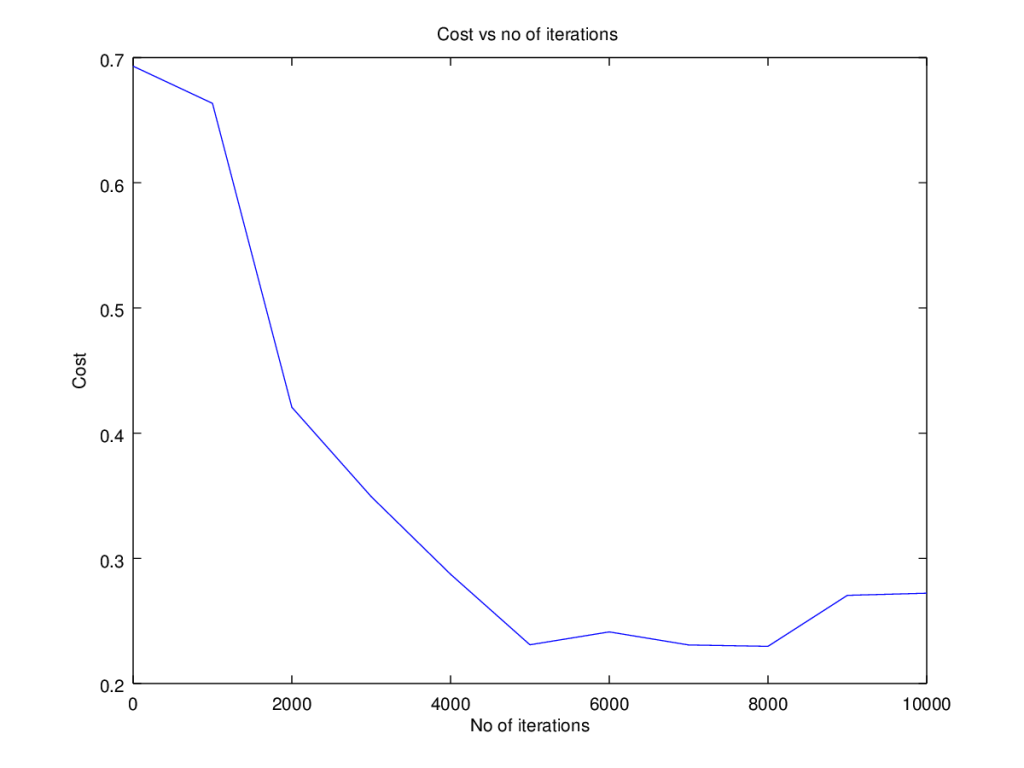
#Plot the cost vs iterations
iterations <- seq(0,5000,1000)
costs=retvalsSGD$costs
df=data.frame(iterations,costs)
ggplot(df,aes(x=iterations,y=costs)) + geom_point() + geom_line(color="blue") +
ggtitle("Costs vs no of epochs") + xlab("No of epochss") + ylab("Cost")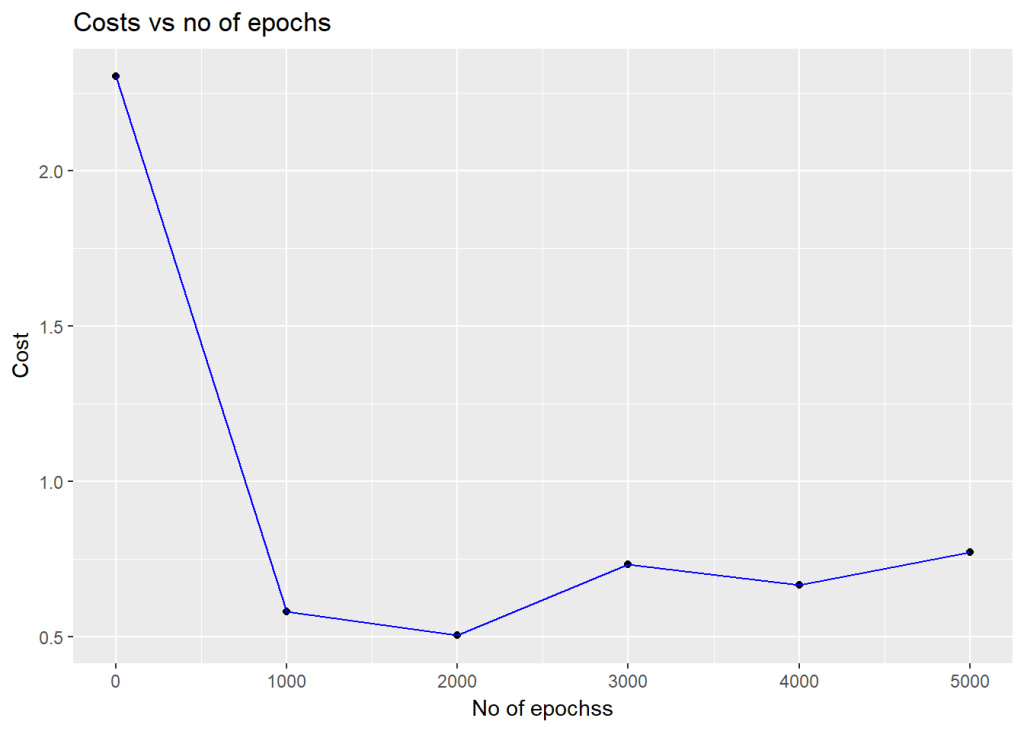
1.1c. Stochastic Gradient Descent (Vanilla) – Octave
source("DL7functions.m")
#Load and read MNIST
load('./mnist/mnist.txt.gz');
#Create a random permutatation from 1024
permutation = randperm(1024);
disp(length(permutation));

# Use this 1024 as the batch
X=trainX(permutation,:);
Y=trainY(permutation,:);

# Set layer dimensions
layersDimensions=[784, 15, 9, 10];
# Perform SGD with regular gradient descent
[weights biases costs]=L_Layer_DeepModel_SGD(X', Y', layersDimensions,
 hiddenActivationFunc='relu',
 outputActivationFunc="softmax",
 learningRate = 0.005,
 lrDecay=true,
 decayRate=1,
 lambd=0,
 keep_prob=1,
 optimizer="gd",
 beta=0.9,
 beta1=0.9,
 beta2=0.999,
 epsilon=10^-8,
 mini_batch_size = 512,
 num_epochs = 5000);

plotCostVsEpochs(5000,costs);

2.1. Stochastic Gradient Descent with Learning rate decay
Since in Stochastic Gradient Descent,with each epoch, we use slight different samples, the gradient descent algorithm, oscillates across the ravines and wanders around the minima, when a fixed learning rate is used. In this technique of ‘learning rate decay’ the learning rate is slowly decreased with the number of epochs and becomes smaller and smaller, so that gradient descent can take smaller steps towards the minima.
There are several techniques employed in learning rate decay
a) Exponential decay:
b) 1/t decay :
c)


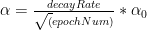
In my implementation I have used the ‘exponential decay’. The code snippet for Python is shown below
if lrDecay == True:
   learningRate = np.power(decayRate,(num_epochs/1000)) * learningRate
2.1a. Stochastic Gradient Descent with Learning rate decay – Python
import numpy as np
import matplotlib
import matplotlib.pyplot as plt
import sklearn.linear_model
import pandas as pd
import sklearn
import sklearn.datasets
exec(open("DLfunctions7.py").read())
exec(open("load_mnist.py").read())

# Read the MNIST data
training=list(read(dataset='training',path=".\\mnist"))
test=list(read(dataset='testing',path=".\\mnist"))
lbls=[]
pxls=[]
for i in range(60000):
       l,p=training[i]
       lbls.append(l)
       pxls.append(p)
labels= np.array(lbls)
pixels=np.array(pxls)
y=labels.reshape(-1,1)
X=pixels.reshape(pixels.shape[0],-1)
X1=X.T
Y1=y.T

# Create  a list of random numbers of 1024
permutation = list(np.random.permutation(2**10))
# Subset 16384 from the data
X2 = X1[:, permutation]
Y2 = Y1[:, permutation].reshape((1,2**10))
# Set layer dimensions
layersDimensions=[784, 15,9,10]
# Perform SGD with learning rate decay
parameters = L_Layer_DeepModel_SGD(X2, Y2, layersDimensions, hiddenActivationFunc='relu',
                                   outputActivationFunc="softmax",
                                   learningRate = 0.01 , lrDecay=True, decayRate=0.9999,
                                   optimizer="gd",
                                   mini_batch_size =512, num_epochs = 1000, print_cost = True,figure="fig2.png")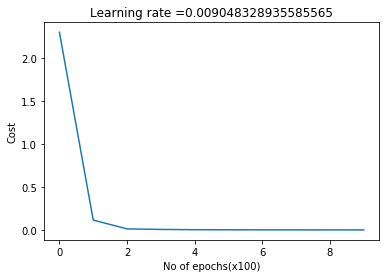
2.1b. Stochastic Gradient Descent with Learning rate decay – R
source("mnist.R")
source("DLfunctions7.R")
# Read and load MNIST
load_mnist()
x <- t(train$x)
X <- x[,1:60000]
y <-train$y
y1 <- y[1:60000]
y2 <- as.matrix(y1)
Y=t(y2)

# Subset 1024 random samples from MNIST
permutation = c(sample(2^10))
# Randomly shuffle the training data
X1 = X[, permutation]
y1 = Y[1, permutation]
y2 <- as.matrix(y1)
Y1=t(y2)
# Set layer dimensions
layersDimensions=c(784, 15,9, 10)
# Perform SGD with Learning rate decay
retvalsSGD= L_Layer_DeepModel_SGD(X1, Y1, layersDimensions,
                                  hiddenActivationFunc='tanh',
                                  outputActivationFunc="softmax",
                                  learningRate = 0.05,
                                  lrDecay=TRUE,
                                  decayRate=0.9999,
                                  optimizer="gd",
                                  mini_batch_size = 512,
                                  num_epochs = 5000,
                                  print_cost = True)
#Plot the cost vs iterations
iterations <- seq(0,5000,1000)
costs=retvalsSGD$costs
df=data.frame(iterations,costs)
ggplot(df,aes(x=iterations,y=costs)) + geom_point() + geom_line(color="blue") +
ggtitle("Costs vs number of epochs") + xlab("No of epochs") + ylab("Cost")
2.1c. Stochastic Gradient Descent with Learning rate decay – Octave
source("DL7functions.m")
#Load and read MNIST
load('./mnist/mnist.txt.gz');
#Create a random permutatation from 1024
permutation = randperm(1024);
disp(length(permutation));
# Use this 1024 as the batch
X=trainX(permutation,:);
Y=trainY(permutation,:);
# Set layer dimensions
layersDimensions=[784, 15, 9, 10];
# Perform SGD with regular Learning rate decay
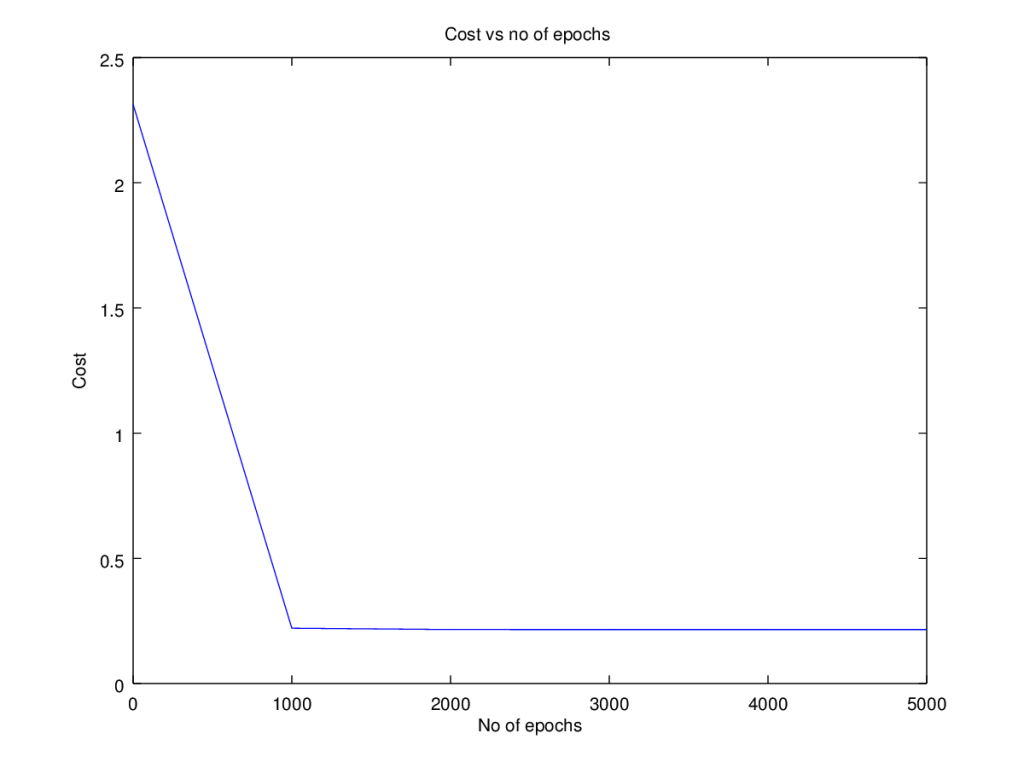
[weights biases costs]=L_Layer_DeepModel_SGD(X', Y', layersDimensions,
hiddenActivationFunc='relu',
outputActivationFunc="softmax",
learningRate = 0.01,
lrDecay=true,
decayRate=0.999,
lambd=0,
keep_prob=1,
optimizer="gd",
beta=0.9,
beta1=0.9,
beta2=0.999,
epsilon=10^-8,
mini_batch_size = 512,
num_epochs = 5000);
plotCostVsEpochs(5000,costs)
3.1. Stochastic Gradient Descent with Momentum
Stochastic Gradient Descent with Momentum uses the exponentially weighted average method discusses above and more generally moves faster into the ravine than across it. The equations are





# Perform Gradient Descent with momentum
# Input : Weights and biases
# : beta
# : gradients
# : learning rate
# : outputActivationFunc - Activation function at hidden layer sigmoid/softmax
#output : Updated weights after 1 iteration
gradientDescentWithMomentum <- function(parameters, gradients,v, beta, learningRate,outputActivationFunc="sigmoid"){
L = length(parameters)/2 # number of layers in the neural network
# Update rule for each parameter. Use a for loop.
for(l in 1:(L-1)){
# Compute velocities
# v['dWk'] = beta *v['dWk'] + (1-beta)*dWk
v[[paste("dW",l, sep="")]] = beta*v[[paste("dW",l, sep="")]] +
(1-beta) * gradients[[paste('dW',l,sep="")]]
v[[paste("db",l, sep="")]] = beta*v[[paste("db",l, sep="")]] +
(1-beta) * gradients[[paste('db',l,sep="")]]
parameters[[paste("W",l,sep="")]] = parameters[[paste("W",l,sep="")]] -
learningRate* v[[paste("dW",l, sep="")]]
parameters[[paste("b",l,sep="")]] = parameters[[paste("b",l,sep="")]] -
learningRate* v[[paste("db",l, sep="")]]
}
# Compute for the Lth layer
if(outputActivationFunc=="sigmoid"){
v[[paste("dW",L, sep="")]] = beta*v[[paste("dW",L, sep="")]] +
(1-beta) * gradients[[paste('dW',L,sep="")]]
v[[paste("db",L, sep="")]] = beta*v[[paste("db",L, sep="")]] +
(1-beta) * gradients[[paste('db',L,sep="")]]
parameters[[paste("W",L,sep="")]] = parameters[[paste("W",L,sep="")]] -
learningRate* v[[paste("dW",l, sep="")]]
parameters[[paste("b",L,sep="")]] = parameters[[paste("b",L,sep="")]] -
learningRate* v[[paste("db",l, sep="")]]
}else if (outputActivationFunc=="softmax"){
v[[paste("dW",L, sep="")]] = beta*v[[paste("dW",L, sep="")]] +
(1-beta) * t(gradients[[paste('dW',L,sep="")]])
v[[paste("db",L, sep="")]] = beta*v[[paste("db",L, sep="")]] +
(1-beta) * t(gradients[[paste('db',L,sep="")]])
parameters[[paste("W",L,sep="")]] = parameters[[paste("W",L,sep="")]] -
learningRate* t(gradients[[paste("dW",L,sep="")]])
parameters[[paste("b",L,sep="")]] = parameters[[paste("b",L,sep="")]] -
learningRate* t(gradients[[paste("db",L,sep="")]])
}
return(parameters)
}
3.1a. Stochastic Gradient Descent with Momentum- Python
import numpy as np
import matplotlib
import matplotlib.pyplot as plt
import sklearn.linear_model
import pandas as pd
import sklearn
import sklearn.datasets
# Read and load data
exec(open("DLfunctions7.py").read())
exec(open("load_mnist.py").read())
training=list(read(dataset='training',path=".\\mnist"))
test=list(read(dataset='testing',path=".\\mnist"))
lbls=[]
pxls=[]
for i in range(60000):
l,p=training[i]
lbls.append(l)
pxls.append(p)
labels= np.array(lbls)
pixels=np.array(pxls)
y=labels.reshape(-1,1)
X=pixels.reshape(pixels.shape[0],-1)
X1=X.T
Y1=y.T
# Create a list of random numbers of 1024
permutation = list(np.random.permutation(2**10))
# Subset 16384 from the data
X2 = X1[:, permutation]
Y2 = Y1[:, permutation].reshape((1,2**10))
layersDimensions=[784, 15,9,10]
# Perform SGD with momentum
parameters = L_Layer_DeepModel_SGD(X2, Y2, layersDimensions, hiddenActivationFunc='relu',
outputActivationFunc="softmax",learningRate = 0.01 ,
optimizer="momentum", beta=0.9,
mini_batch_size =512, num_epochs = 1000, print_cost = True,figure="fig3.png")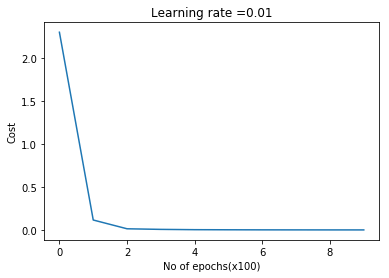
3.1b. Stochastic Gradient Descent with Momentum- R
source("mnist.R")
source("DLfunctions7.R")
load_mnist()
x <- t(train$x)
X <- x[,1:60000]
y <-train$y
y1 <- y[1:60000]
y2 <- as.matrix(y1)
Y=t(y2)
# Subset 1024 random samples from MNIST
permutation = c(sample(2^10))
# Randomly shuffle the training data
X1 = X[, permutation]
y1 = Y[1, permutation]
y2 <- as.matrix(y1)
Y1=t(y2)
layersDimensions=c(784, 15,9, 10)
# Perform SGD with momentum
retvalsSGD= L_Layer_DeepModel_SGD(X1, Y1, layersDimensions,
hiddenActivationFunc='tanh',
outputActivationFunc="softmax",
learningRate = 0.05,
optimizer="momentum",
beta=0.9,
mini_batch_size = 512,
num_epochs = 5000,
print_cost = True)
#Plot the cost vs iterations
iterations <- seq(0,5000,1000)
costs=retvalsSGD$costs
df=data.frame(iterations,costs)
ggplot(df,aes(x=iterations,y=costs)) + geom_point() + geom_line(color="blue") +
 ggtitle("Costs vs number of epochs") + xlab("No of epochs") + ylab("Cost")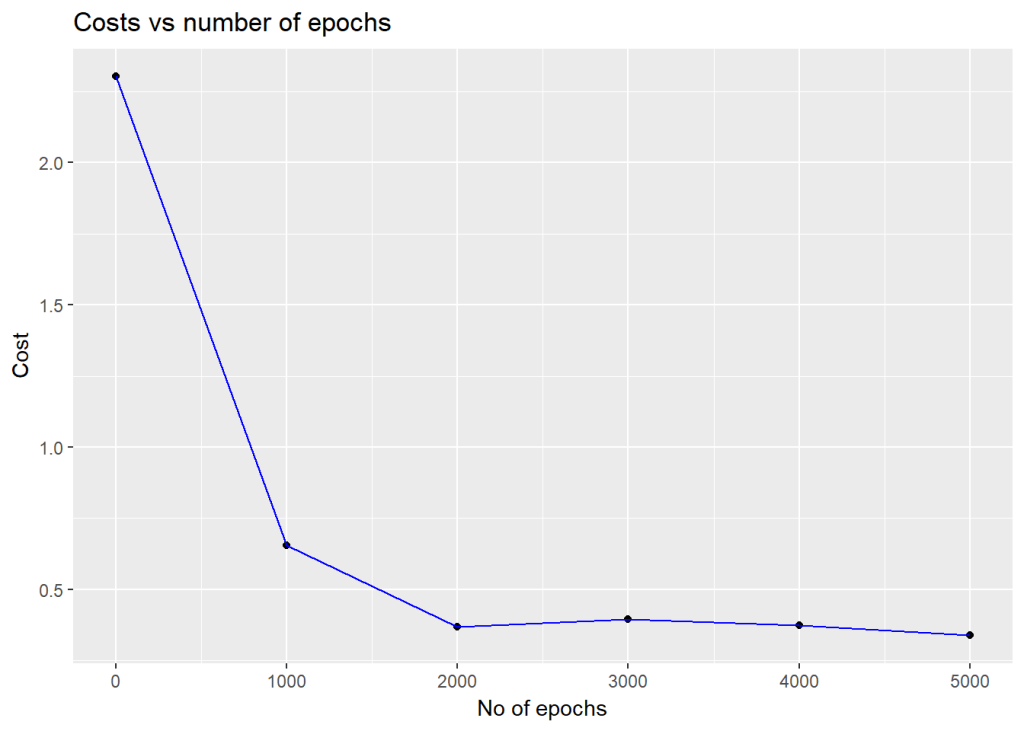
3.1c. Stochastic Gradient Descent with Momentum- Octave
source("DL7functions.m")
#Load and read MNIST
load('./mnist/mnist.txt.gz');
#Create a random permutatation from 60K
permutation = randperm(1024);
disp(length(permutation));

# Use this 1024 as the batch
X=trainX(permutation,:);
Y=trainY(permutation,:);

# Set layer dimensions
layersDimensions=[784, 15, 9, 10];
# Perform SGD with Momentum
[weights biases costs]=L_Layer_DeepModel_SGD(X', Y', layersDimensions,
 hiddenActivationFunc='relu',
 outputActivationFunc="softmax",
 learningRate = 0.01,
 lrDecay=false,
 decayRate=1,
 lambd=0,
 keep_prob=1,
 optimizer="momentum",
 beta=0.9,
 beta1=0.9,
 beta2=0.999,
 epsilon=10^-8,
 mini_batch_size = 512,
 num_epochs = 5000);

plotCostVsEpochs(5000,costs)

4.1. Stochastic Gradient Descent with RMSProp
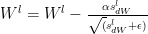
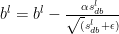
Stochastic Gradient Descent with RMSProp tries to move faster towards the minima while dampening the oscillations across the ravine.
The equations are
where 



The code snippet in Octave is shown below
# Update parameters with RMSProp
# Input : parameters
#       : gradients
#       : s
#       : beta
#       : learningRate
#       :
#output : Updated parameters RMSProp
function [weights biases] = gradientDescentWithRMSProp(weights, biases,gradsDW,gradsDB, sdW, sdB, beta1, epsilon, learningRate,outputActivationFunc="sigmoid")
    L = size(weights)(2); # number of layers in the neural network
    # Update rule for each parameter.
    for l=1:(L-1)
        sdW{l} =  beta1*sdW{l} + (1 -beta1) * gradsDW{l} .* gradsDW{l};
        sdB{l} =  beta1*sdB{l} + (1 -beta1) * gradsDB{l} .* gradsDB{l};
        weights{l} = weights{l} - learningRate* gradsDW{l} ./ sqrt(sdW{l} + epsilon);
        biases{l} = biases{l} -  learningRate* gradsDB{l} ./ sqrt(sdB{l} + epsilon);
    endfor

    if (strcmp(outputActivationFunc,"sigmoid"))
        sdW{L} =  beta1*sdW{L} + (1 -beta1) * gradsDW{L} .* gradsDW{L};
        sdB{L} =  beta1*sdB{L} + (1 -beta1) * gradsDB{L} .* gradsDB{L};
        weights{L} = weights{L} -learningRate* gradsDW{L} ./ sqrt(sdW{L} +epsilon);
        biases{L} = biases{L} -learningRate* gradsDB{L} ./ sqrt(sdB{L} + epsilon);
     elseif (strcmp(outputActivationFunc,"softmax"))
        sdW{L} =  beta1*sdW{L} + (1 -beta1) * gradsDW{L}' .* gradsDW{L}';
        sdB{L} =  beta1*sdB{L} + (1 -beta1) * gradsDB{L}' .* gradsDB{L}';
        weights{L} = weights{L} -learningRate* gradsDW{L}' ./ sqrt(sdW{L} +epsilon);
        biases{L} = biases{L} -learningRate* gradsDB{L}' ./ sqrt(sdB{L} + epsilon);
     endif
end
4.1a. Stochastic Gradient Descent with RMSProp – Python
import numpy as np
import matplotlib
import matplotlib.pyplot as plt
import sklearn.linear_model
import pandas as pd
import sklearn
import sklearn.datasets
exec(open("DLfunctions7.py").read())
exec(open("load_mnist.py").read())

# Read and load MNIST
training=list(read(dataset='training',path=".\\mnist"))
test=list(read(dataset='testing',path=".\\mnist"))
lbls=[]
pxls=[]
for i in range(60000):
       l,p=training[i]
       lbls.append(l)
       pxls.append(p)
labels= np.array(lbls)
pixels=np.array(pxls)
y=labels.reshape(-1,1)
X=pixels.reshape(pixels.shape[0],-1)
X1=X.T
Y1=y.T

print("X1=",X1.shape)
print("y1=",Y1.shape)

# Create  a list of random numbers of 1024
permutation = list(np.random.permutation(2**10))
# Subset 16384 from the data
X2 = X1[:, permutation]
Y2 = Y1[:, permutation].reshape((1,2**10))

layersDimensions=[784, 15,9,10]
# Use SGD with RMSProp
parameters = L_Layer_DeepModel_SGD(X2, Y2, layersDimensions, hiddenActivationFunc='relu',
                                   outputActivationFunc="softmax",learningRate = 0.01 ,
                                   optimizer="rmsprop", beta1=0.7, epsilon=1e-8,
                                   mini_batch_size =512, num_epochs = 1000, print_cost = True,figure="fig4.png")
4.1b. Stochastic Gradient Descent with RMSProp – R
source("mnist.R")
source("DLfunctions7.R")
load_mnist()
x <- t(train$x)
X <- x[,1:60000]
y <-train$y
y1 <- y[1:60000]
y2 <- as.matrix(y1)
Y=t(y2)

# Subset 1024 random samples from MNIST
permutation = c(sample(2^10))
# Randomly shuffle the training data
X1 = X[, permutation]
y1 = Y[1, permutation]
y2 <- as.matrix(y1)
Y1=t(y2)
layersDimensions=c(784, 15,9, 10)
#Perform SGD with RMSProp
retvalsSGD= L_Layer_DeepModel_SGD(X1, Y1, layersDimensions,
                                  hiddenActivationFunc='tanh',
                                  outputActivationFunc="softmax",
                                  learningRate = 0.001,
                                  optimizer="rmsprop",
                                  beta1=0.9,
                                  epsilon=10^-8,
                                  mini_batch_size = 512,
                                  num_epochs = 5000 ,
                                  print_cost = True)
#Plot the cost vs iterations
iterations <- seq(0,5000,1000)
costs=retvalsSGD$costs
df=data.frame(iterations,costs)
ggplot(df,aes(x=iterations,y=costs)) + geom_point() + geom_line(color="blue") +
ggtitle("Costs vs number of epochs") + xlab("No of epochs") + ylab("Cost")

4.1c. Stochastic Gradient Descent with RMSProp – Octave
source("DL7functions.m")
load('./mnist/mnist.txt.gz');
#Create a random permutatation from 1024
permutation = randperm(1024);

# Use this 1024 as the batch
X=trainX(permutation,:);
Y=trainY(permutation,:);

# Set layer dimensions
layersDimensions=[784, 15, 9, 10];
#Perform SGD with RMSProp
[weights biases costs]=L_Layer_DeepModel_SGD(X', Y', layersDimensions,
 hiddenActivationFunc='relu',
 outputActivationFunc="softmax",
 learningRate = 0.005,
 lrDecay=false,
 decayRate=1,
 lambd=0,
 keep_prob=1,
 optimizer="rmsprop",
 beta=0.9,
 beta1=0.9,
 beta2=0.999,
 epsilon=1,
 mini_batch_size = 512,
 num_epochs = 5000);
plotCostVsEpochs(5000,costs)

5.1. Stochastic Gradient Descent with Adam
Adaptive Moment Estimate is a combination of the momentum (1st moment) and RMSProp(2nd moment). The equations for Adam are below
The bias corrections for the 1st moment



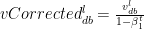
Similarly the moving average for the 2nd moment- RMSProp
The bias corrections for the 2nd moment



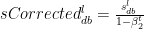
The Adam Gradient Descent is given by
The code snippet of Adam in R is included below


# Perform Gradient Descent with Adam
# Input : Weights and biases
#       : beta1
#       : epsilon
#       : gradients
#       : learning rate
#       : outputActivationFunc - Activation function at hidden layer sigmoid/softmax
#output : Updated weights after 1 iteration
gradientDescentWithAdam  <- function(parameters, gradients,v, s, t,
                        beta1=0.9, beta2=0.999, epsilon=10^-8, learningRate=0.1,outputActivationFunc="sigmoid"){

    L = length(parameters)/2 # number of layers in the neural network
    v_corrected <- list()
    s_corrected <- list()
    # Update rule for each parameter. Use a for loop.
    for(l in 1:(L-1)){
        # v['dWk'] = beta *v['dWk'] + (1-beta)*dWk
        v[[paste("dW",l, sep="")]] = beta1*v[[paste("dW",l, sep="")]] +
            (1-beta1) * gradients[[paste('dW',l,sep="")]]
        v[[paste("db",l, sep="")]] = beta1*v[[paste("db",l, sep="")]] +
            (1-beta1) * gradients[[paste('db',l,sep="")]]


        # Compute bias-corrected first moment estimate.
        v_corrected[[paste("dW",l, sep="")]] = v[[paste("dW",l, sep="")]]/(1-beta1^t)
        v_corrected[[paste("db",l, sep="")]] = v[[paste("db",l, sep="")]]/(1-beta1^t)

        # Element wise multiply of gradients
        s[[paste("dW",l, sep="")]] = beta2*s[[paste("dW",l, sep="")]] +
            (1-beta2) * gradients[[paste('dW',l,sep="")]] * gradients[[paste('dW',l,sep="")]]
        s[[paste("db",l, sep="")]] = beta2*s[[paste("db",l, sep="")]] +
            (1-beta2) * gradients[[paste('db',l,sep="")]] * gradients[[paste('db',l,sep="")]]

        # Compute bias-corrected second moment estimate.
        s_corrected[[paste("dW",l, sep="")]] = s[[paste("dW",l, sep="")]]/(1-beta2^t)
        s_corrected[[paste("db",l, sep="")]] = s[[paste("db",l, sep="")]]/(1-beta2^t)

        # Update parameters.
        d1=sqrt(s_corrected[[paste("dW",l, sep="")]]+epsilon)
        d2=sqrt(s_corrected[[paste("db",l, sep="")]]+epsilon)

        parameters[[paste("W",l,sep="")]] = parameters[[paste("W",l,sep="")]] -
            learningRate * v_corrected[[paste("dW",l, sep="")]]/d1
        parameters[[paste("b",l,sep="")]] = parameters[[paste("b",l,sep="")]] -
            learningRate*v_corrected[[paste("db",l, sep="")]]/d2
    }
    # Compute for the Lth layer
    if(outputActivationFunc=="sigmoid"){
        v[[paste("dW",L, sep="")]] = beta1*v[[paste("dW",L, sep="")]] +
            (1-beta1) * gradients[[paste('dW',L,sep="")]]
        v[[paste("db",L, sep="")]] = beta1*v[[paste("db",L, sep="")]] +
            (1-beta1) * gradients[[paste('db',L,sep="")]]

        # Compute bias-corrected first moment estimate.
        v_corrected[[paste("dW",L, sep="")]] = v[[paste("dW",L, sep="")]]/(1-beta1^t)
        v_corrected[[paste("db",L, sep="")]] = v[[paste("db",L, sep="")]]/(1-beta1^t)

        # Element wise multiply of gradients
        s[[paste("dW",L, sep="")]] = beta2*s[[paste("dW",L, sep="")]] +
            (1-beta2) * gradients[[paste('dW',L,sep="")]] * gradients[[paste('dW',L,sep="")]]
        s[[paste("db",L, sep="")]] = beta2*s[[paste("db",L, sep="")]] +
            (1-beta2) * gradients[[paste('db',L,sep="")]] * gradients[[paste('db',L,sep="")]]

        # Compute bias-corrected second moment estimate.
        s_corrected[[paste("dW",L, sep="")]] = s[[paste("dW",L, sep="")]]/(1-beta2^t)
        s_corrected[[paste("db",L, sep="")]] = s[[paste("db",L, sep="")]]/(1-beta2^t)

        # Update parameters.
        d1=sqrt(s_corrected[[paste("dW",L, sep="")]]+epsilon)
        d2=sqrt(s_corrected[[paste("db",L, sep="")]]+epsilon)

        parameters[[paste("W",L,sep="")]] = parameters[[paste("W",L,sep="")]] -
            learningRate * v_corrected[[paste("dW",L, sep="")]]/d1
        parameters[[paste("b",L,sep="")]] = parameters[[paste("b",L,sep="")]] -
            learningRate*v_corrected[[paste("db",L, sep="")]]/d2

    }else if (outputActivationFunc=="softmax"){
        v[[paste("dW",L, sep="")]] = beta1*v[[paste("dW",L, sep="")]] +
            (1-beta1) * t(gradients[[paste('dW',L,sep="")]])
        v[[paste("db",L, sep="")]] = beta1*v[[paste("db",L, sep="")]] +
            (1-beta1) * t(gradients[[paste('db',L,sep="")]])

        # Compute bias-corrected first moment estimate.
        v_corrected[[paste("dW",L, sep="")]] = v[[paste("dW",L, sep="")]]/(1-beta1^t)
        v_corrected[[paste("db",L, sep="")]] = v[[paste("db",L, sep="")]]/(1-beta1^t)

        # Element wise multiply of gradients
        s[[paste("dW",L, sep="")]] = beta2*s[[paste("dW",L, sep="")]] +
            (1-beta2) * t(gradients[[paste('dW',L,sep="")]]) * t(gradients[[paste('dW',L,sep="")]])
        s[[paste("db",L, sep="")]] = beta2*s[[paste("db",L, sep="")]] +
            (1-beta2) * t(gradients[[paste('db',L,sep="")]]) * t(gradients[[paste('db',L,sep="")]])

        # Compute bias-corrected second moment estimate.
        s_corrected[[paste("dW",L, sep="")]] = s[[paste("dW",L, sep="")]]/(1-beta2^t)
        s_corrected[[paste("db",L, sep="")]] = s[[paste("db",L, sep="")]]/(1-beta2^t)

        # Update parameters.
        d1=sqrt(s_corrected[[paste("dW",L, sep="")]]+epsilon)
        d2=sqrt(s_corrected[[paste("db",L, sep="")]]+epsilon)

        parameters[[paste("W",L,sep="")]] = parameters[[paste("W",L,sep="")]] -
            learningRate * v_corrected[[paste("dW",L, sep="")]]/d1
        parameters[[paste("b",L,sep="")]] = parameters[[paste("b",L,sep="")]] -
            learningRate*v_corrected[[paste("db",L, sep="")]]/d2
    }
    return(parameters)
}
5.1a. Stochastic Gradient Descent with Adam – Python
import numpy as np
import matplotlib
import matplotlib.pyplot as plt
import sklearn.linear_model
import pandas as pd
import sklearn
import sklearn.datasets
exec(open("DLfunctions7.py").read())
exec(open("load_mnist.py").read())
training=list(read(dataset='training',path=".\\mnist"))
test=list(read(dataset='testing',path=".\\mnist"))
lbls=[]
pxls=[]
print(len(training))
#for i in range(len(training)):
for i in range(60000):
       l,p=training[i]
       lbls.append(l)
       pxls.append(p)
labels= np.array(lbls)
pixels=np.array(pxls)
y=labels.reshape(-1,1)
X=pixels.reshape(pixels.shape[0],-1)
X1=X.T
Y1=y.T


# Create  a list of random numbers of 1024
permutation = list(np.random.permutation(2**10))
# Subset 16384 from the data
X2 = X1[:, permutation]
Y2 = Y1[:, permutation].reshape((1,2**10))
layersDimensions=[784, 15,9,10]
#Perform SGD with Adam optimization
parameters = L_Layer_DeepModel_SGD(X2, Y2, layersDimensions, hiddenActivationFunc='relu',
                                   outputActivationFunc="softmax",learningRate = 0.01 ,
                                   optimizer="adam", beta1=0.9, beta2=0.9, epsilon = 1e-8,
                                   mini_batch_size =512, num_epochs = 1000, print_cost = True, figure="fig5.png")
5.1b. Stochastic Gradient Descent with Adam – R
source("mnist.R")
source("DLfunctions7.R")
load_mnist()
x <- t(train$x)
X <- x[,1:60000]
y <-train$y
y1 <- y[1:60000]
y2 <- as.matrix(y1)
Y=t(y2)

# Subset 1024 random samples from MNIST
permutation = c(sample(2^10))
# Randomly shuffle the training data
X1 = X[, permutation]
y1 = Y[1, permutation]
y2 <- as.matrix(y1)
Y1=t(y2)
layersDimensions=c(784, 15,9, 10)
#Perform SGD with Adam
retvalsSGD= L_Layer_DeepModel_SGD(X1, Y1, layersDimensions,
                                  hiddenActivationFunc='tanh',
                                  outputActivationFunc="softmax",
                                  learningRate = 0.005,
                                  optimizer="adam",
                                  beta1=0.7,
                                  beta2=0.9,
                                  epsilon=10^-8,
                                  mini_batch_size = 512,
                                  num_epochs = 5000 ,
                                  print_cost = True)
#Plot the cost vs iterations
iterations <- seq(0,5000,1000)
costs=retvalsSGD$costs
df=data.frame(iterations,costs)
ggplot(df,aes(x=iterations,y=costs)) + geom_point() + geom_line(color="blue") +
ggtitle("Costs vs number of epochs") + xlab("No of epochs") + ylab("Cost")
5.1c. Stochastic Gradient Descent with Adam – Octave
source("DL7functions.m")
load('./mnist/mnist.txt.gz');
#Create a random permutatation from 1024
permutation = randperm(1024);
disp(length(permutation));

# Use this 1024 as the batch
X=trainX(permutation,:);
Y=trainY(permutation,:);
# Set layer dimensions
layersDimensions=[784, 15, 9, 10];

# Note the high value for epsilon.
#Otherwise GD with Adam does not seem to converge
# Perform SGD with Adam
[weights biases costs]=L_Layer_DeepModel_SGD(X', Y', layersDimensions,
                       hiddenActivationFunc='relu',
                       outputActivationFunc="softmax",
                       learningRate = 0.1,
                       lrDecay=false,
                       decayRate=1,
                       lambd=0,
                       keep_prob=1,
                       optimizer="adam",
                       beta=0.9,
                       beta1=0.9,
                       beta2=0.9,
                       epsilon=100,
                       mini_batch_size = 512,
                       num_epochs = 5000);
plotCostVsEpochs(5000,costs)

Conclusion: In this post I discuss and implement several Stochastic Gradient Descent optimization methods. The implementation of these methods enhance my already existing generic L-Layer Deep Learning Network implementation in vectorized Python, R and Octave, which I had discussed in the previous post in this series on Deep Learning from first principles in Python, R and Octave. Check it out, if you haven’t already. As already mentioned the code for this post can be cloned/forked from Github at DeepLearning-Part7
Watch this space! I’ll be back!
Also see
1.My book ‘Practical Machine Learning with R and Python’ on Amazon
2. Deep Learning from first principles in Python, R and Octave – Part 3
3. Experiments with deblurring using OpenCV
3. Design Principles of Scalable, Distributed Systems
4. Natural language processing: What would Shakespeare say?
5. yorkr crashes the IPL party! – Part 3!
6. cricketr flexes new muscles: The final analysis
To see all post click Index of posts











 The regularized L2 cost is given by











 Giga thoughts ...