Programming Zen and now – Some essential tips-2

This post is a follow-up to my earlier post – How to program – Some essential tips. In this post I expand on some of the ideas of my earlier post.

Programming means different things to different people. To some programming is a drudgery almost akin to manual labor, to others programming is an insurmountable mountain full of frustrations and disappointments while to others it is an intense problem solving and a creative activity. In my opinion programming can mean anything to you. It is your attitude towards coding that make it a chore, a daunting task or something really creative.

Here are some my insights on how to go about learning to code

Eyes wide open:  People generally get frustrated when a piece of code that they wrote does not do what they intended it to do. In some cases the code snippet will do nothing when they were expecting final result, sometimes the code will crash or it will go into an infinite loop and drive the person nuts. (Let me assure you – I have been there, done that!) The usual reaction when this happens is anger and frustration where we generally tinker around with the code only to get the same result. Soon the emotions will progress from anger to hopelessness.

The first thing that one needs to while coding is to keep your ‘eyes wide open’. We tend to be  guilty of ignoring the error messages that show up. Here one way to attack coding

a) Fully understand the ‘what’ of the problem. If there is an infinite loop or a core dump check after which point does it happen? If there is an execution error, what is the error trying to tell us?
b) Next look into ‘why’  the error occurred.  You could either use debugger or insert appropriate print statements to take the offending code apart.
c) Thirdly think ‘how‘ you can address the situation. Make appropriate changes and re-run the code
d) Did it solve the issue.If yes, move forward. Otherwise go to step a)

Remember that we learn more from our programming mistakes more than when our code just ‘happens’ to work!  Mistakes in our code make us to explain every part of the program

Changing times:

Times have changed. Programming Zen and programming now are worlds apart. In many ways, IDEs, Git, Google etc. have made the programmer’s life a lot easier

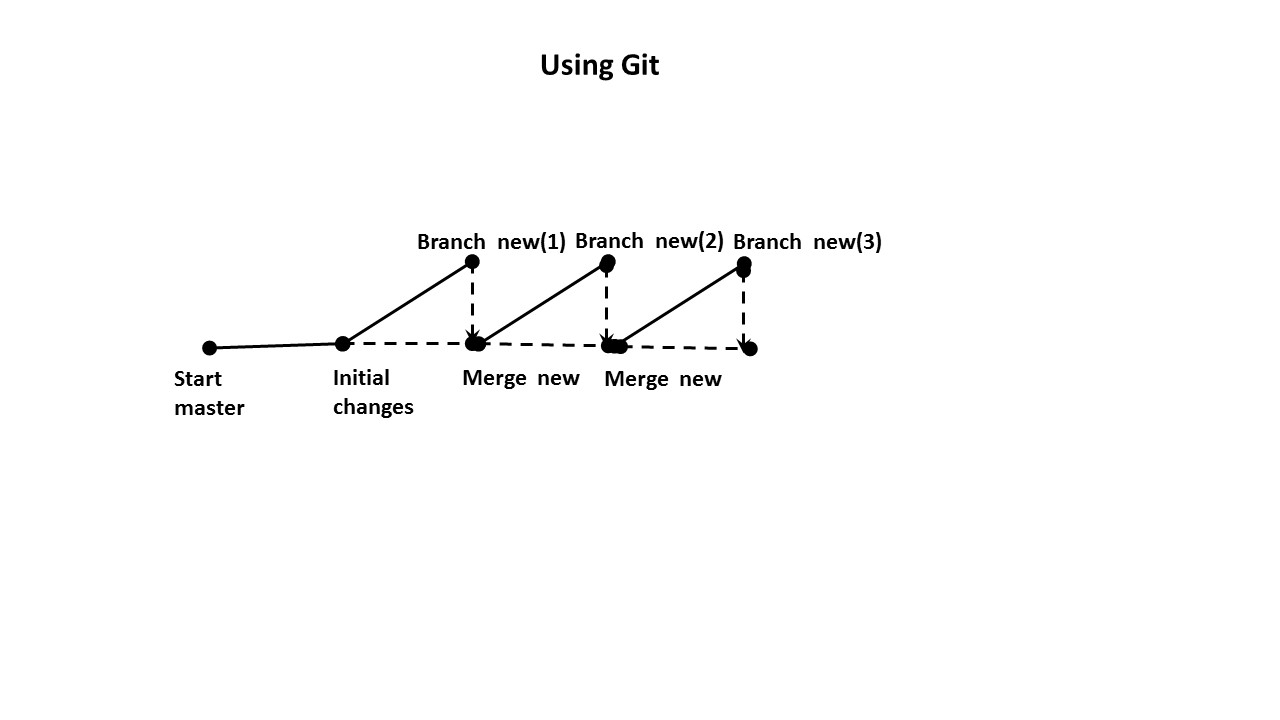
‘Git’ing from here to there:  Here is a trick that I learnt fairly recently, though it should have occurred to me more than 2 years back. This is using Git judiciously for all programming tasks (Note:  I am saying nothing new here!).  I find it really useful in writing code with incremental changes.  I create my initial code on the master and then test out incremental changes on a ‘new branch’ even for personal projects. Once I have proved a small increment works, I merge it with the ‘main’ branch. I again start working on the ‘new’ for the next incremental change followed by a merge to the master

The steps are

Make initial changes

1. git add  .
2. git commit –m “ Initial changes’

Create a new branch
3. git checkout –b ‘new

Make incremental changes. Test.
4.git add  .
5. git commit –m “Change 1”

Merge with the master
6.git checkout master
7. git merge new

Continue to work with ‘new’.
8 . git checkout new
9. Go to step 4)

This process can be continued till you get your final product. I find this extremely useful instead of just using an IDE to make code changes. Invariably you can run into a situation where you had something working some time back and in the next instant it is broken and you can’t figure out all the changes you made to the working code. This can be extremely frustrating. With Git you have a history of changes and you can switch to an earlier version of working code and start from there.

Rarely do I find a reason to have more than 1 branch

Here is a pictorial version of this
1

Taking help from Dr. Google: For most questions and errors that you encounter you will find others who have hit similar bugs. Just google it. You will more than surprised that others went down the exact same path that you are treading.  Besides the internet is full of tutorials, blogs and articles on key aspects of programming

Explore the cave of Stack overflow:   Spend time exploring Stack overflow. Stack overflow is replete with code snippets and questions that you wanted to ask. There is so much information out there. If you really don’t find an answer to your problem, post it in Stack overflow and you are bound to get an answer or a link to a similar question asked previously

Finally programming requires dollops of patience. Develop patience along with your skill in coding and soon programming will much more enjoyable to you.

1. Programming languages in layman’s language
2. The common alphabet of programming languages
3. How to program – Some essential tips
4. The mind of a programmer

You may also like
1. A crime map of India in R: Crimes against women
2.  What’s up Watson? Using IBM Watson’s QAAPI with Bluemix, NodeExpress – Part 1
3.  Bend it like Bluemix, MongoDB with autoscaling – Part 2
4. Informed choices through Machine Learning : Analyzing Kohli, Tendulkar and Dravid
5. Thinking Web Scale (TWS-3): Map-Reduce – Bring compute to data
6. Deblurring with OpenCV:Weiner filter reloaded

A crime map of India in R – Crimes against women

In this post I take a look at the gory crime scene across India to determine which states are the heavy weights in crimes. Who is the undisputed champion of rapes in a year? Which state excels in cruelty by husbands and the relatives to wives? Which state leads in dowry deaths? To get the answers to these questions I perform analysis of the state-wise crime data against women with the data  from Open Government Data (OGD) Platform India. The dataset  for this analysis was taken for the Crime against Women from OGD.

(Do see my post Revisiting crimes against women in India which includes an interactive Shiny app)

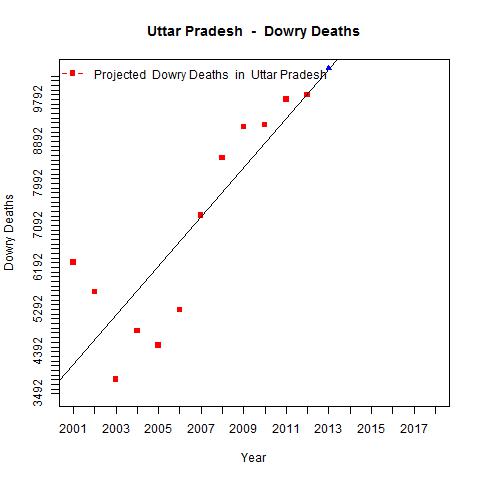
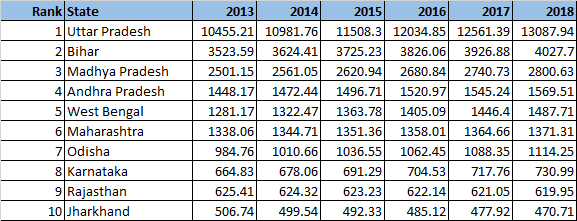
The data in OGD is available for crimes against women in different states under different ‘crime heads’ like rape, dowry deaths, kidnapping & abduction etc. The data is available for years from 2001 to 2012. This data is plotted as a scatter plot and a linear regression line is then fit on the available data. Based on this linear model,  the projected incidence of crimes likes rapes, dowry deaths, abduction & kidnapping is performed for each of the states. This is then used to build a table of  different crime heads for all the states predicting the number of crimes till the year 2018. Fortunately, R  crunches through the data sets quite easily. The overall projections of crimes against as women is shown below based on the linear regression for each of these states

Projections over the next couple of years
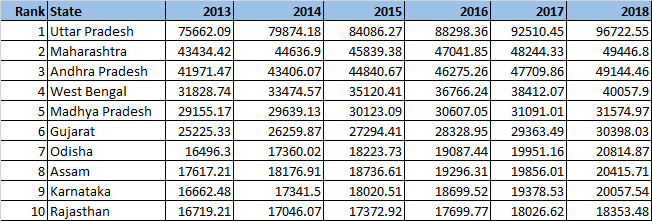
The tables below are based on the projected incidence of crimes under various categories assuming that these states maintain their torrid crime rate. A cursory look at the tables below clearly indicate the Uttar Pradesh is the undisputed heavy weight champion in 4 of 5 categories shown. Maharashtra and Andhra Pradesh take 2nd and 3rd ranks in the total crimes against women and are significant contenders in other categories too.

A) Projected rapes in India
The top 3 heavy weights in projected rapes over the next 5 years are 1) Madhya Pradesh  2) Uttar Pradesh 3) Maharashtra

rapes

Full table: Rape.csv
B) Projected Dowry deaths in India 
dowrydeaths

Full table: Dowry Deaths.csv
C) Kidnapping & Abduction
kidnapping

Full table: Kidnapping&Abduction.csv
D) Cruelty by husband & relatives
cruelty

Full table: Cruelty by husbands_relatives.csv
E) Total crimes against women

total

Full table: Total crimes.csv
Here is a visualization of ‘Total crimes against women’  created as a choropleth map

1The implementation for this analysis was done using the  R language.  The R code, dataset, output and the crime charts can be accessed at GitHub at crime-against-women

Directory structure
– R code
dataset used
output
statewise-crime-charts

The analysis has been completely parametrized. A quick look at the implementation is shown  below. A function state crime was created as given below

statecrime.R
This function (statecrime.R)  does the following
a) Creates a scatter plot for the state for the crime head
b) Computes a best linear regression fir and draws this line
c) Uses the model parameters (coefficients) to compute the projected crime in the years to come
d) Writes the projected values to a text file
c) Creates a directory with the name of the state if it does not exist and stores the jpeg of the plot there.

statecrime <- function(indiacrime, row, state,crime) {
year <- c(2001:2012)
# Make seperate folders for each state
if(!file.exists(state)) {
dir.create(state)
}
setwd(state)
crimeplot <- paste(crime,".jpg")
jpeg(crimeplot)

# Plot the details of the crime
plot(year,thecrime ,pch= 15, col="red", xlab = "Year", ylab= crime, main = atitle,
,xlim=c(2001,2018),ylim=c(ymin,ymax), axes=FALSE)

A linear regression line is fit using ‘lm’

# Fit a linear regression model
lmfit <-lm(thecrime~year)
# Draw the lmfit line
abline(lmfit)

The model parameters are then used to draw the line and also project for the next 5 years from 2013 to 2018

nyears <-c(2013:2018)
nthecrime <- rep(0,length(nyears))
# Projected crime incidents from 2013 to 2018 using a linear regression model
for (i in seq_along(nyears)) {
nthecrime[i] <- lmfit$coefficients[2] * nyears[i] + lmfit$coefficients[1]
}

The projected data for each state is appended into an appropriate file which is then used to display the tables at the top of this post

# Write the projected crime rate in a file
nthecrime <- round(nthecrime,2)
nthecrime <- c(state, nthecrime, "\n")
print(nthecrime)
#write(nthecrime,file=fileconn, ncolumns=9, append=TRUE,sep="\t")
filename <- paste(crime,".txt")
# Write the output in the ./output directory
setwd("./output")
cat(nthecrime, file=filename, sep=",",append=TRUE)

The above function is then repeatedly called for each state for the different crime heads. (Note: It is possible to check the read both the states and crime heads with R and perform the computation repeatedly. However, I have done this the manual way!)

crimereport.R
# 1. Andhra Pradesh
i <- 1
statecrime(indiacrime, i, "Andhra Pradesh","Rape")
i <- i+38
statecrime(indiacrime, i, "Andhra Pradesh","Kidnapping& Abduction")
i <- i+38
statecrime(indiacrime, i, "Andhra Pradesh","Dowry Deaths")
i <- i+38
statecrime(indiacrime, i, "Andhra Pradesh","Assault on Women")
i <- i+38
statecrime(indiacrime, i, "Andhra Pradesh","Insult to modesty")
i <- i+38
statecrime(indiacrime, i, "Andhra Pradesh","Cruelty by husband_relatives")
i <- i+38
statecrime(indiacrime, i, "Andhra Pradesh","Imporation of girls from foreign country")
i <- i+38
statecrime(indiacrime, i, "Andhra Pradesh","Immoral traffic act")
i <- i+38
statecrime(indiacrime, i, "Andhra Pradesh","Dowry prohibition act")
i <- i+38
statecrime(indiacrime, i, "Andhra Pradesh","Indecent representation of Women Act")
i <- i+38
statecrime(indiacrime, i, "Andhra Pradesh","Commission of Sati Act")
i <- i+38
statecrime(indiacrime, i, "Andhra Pradesh","Total crimes against women")
...
...

and so on for all the states

Charts for different crimes against women

1) Uttar Pradesh

The plots for  Uttar Pradesh  are shown below

Rapes in UP

Rape

Dowry deaths in UP

Dowry Deaths

Cruelty by husband/relative

Cruelty by husband_relatives

Total crimes against women in Uttar Pradesh

Total crimes against women

You can find more charts in GitHub by clicking Uttar Pradesh

2) Maharashtra : Some of the charts for Maharashtra

Rape

Rape

Kidnapping & Abduction

Kidnapping& Abduction

Total crimes against women in Maharashtra

Total crimes against women

More crime charts  for Maharashtra

Crime charts can be accessed for the following states from GitHub ( in alphabetical order)

3) Andhra Pradesh
4) Arunachal Pradesh
5) Assam
6) Bihar
7) Chattisgarh
8) Delhi (Added as an exception based on its notoriety)
9) Goa
10) Gujarat
11) Haryana
12) Himachal Pradesh
13) Jammu & Kashmir
14) Jharkhand
15) Karnataka
16) Kerala
17) Madhya Pradesh
18) Manipur
19) Meghalaya
20) Mizoram
21) Nagaland
22) Odisha
23) Punjab
24) Rajasthan
25) Sikkim
26) Tamil Nadu
27) Tripura
28) Uttarkhand
29) West Bengal

The code, dataset and the charts can be cloned/forked from GitHub at crime-against-women

Let me know if you find any interesting patterns in the data.
Thoughts, comments welcome!


See also
My book ‘Practical Machine Learning with R and Python’ on Amazon
A peek into literacy in India: Statiscal learning with R

You may also like
– Analyzing cricket’s batting legends – Through the mirage with R
– What’s up Watson? Using IBM Watson’s QAAPI with Bluemix, NodeExpress – Part 1
– Bend it like Bluemix, MongoDB with autoscaling – Part 1

How to program – Some essential tips

If one follows the arrow of time from the early 1980s to the present day, the number of programming problems have not only proliferated but have also become more difficult. Fortunately  programming in itself has  become more manageable with massive increases in computing horsepower, smarter tools and instant availability of information on the internet, typically with the click of a mouse.

Learning to program is no easy task, but can be done with the right mix of attitude, curiosity and interest. Becoming adept at programming, however, is something else. An interesting essay in this context is Peter Norvig’s ‘Teach yourself programming in 10 years’

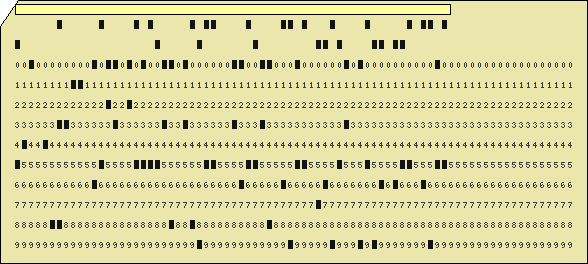
Back in the 1980s when I wrote my first Fortran program on my college Mainframe, programming was a lengthy exercise, spanning several days.

1

My first program was to plot a sine wave of characters on a computer printout. Running this program required the following several steps

  1. Enter the program on a teletype terminal and create a stack of Hollerith (punched) cards
  2. Submit the stack of cards to the computer center
  3. The computer center would do a batch execute in the evening on the Mainframe
  4. God forbid, if your program has a syntax error. If you did find an error, go back to step 1, the next day.
  5. Assuming everything is fine, the computer center would run your program and your output (printout) would be placed in the appropriate pigeon hole which you would need to pick up the next day.

The whole exercise to write a small-sized program could take anywhere between a couple of days to a whole week.

In the early 1990s things got a little better where one could code, compile, link and execute sitting at one’s desk. However while the programming itself got much simpler than before, certain tasks were still difficult.  Till the late 90s programs of any sort had to be written using a regular text editor (vi , emacs etc.)  You would then have to go through the process of compiling, linking and executing.

An angry compiler would typically spew forth venom at missing semi-colons, undeclared variables, and uninitialized values. This would happen till you are able to iron out all syntax errors.  Then you would link, get undefined symbols and have to include appropriate libraries etc. And then finally you would execute your code, only to have it crash. The process of debugging would then start.

Luckily technology has made life a whole lot easier except for the last step where you could still  run into an execution errors . In these days an IDE (Interactive Development Environment) like Eclipse will flag syntax errors, missing definitions/declarations etc. as you write your code. Moreover Eclipse can also indicate which libraries (imports) you would need to include in your package for it to build. The only missing step in IDEs of these days is the ability to predict possible execution errors in your program.  I wouldn’t be surprised, if in future, like Microsoft Word,  the IDE is able to tell you if a programming construct does not make sense.

So things have gotten a lot easier for the programmer. The following tips for are particularly useful as you progress along in programming

  1. These days when you are learning a new programming language it is not necessary to know the language from cover to cover by reading a book. In those days when we learnt C it was necessary to know everything from bit structures, macros, pragma etc. The reason being that every syntax or execution error one had to rush to get the textbook and thumb through it for the answer. Not so, in these days of Google. You have the world’s library at your fingertips.
  2. To get started it is necessary to learn just the most important programming constructs of the language say structure, class, car, cdr besides the usual suspects like loops, conditions and case constructs
  3. Download and install an IDE for the language. In most case Eclipse will work
  4. Try to write a simple program and test out your code.
  5. To do any sort of programming these days you will necessarily need to make 3 friends
    1. Google
    2. Stackoverflow
    3. Git & GitHub
  6. Honing your Googling skills is very important. There are answers to almost any sort of programming problems out there. You would be surprised to know that there are many others who did exactly the same stupid mistake that you did out there. Also googling will take you to interesting tutorials, blogs, articles that discuss different aspects of the programming language and the problem you are trying to solve
  7. Stackoverflow is really a God send to all programmers. There are so many questions on so many aspects of every programming language on earth there. If you spend time searching Stackoverflow you are bound to find answers, code snippets that you can readily use in your code
  8. Post your questions in stackoverflow when you don’t find the answers there. You are bound to get quick answers. Thanks to the gamification of Stackoverflow (points, upvotes,badges  etc) that has been created on Stackoverflow.
  9. Git & GitHub: I would suggest that you download and install GitHub for Windows. This will provide you with version control on your desktop. You can modify code while being to switch back to an earlier version with Git. Read up a good tutorial on Git for Windows
  10. Once you have working code you push it onto GitHub and share with other programmers

Now that you have the basic setup here are few other extremely important tips

  1. The most important criteria for programming is ‘attitude’. Initially you are bound to get frustrated, angry, irritated etc. But it is necessary to look at the errors that you get with the right attitude. Know that an error is telling you something. Usually the answers to your mistake are in the ‘error message’ itself. Look at it closely and try to understand it. You will learn a lot more when you learn from errors than from copy-pasting from somebody else’s code, even if works right the first time around!
  2. Make sure you do something different each time. As Einstein said “ If you keep doing the same thing, you will keep getting the same result’
  3. There are different ways to debug your code. You could use the debugger and single step through the code and keep checking the values of the variables. I personally prefer print statements to localize where things are going wrong. I then try to narrow down the problem to a few lines of code and try to take it apart.

Hopefully the above tips are useful. Programming can be creative activity and will be indispensable in our future.

Above all have fun coding, there are so many possibilities these days!

Also see

1. Programming languages in layman’s language
2. The common alphabet of programming languages
3. The mind of the programmer
4. Programming Zen and now – Some essential tips -2 

You may also like
1. A crime map of India in R: Crimes against women
2.  What’s up Watson? Using IBM Watson’s QAAPI with Bluemix, NodeExpress – Part 1
3.  Bend it like Bluemix, MongoDB with autoscaling – Part 2
4. Informed choices through Machine Learning : Analyzing Kohli, Tendulkar and Dravid
5. Thinking Web Scale (TWS-3): Map-Reduce – Bring compute to data
6. Deblurring with OpenCV:Weiner filter reloaded
Programming Zen and now – Some essential tips-2

Rock N’ Roll with Bluemix, Cloudant & NodeExpress

Published as a tutorial in IBM Cloudant – Bluemix tutorial and demos

In this post I create a  cloud application that is based on Bluemix, Cloudant DB and NodeExpress.  NodeExpress is used to perform DB operations on  CloudantDB

The code can be forked from Devops from bluemix-cloudant-exp. You can also clone the code from Github from bluemix-cloudant-exp

The following NodeExpress routes are created for performing the basic database operations

  1. a) Displaying the list of books
  2. b) Adding a book
  3. c) Updating a book and
  4. d) Deleting a book

1


Push the app to Bluemix

a) Push the app to Bluemix using
cf push bluemix-cloudant -p . -m 512M

b) In the Bluemix dashboard add the Cloudant service.

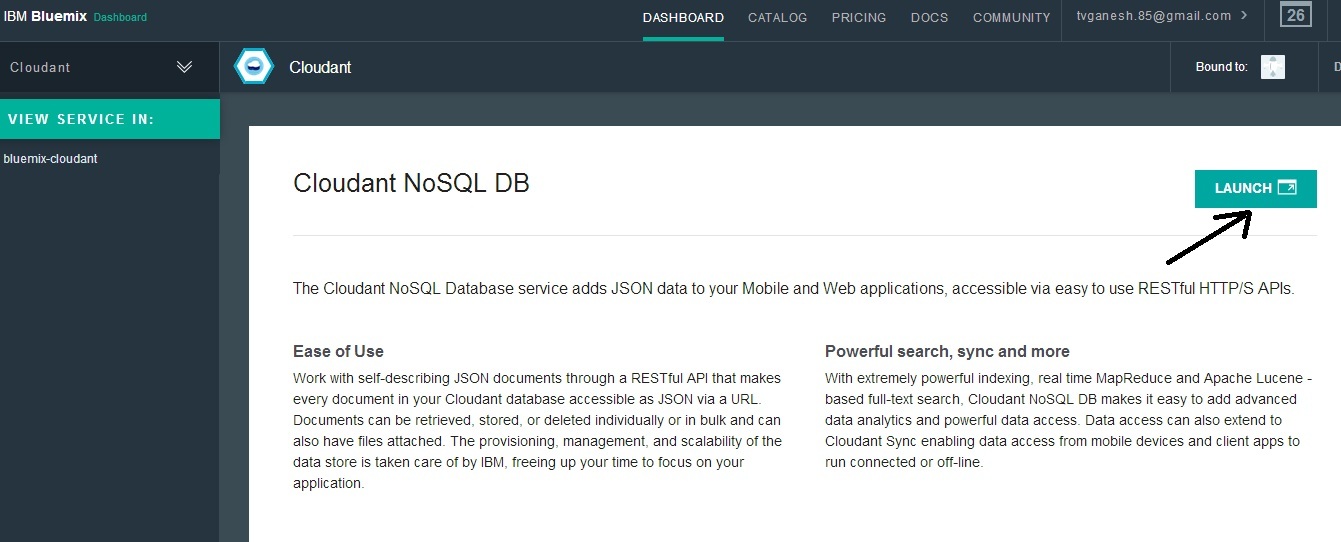
c) Double click the CloudantNoSQLDB

9

and then click the ‘Launch’ button. This will bring the WebSQL based version of Cloudant DB

10

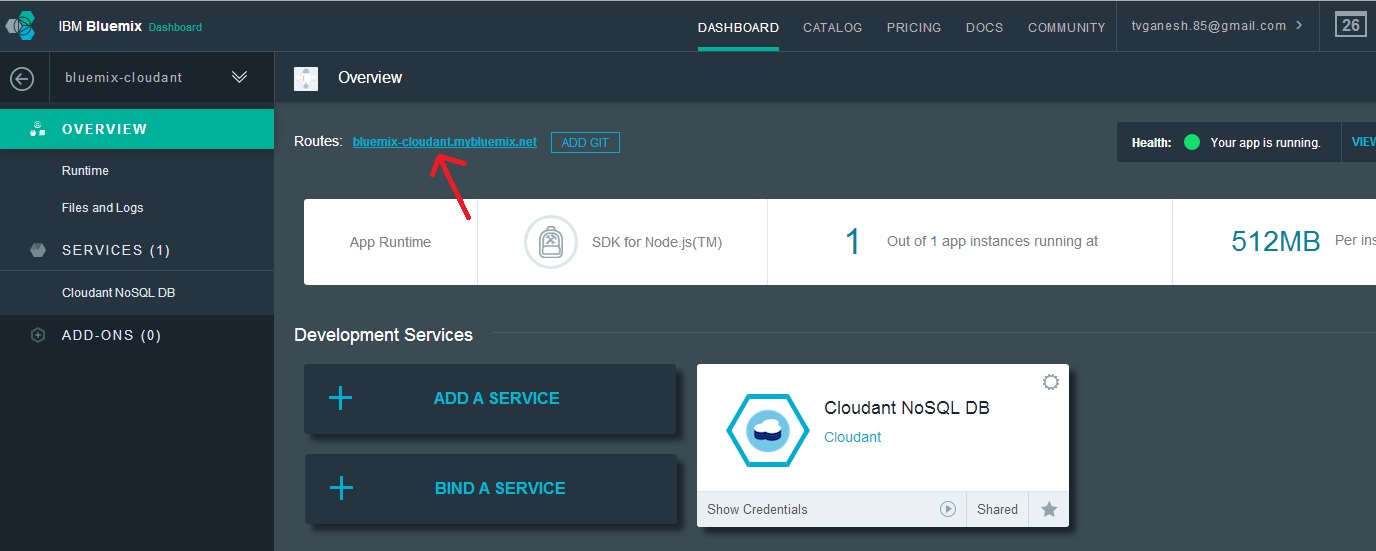
c) Next click the link bluemix-cloudant.mybluemix.net

11

This will start the Webserver and also populate the database.

e) This can be seen in the Cloudant Dashboard for the ‘test’ database which has 3 records shown below
12
The setup for these routes in the NodeExpress are as follows

app.get('/', routes.index);
app.get('/booklist', booklist.list);
app.get('/newbook', newbook.list);
app.post('/addbook',addbook.list);
app.get('/changebook', changebook.list);
app.post('/updatebook', updatebook.list);
app.get('/rembook', rembook.list);
app.post('/deletebook',deletebook.list);

Setting up the environment for Cloudant’s PouchDB

The first thing is to setup the environment for Cloudant’s Pouch DB by parsing the process.env environment variables as shown below

//Parse the process.env for the port and host that we've been assigned
if (process.env.VCAP_SERVICES) {
// Running on Bluemix. Parse the port and host that we've been assigned.
var env = JSON.parse(process.env.VCAP_SERVICES);
var host = process.env.VCAP_APP_HOST;
var port = process.env.VCAP_APP_PORT;
console.log('VCAP_SERVICES: %s', process.env.VCAP_SERVICES);
// Also parse Cloudant settings.
var cloudant = env['cloudantNoSQLDB'][0]['credentials'];
}
var db = new pouchdb('books'),
remote =cloudant.url + '/books';
opts = {
continuous: true
};
// Replicate the DB to remote
console.log(remote);
db.replicate.to(remote, opts);
db.replicate.from(remote, opts);

Displaying the list of books

Cloudant responds to DB queries as JSON messages. Hence to display the list of books the fields of each document is stored as an array and then displayed using the Jade table in booklist.jade  This is shown below

  1. a) booklist.js

var docs = db.allDocs(function(err, response) {
val = response.total_rows;
var details = "";
j=0;
var booklist = new Array(val);
for(i=0; i < val; i++) {
db.get(response.rows[i].id, function (err,doc){
j++;
booklist[j] = new Array(3);
booklist[j][0] = doc._id;
booklist[j][1] = doc.Title;
booklist[j][2] = doc.author;
details= details + JSON.stringify(doc.Title) + "  " +  JSON.stringify(doc.author) + "\n";
// Kludge because of Node.js asynchronous handling. To be fixed - T V Ganesh
if(j == val) {
res.render('booklist', {
"booklist" : booklist
});
}
}); // End db.get
} //End for
}); // End db.allDocs

  1. b) booklist.jade

The jade template simply displays the each booklist as a row in a table

block content
h1= "Display the list of books"
p
strong DocId  Title   Author
table
each book, i in booklist
tr
td #{book}
p
p
a(href='/') Home

2

Adding a book
To add a book the book details are obtained using the newbook.jade which display a form
block content
h1= "Add a book"
form#formAddBook(name="addbook",method="post",action="/addbook")
input#inputBookTitle(type="text", placeholder="Title", name="title")
input#inputBookAuthor(type="text", placeholder="Author", name="author")
button#btnSubmit(type="submit") submit
a(href='/') Home

With the values obtained from the form above a document is inserted into the books database as follows

// Get our form values. These rely on the "name" attributes
var Title = req.body.title;
var Author = req.body.author;
db.put({
author: Author,
Title : Title,
}, Title, function (err, response) {
console.log(err || response);
if (err) {
// If it failed, return error
res.send("There was a problem adding the information to the database.");
}
else {
// Redirect to booklist - Display booklist
res.location("booklist");
// And forward to success page
res.redirect("booklist");
}
});

Note: When inserting a document into the books database the docid for the document is set to be the same as the book Title itself

7

4

Updating a book

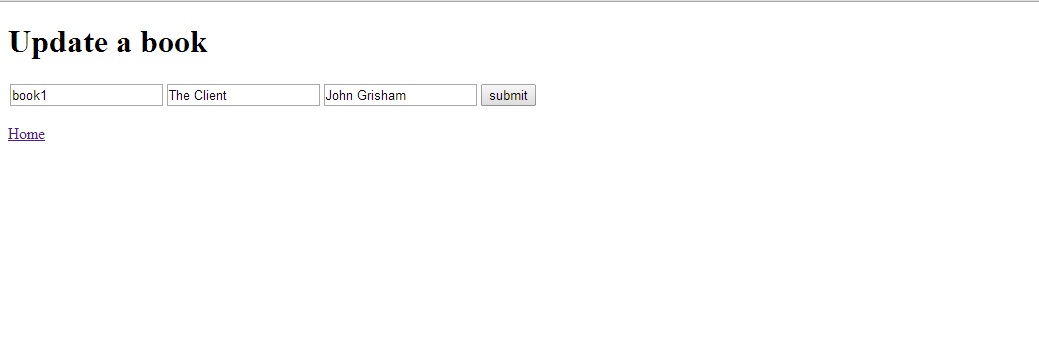
To update a document we need to input the document id. Also the document to be updated should use the “_rev” field which is obtained when we get the document. The values to be input are taken with the changeuser form

block content

h1= "Update a book"
form#formUpdateBook(name="addbook",method="post",action="/updatebook")
input#inputDocId(type="text", placeholder="DocId", name="docid")
input#inputBookTitle(type="text", placeholder="Title", name="title")
input#inputBookAuthor(type="text", placeholder="Author", name="author")
button#btnSubmit(type="submit") submit
a(href='/') Home

The values obtained are used to populate the document as follows

db.get(DocId, function(err, response) {
db.put({
_id: DocId,
_rev: response._rev,
author: Author,
Title : Title,
}, function(err, response) {
if (err) {
// If it failed, return error
res.send("There was a problem updating the information to the database.");
}
else {
// If it worked, redirect to display books
res.location("booklist");
// And forward to success page
res.redirect("booklist");
}
});
});

6

5

Deleting a document

To delete a document we need the document id which is taken with the rembook.jade form

block content
h1= "Delete a book"
form#formDeleteBook(name="addbook",method="post",action="/deletebook")
input#DocId(type="text", placeholder="DocId", name="docid")
button#btnSubmit(type="submit") submit
a(href='/') Home

//Deleting document book1
db.get(DocId, function(err, doc) {
db.remove(doc, function(err, response) {
if (err) {
// If it failed, return error
res.send("There was a problem removing the information to the database.");
}
else {
// Redirect to booklist
res.location("booklist");
// And forward to success page
res.redirect("booklist");
}
console.log(err || response);
});
});

In the diagram below docid ‘book3’ is deleted

13

8

Important tips

  1. If you run into issues while create a Jade template then do the following

npm install jade --g

You can check your jade template for correctness using

jade <name of jade template>

If the response is ‘rendered <name of jade template>.html’ then the template is fine.

  1. If there are problems with deploying the application or if the application crashes you check the cf logs as follows for the issue

cf logs <name of application> --recent

As mentioned the  code can be forked from Devops from bluemix-cloudant-exp. You can also clone the code from Github from bluemix-cloudant-exp

Disclaimer: This article represents the author’s viewpoint only and doesn’t necessarily represent IBM’s positions, strategies or opinions

See also

1. Brewing a potion with Bluemix, PostgreSQL & Node.js in the cloud
2. A Bluemix recipe with MongoDB and Node.js
3. Spicing up IBM Bluemix with MongoDB and NodeExpress
4. A Cloud Medley with IBM’s Bluemix, Cloudant and Node.js
Find me on Google+

A Cloud medley with IBM Bluemix, Cloudant DB and Node.js

Published as a tutorial in IBM Cloudant – Bluemix tutorial and demos

Here is an interesting Cloud medley based on IBM’s Bluemix PaaS platform, Cloudant DB and Node.js. This application  creates a Webserver using Node.js and uses REST APIs to perform CRUD operations on a Cloudant DB. Cloudant DB is a NoSQL Database as a service (DBaaS) that can handle a wide variety of data types like JSON, full text and geo-spatial data. The documents  are stored, indexed and distributed across a elastic datastore spanning racks, datacenters and perform replication of data across datacenters.Cloudant  allows one to work with self-describing JSON documents through  RESTful APIs making every document in the Cloudant database accessible as JSON via a URL.

This application on Bluemix uses REST APIs to perform the operations of inserting, updating, deleting and listing documents on the Cloudant DB.  The code can be forked from Devops at bluemix-cloudant. The code can also be clone from GitHub at bluemix-cloudant.

1) Once the code is forked the application can be deployed on to Bluemix using

cf login -a https://api.ng.bluemix.net
cf push bm-cloudant -p . -m 512M

2) After this is successful go to the Bluemix dashboard and add the Cloudant DB service.  The CRUD operations can be performed by invoking REST API calls using an appropriate REST client like SureUtils ot Postman in the browser of your choice.

Here are the details of the Bluemix-Cloudant application

3) Once the Cloudant DB service has been added to the Web started Node.js application we need to parse the process.env variable to obtain the URL of the Cloudant DB and the port and host to be used for the Web server.

The Node.js Webserver is started based on the port and host values obtained from process.env

require('http').createServer(function(req, res) {
//Set up the DB connection
if (process.env.VCAP_SERVICES) {
// Running on Bluemix. Parse for  the port and host that we've been assigned.
var env = JSON.parse(process.env.VCAP_SERVICES);
var host = process.env.VCAP_APP_HOST;
var port = process.env.VCAP_APP_PORT;
....
}
....
// Perform CRUD operations through REST APIs
// Insert document
if(req.method == 'POST') {
insert_records(req,res);
}
// List documents
else if(req.method == 'GET') {
list_records(req,res);
}
// Update a document
else if(req.method == 'PUT') {
update_records(req,res);
}
// Delete a document
else if(req.method == 'DELETE') {
delete_record(req,res);
}
}).listen(port, host);

2) Access to the Cloudant DB Access to Cloudant DB is obtained as follows

if (process.env.VCAP_SERVICES) {
// Running on Bluemix. Parse the port and host that we've been assigned.
var env = JSON.parse(process.env.VCAP_SERVICES);
var host = process.env.VCAP_APP_HOST;
var port = process.env.VCAP_APP_PORT;
console.log('VCAP_SERVICES: %s', process.env.VCAP_SERVICES);
// Also parse Cloudant settings.
var cloudant = env['cloudantNoSQLDB'][0]['credentials'];
}
var db = new pouchdb('books'),
remote =cloudant.url + '/books';
opts = {
continuous: true
};
// Replicate the DB to remote
console.log(remote);
db.replicate.to(remote, opts);
db.replicate.from(remote, opts);

Access to the Cloudant DB is through the cloudant.url shown above

3)  Once the access to the DB is setup we can perform CRUD operations. There are many options for the backend DB. In this application I have PouchDB.

4) Inserting a document: To insert documents into the Cloudant DB based on Pouch DB we need to do the following

var insert_records = function(req, res) {
//Parse the process.env for the port and host that we've been assigned
if (process.env.VCAP_SERVICES) {
// Running on Bluemix. Parse the port and host that we've been assigned.
var env = JSON.parse(process.env.VCAP_SERVICES);
var host = process.env.VCAP_APP_HOST;
var port = process.env.VCAP_APP_PORT;
console.log('VCAP_SERVICES: %s', process.env.VCAP_SERVICES);
// Also parse Cloudant settings.
var cloudant = env['cloudantNoSQLDB'][0]['credentials'];
}
var db = new pouchdb('books'),
remote =cloudant.url + '/books';
opts = {
continuous: true
};
// Replicate the DB to remote
console.log(remote);
db.replicate.to(remote, opts);
db.replicate.from(remote, opts);
// Put 3 documents into the DB
db.put({
author: 'John Grisham',
Title : 'The Firm'
}, 'book1', function (err, response) {
console.log(err || response);
});
...
...
res.writeHead(200, {'Content-Type': 'text/plain'});
res.write("3 documents is inserted");
res.end();
}; // End insert_records

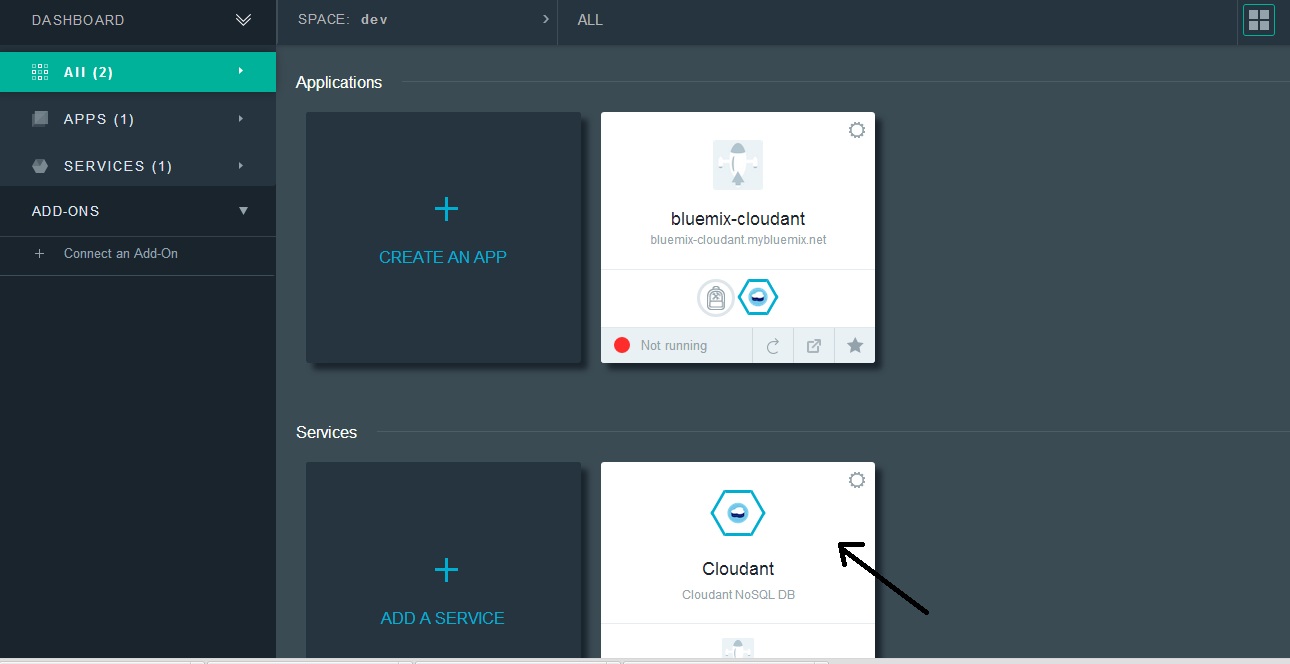
The nice part about Cloudant DB is that you can access your database through the URL. The steps are shown below. Once your application is running. Click on your application. You should see the screen as below.

1

Click on Cloudant as shown by the arrow.

Next click on the “Launch’ icon

2

This should bring up the Cloudant dashboard. The database will be empty.

3

If you use a REST API Client to send a POST API call then the Application will insert 3 documents.

4

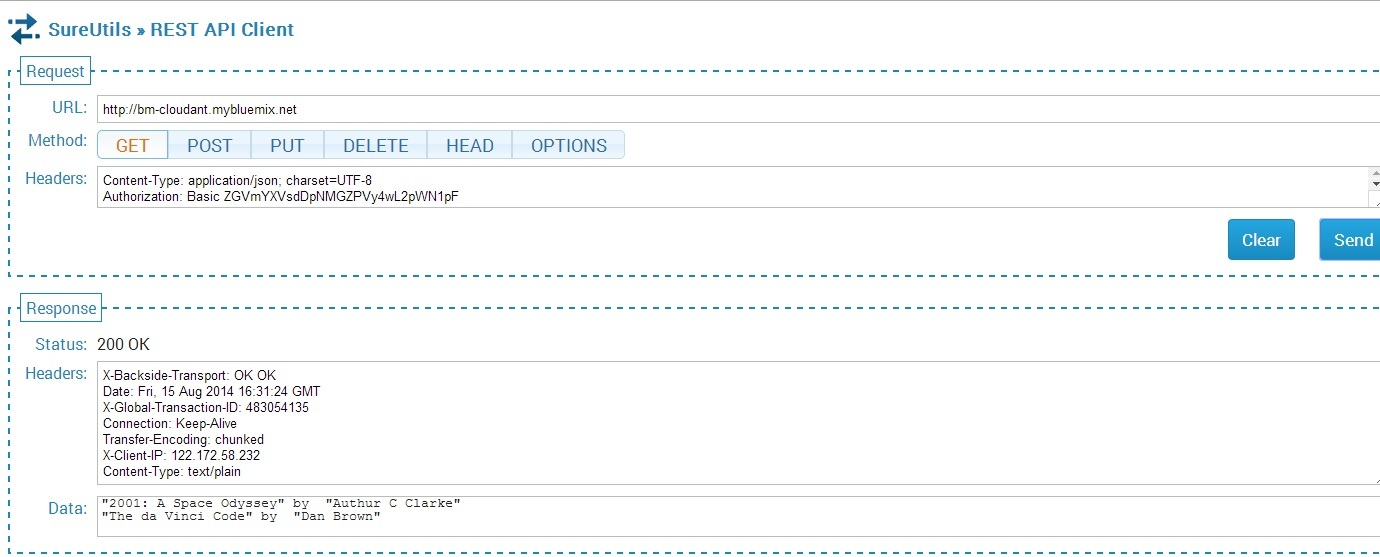
The documents inserted can be seen by sending the GET REST API call.

5

The nice part of Cloudant DB is that you can use the URL to see your database. If you refresh your screen you should see the “books” database added. Clicking this database you should see the 3 documents that have been added

6

If you click “Edit doc” you should see the details of the document

7

5) Updating a document

The process to update a document in the database is shown below

// Update book3
db.get('book3', function(err, response) {
console.log(response);
return db.put({
_id: 'book3',
_rev: response._rev,
author: response.author,
Title : 'The da Vinci Code',
});
}, function(err, response) {
if (err) {
console.log("error " + err);
} else {
console.log("Success " + response);
}
});

This is performed with a PUT REST API call

8

The updated list is shown below

9

This can be further verified in the Cloudant DB dashboard for book3.

10

6) Deleting a document

The code to delete a document in PouchDB is shown below

//Deleting document book1
db.get('book1', function(err, doc) {
db.remove(doc, function(err, response) {
console.log(err || response);
});
});

The REST calls to delete a document and the result  are shown below

11

12

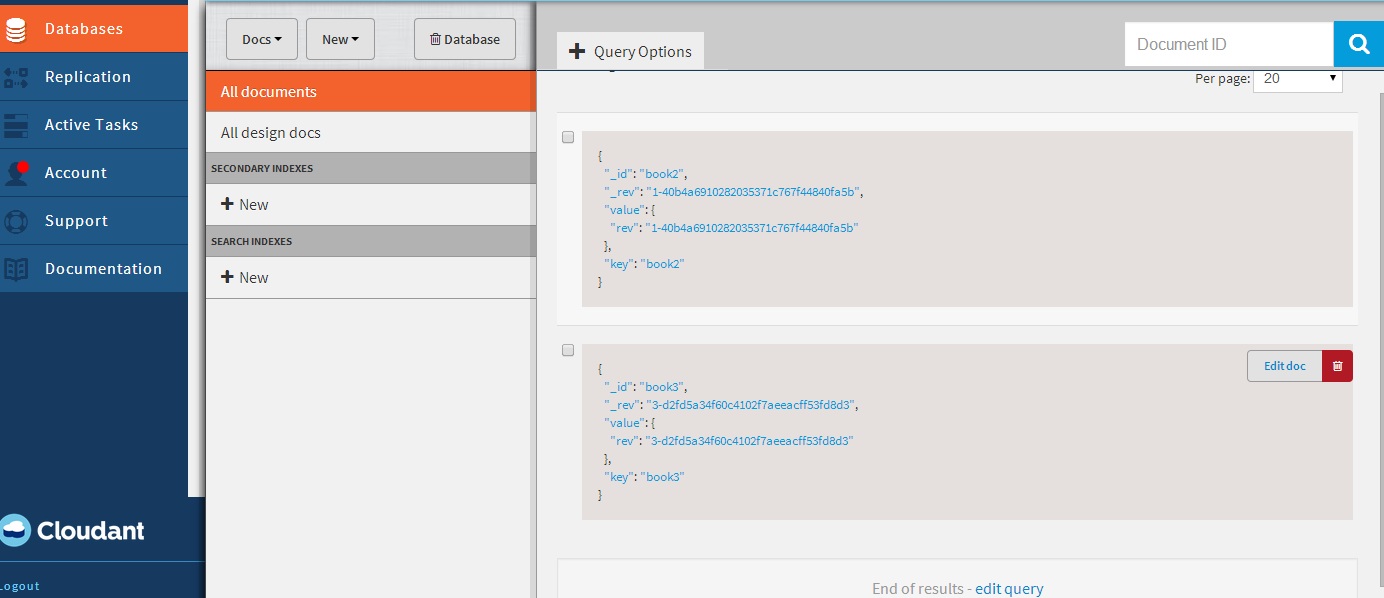
Checking the Cloudant dashboard we see that only book2 & book3 are present and book1 has been deleted

13

7) Displaying documents in the database

The code for displaying the list of documents is shown below

var docs = db.allDocs(function(err, response) {
val = response.total_rows;
var details = "";
j=0;
for(i=0; i < val; i++) {
db.get(response.rows[i].id, function (err,doc){
j++;
details= details + JSON.stringify(doc.Title) + " by  " +  JSON.stringify(doc.author) + "\n";
// Kludge because of Node.js asynchronous handling. To be fixed - T V Ganesh
if(j == val) {
res.writeHead(200, {'Content-Type': 'text/plain'});
res.write(details);
res.end();
console.log(details);
}
}); // End db.get
} //End for
}); // End db.allDocs

If you happened to notice, I had to use a kludge to work around Node.js’ idiosyncracy of handling asynchronous calls. I was fooled by the remarkable similarity of Node.js & hence  javascript to C language that I thought functions within functions would work sequentially. However I had undergo much grief  trying to get Node.js to work sequentially. I wanted to avoid the ‘async’ module but was unsuccessful with trying to code callbacks. So the kludge! I will work this out eventually but this workaround will have to do for now!

As always you can use the “Files and Logs” in the Bluemix dashboard to get any output that are written to stdout.

Note: As always I can’t tell how useful the command
'cf  logs <application name> -- recent is for debugging.

Hope you enjoyed this Cloud Medley of Bluemix, Cloudant and Node.js!

Disclaimer: This article represents the author’s viewpoint only and doesn’t necessarily represent IBM’s positions, strategies or opinions

You may also like
1. Brewing a potion with Bluemix, PostgreSQL & Node.js in the cloud
2.  A Bluemix recipe with MongoDB and Node.js
3.  Spicing up IBM Bluemix with MongoDB and NodeExpress
4.  Rock N’ Roll with Bluemix, Cloudant & NodeExpress


Find me on Google+

Spicing up a IBM Bluemix cloud app with MongoDB and NodeExpress

In this post I highlight the rudiments for a creating a cloud application on IBM’s PaaS offering Bluemix, using MongoDB and NodeExpress.   Clearly Bluemix allows one to fire up a cloud application with a NoSQL database in a matter of  a few hours which makes it really attractive. The NodeExpress  application was initially created using Enide Studio for Node.js  with a local Mongodb server running on my desktop. (Please see my post Elements of CRUD with Node Express and MongoDB) Once you have ironed out the issues in this local application you are ready to deploy on IBM Bluemix.

The code for this Bluemix application can be forked from bluemix-mongo from IBM Devops.

You can also clone the code from GitHub at bluemix-mongo

Here are the key changes that need to be made for running the NodeExpress Webserver with MongoDB as the backend DB

1) Webserver : Setup the port and host for the Webserver.

  1. app.js

var port = (process.env.VCAP_APP_PORT || 1337);
var host = (process.env.VCAP_APP_HOST || '0.0.0.0');
var app = express();
app.configure(function(){
app.set('port', port);

As seen above the host & port for the Webserver are obtained from the process.env variable.
2) Routes and Middleware
Setup the routes and invoke them appropriately in app.js
var express = require('express')
, routes = require('./routes')
, user = require('./routes/user')
, userlist = require('./routes/userlist')
, newuser = require('./routes/newuser')
, adduser = require('./routes/adduser')
, changeuser = require('./routes/changeuser')
, updateuser = require('./routes/updateuser')
, remuser = require('./routes/remuser')
, deleteuser = require('./routes/deleteuser')

app.get('/users', user.list);
app.get('/helloworld', routes.index);
app.get('/userlist', userlist.list);
app.get('/newuser', newuser.list);
app.post('/adduser',adduser.list);
app.get('/changeuser', changeuser.list);
app.post('/updateuser', updateuser.list);
app.get('/remuser', remuser.list);
app.post('/deleteuser',deleteuser.list);

3) Initialize MongoDB database: Create a set of 3 records when the Webserver starts as follows

if (process.env.VCAP_SERVICES) {
var env = JSON.parse(process.env.VCAP_SERVICES);
if (env['mongodb-2.2']) {
var mongo = env['mongodb-2.2'][0]['credentials'];
}
} else {
var mongo = {
"username" : "user1",
"password" : "secret",
"url" : "mongodb://user1:secret@localhost:27017/test"
}
}
var MongoClient = mongodb.MongoClient;
var db= MongoClient.connect(mongo.url, function(err, db) {
if(err) {
log("failed to connect to the database");
} else {
log("connected to database");
}
var collection = db.collection('phonebook');
//Clear DB and insert 3 records
remove(mycallback);
var user1 = { "FirstName" : "Tinniam", "LastName" : "Ganesh","Mobile": "916732177728" };
var user2 = { "FirstName" : "Darth", "LastName" : "Vader","Mobile": "6666699999" };
var user3 = { "FirstName" : "Bill", "LastName" : "Shakespeare","Mobile": "8342189991" };

  1. insert(user1,function(err,result){});
  2. insert(user2,function(err,result){});
  3. insert(user3,function(err,result){});
  4. find().toArray(function(err, items) {

});
});

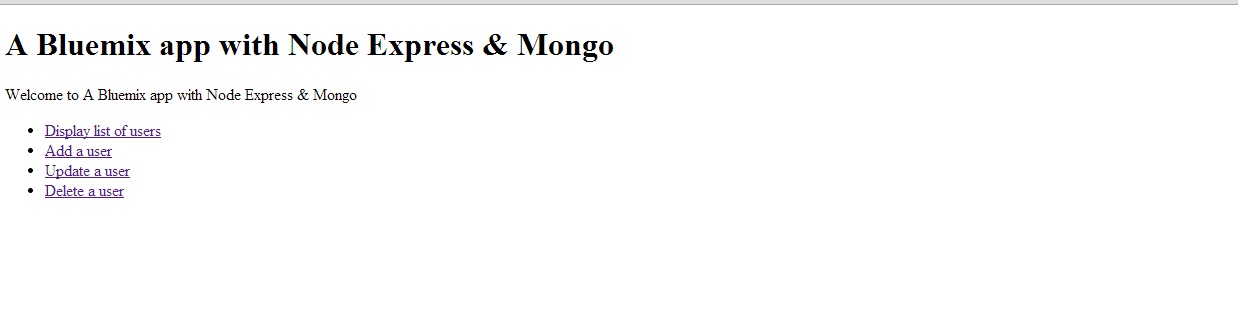
3) Home Page: Setup up a Home page with the CRUD operations when the Bluemix cloud application’s route  for e.g. http://bluemix-mongo.mybluemix.net is clicked. This is shown below.

1


2

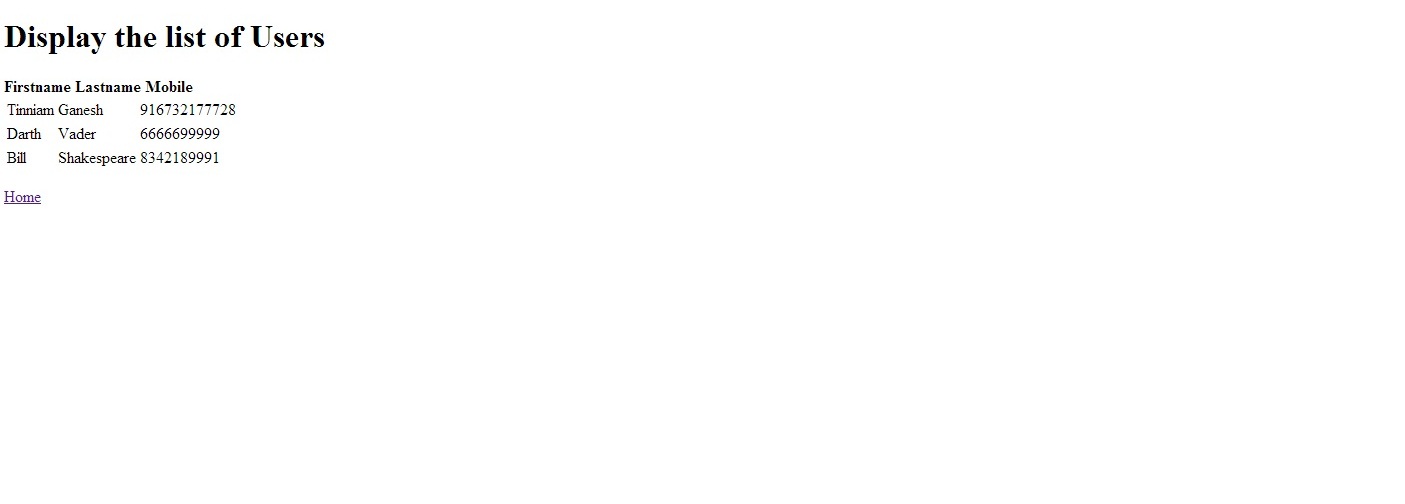
4) Display Users: To display the list of users the route /userlist is invoked. This function gets all the records from the collection and stores them into a toArray element, which is then used for rendering the list of uses with a ‘userlist.jade’ template

userlist.js
var MongoClient = mongodb.MongoClient;
var db= MongoClient.connect(mongo.url, function(err, db) {
if(err) {

  1. log(“Failed to connect to the database”);

} else {

  1. log(“Connected to database”);

}
var collection = db.collection(‘phonebook’);
//Get all records and display them

  1. find().toArray(function(err, items) {
  2.    log(items);
  3. render(‘userlist’, {

“userlist” : items
});
});
});

  1. jade

This template displays the list of users as a table. The code is shown below

extends layout
block content
h1= "Display the list of Users"
p
strong Firstname Lastname   Mobile
table
each user, i in userlist
tr
td #{user.FirstName}
td #{user.LastName}
td #{user.Mobile}
p
p
a(href='/') Home

Note: A link back to the Home page is included in here at the bottom.

7


5) Adding a User
There are 2 parts to this
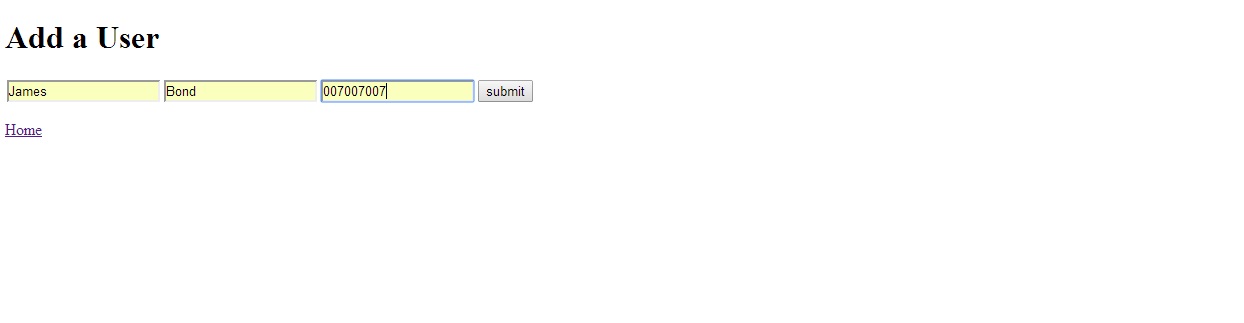
a) Invoking the /newuser route to display the input form through the newuser.jade
b) Invoking the /adduser route to insert the values entered in the form. The changes are shown below
a) app.js
..
newuser = require('./routes/newuser')
adduser = require('./routes/adduser')
..
app.get('/newuser', newuser.list);
app.post('/adduser',adduser.list);

b) newuser.js
exports.list = function(req, res){

  1. render(‘newuser’, { title: ‘Add User’});

};

The newuser jade displays the input form
c) newuser.jade
extends layout
block content
h1= "Add a User"
form#formAddUser(name="adduser",method="post",action="/adduser")
input#inputUserFirstName(type="text", placeholder="firstname", name="firstname")
input#inputUserLastName(type="text", placeholder="lastname", name="lastname")
input#inputUserLastName(type="text", placeholder="mobile", name="mobile")
button#btnSubmit(type="submit") submit
p
p
a(href='/') Home

3

d) adduser.js

The adduser.js gets the mongo url from the process.env.VCAP_SERVICES and  setups up the connection to the DB and inserts the values received in the ‘newuser.jade’ form into the database

exports.list = function(req, res) {
if (process.env.VCAP_SERVICES) {
var env = JSON.parse(process.env.VCAP_SERVICES);
if (env['mongodb-2.2']) {
var mongo = env['mongodb-2.2'][0]['credentials'];
}
} else {
var mongo = {
"username" : "user1",
"password" : "secret",
"url" : "mongodb://user1:secret@localhost:27017/test"
}
}
// Set up the DB connection
var MongoClient = mongodb.MongoClient;
var db= MongoClient.connect(mongo.url, function(err, db) {
if(err) {

  1. log(“Failed to connect to the database”);

} else {

  1. log(“Connected to database”);

}
// Get our form values. These rely on the “name” attributes
var FirstName = req.body.firstname;
var LastName = req.body.lastname;
var Mobile = req.body.mobile;
// Set our collection
var collection = db.collection(‘phonebook’);
// Insert the record into the DB

  1. insert({

“FirstName” : FirstName,
“LastName” : LastName,
“Mobile” : Mobile
}, function (err, doc) {
if (err) {
// If it failed, return error

  1. send(“There was a problem adding the information to the database.”);

}
else {
// Redirect to userlist – Display users

  1. location(“userlist”);

// And forward to success page

  1. redirect(“userlist”);

}
});
});

If the insert is successful the userlist page is displayed with the new user

4

6) Updating a User & Deleting a User: Updating and Deleting users follow the same format as Adding a user.

7) index.jade The Home page is built using index.jade with a hyperlink invoking the route for each database operation
extends layout
block content
h1= title
p Welcome to #{title}
ul
li
a(href='/userlist') Display list of users
li
a(href='/newuser') Add a user
li
a(href='/changeuser') Update a user
li
a(href='/remuser') Delete a user

Tip: “Return of the Jadei : Getting the jade template right is truly an art as Jade is extremely finicky about spaces, tabs, indents and outdents(???). Creating the Jade template had me run into circles. I found out that you can debug the jade template individually by executing

C:> npm install jade -g"
and then  running
C:> jade <template name>

from the command prompt. If the result of the command is “rendered <template name>.html” then you are in luck and you can incorporate this jade template into your views folder for e.g.

C: >jade index.jade
rendered index.html

8) Push changes to Bluemix: Once the changes have been made push the changes on to Bluemix with ‘cf’ as follows

cf login -a https://api.ng.bluemix.net
cf push bluemix-mongo -p . -m 512M
cf create-service mongodb 100 mongodb01
cf bind-service bluemix-mongo mongodb01


The last 2 commands can also be performed through the Bluemix dashboard in which you add the mongodb service to your Node.js app/

8) Files and Logs: In the Bluemix dashboard you can check your logs in the Files and Logs

5


6

Important tip: Finally if the application fails to start when you  push the application with ‘cf’ for e.g.

cf push <app name> -p . -m 512M
....
.....
----> Writing a custom .npmrc to circumvent npm bugs
----> Installing dependencies
----> Caching node_modules directory for future builds
----> Cleaning up node-gyp and npm artifacts
----> No Procfile found; Adding npm start to new Procfile
----> Building runtime environment
----> Checking and configuring service extensions
----> Uploading droplet (7.6M)
of 1 instances running, 1 down

or if  it crashes when you click a link then your debugging friend is

cf logs <app name > — recent
This will dump the error that was encountered either while the application was being started of why the application crashed.

You can fork this Bluemix application from bluemix-mongo at  IBM Devops or from GitHub at bluemix-mongo

Disclaimer: This article represents the author’s viewpoint only and doesn’t necessarily represent IBM’s positions, strategies or opinions

You may also like
1. Brewing a potion with Bluemix, PostgreSQL & Node.js in the cloud
2. A Bluemix recipe with MongoDB and Node.js
3. A Cloud Medley with IBM’s Bluemix, Cloudant and Node.js
4. Rock N’ Roll with Bluemix, Cloudant & NodeExpress


Find me on Google+

Simulating an Edge Shape in Android

Here is a small post on how I managed to simulate an Edge Shape in Android. I wanted to do this after I saw the Java demo of Box2D in JBox2D(see RayCast). For the Edge Shape I chose a cosine curve. I used the same method I used, mentioned in my earlier post “Making of the Total Control Android Game

The simulation can be seen at Simulating an Edge Shape on YouTube
You can clone the entire project from Github at EdgeShape.

Since it is a cosine curve I place a ball shape for every point on a cosine function, close to each other to seem continuous and create a body from the Sprite with physical properties.

for (int i = 0; i < nBodies; ++i)

{

float angle = (float) ((10.0 * PI * i)/180.0);

float y1 = 300 + (float)Math.cos(angle/20) * 120;

//Log.d(“Test”,”Test” + “x:” + x1 +”y:”+ y1);

circles[i] = new Sprite(x1, y1, this.mBallTextureRegion, this.getVertexBufferObjectManager());

circlesBody[i] = PhysicsFactory.createCircleBody(this.mPhysicsWorld, circles[i], BodyType.StaticBody, FIXTURE_DEF);

this.mScene.attachChild(circles[i]);

x1 = (float) (x1 + 0.5);

}

So this can be done for every mathematical curve. I also intended to create other curves like the Archimedes Spiral and the Lemniscate. Maybe I will leave that for a rainy day!! 🙂

However, I am not sure how to create a irregular edge shape. I will probably figure that out.

The egde shape is made to be a STATIC_BODY. I then took code of creating Animated Sprites at the point where I touch from AndEngine examples (PhysicsExample.java). To make the simulation more fun I also added a Linear Impulse to the Animated Sprite.

face = new AnimatedSprite(pX, pY, this.mCircleFaceTextureRegion, this.getVertexBufferObjectManager());

body = PhysicsFactory.createCircleBody(this.mPhysicsWorld, face, BodyType.DynamicBody, gameFixtureDef);

face.animate(200);

body.applyLinearImpulse(-200,200,pX,pY);

The effect is better if the phone is horizontal to the ground and not so great if the phone is kept vertical and the bodies do not seem to shoot off.

The simulation can be seen at Simulating an Edge Shape

You can clone the entire project from Github at EdgeShape.


Take a look at some cool simulations using AndEngine & Box2D
1. Simulating the domino effect using Box2D and AndEngine
2. Blob with an attitude(stiffness) in Android
3. The making of Total Control Android game
4. Simulating a Web Joint in Android
20. A closer look at “Robot horse on a Trot! in Android”
and many more …
Find me on Google+

Bull in a china shop – Behind the scenes in Android

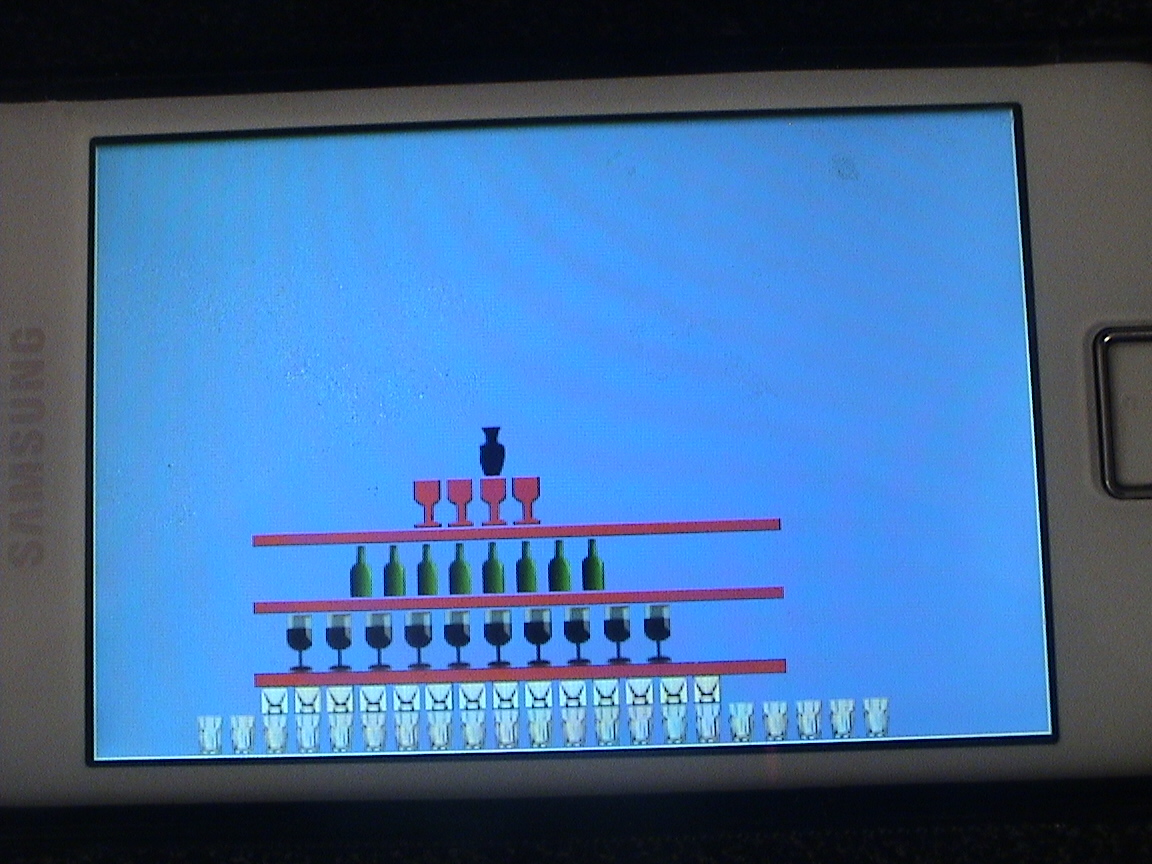
DSC00032Here are the details about how I constructed the “Bull in a china shop” demo. For this demo I used Box2D physics engine and AndEngine to make the demo. I decided to use sprites for the china shop and picked up images of glasses, wine glasses, bottles etc from www.openclipart.org.

Be extremely careful when creating the TextureRegion using BitmapTextureAtlas. If you don’t get the co-ordinates right the display can be weird.

Here are 2 clips of Bull in a China Shop demo
1.Bull in a china shop in Moon’s gravity
2.Bull in a china shop in Earth’s gravity
The code for this can be cloned  from Github from Bulldozed

Here is a snippet of this

this.mBitmapTextureAtlas = new BitmapTextureAtlas(this.getTextureManager(), 556, 246, TextureOptions.BILINEAR);
this.mTumblerTextureRegion = BitmapTextureAtlasTextureRegionFactory.createFromAsset(this.mBitmapTextureAtlas, this, "tumblr.png", 0, 0);
this.mBitmapTextureAtlas.load();
this.mBottleTextureRegion = BitmapTextureAtlasTextureRegionFactory.createFromAsset(this.mBitmapTextureAtlas, this, "bottle.png",20, 29);
this.mBitmapTextureAtlas.load();
this.mGlassTextureRegion = BitmapTextureAtlasTextureRegionFactory.createFromAsset(this.mBitmapTextureAtlas, this, "glass.png",36, 69);
this.mBitmapTextureAtlas.load();
this.mVaseTextureRegion = BitmapTextureAtlasTextureRegionFactory.createFromAsset(this.mBitmapTextureAtlas, this, "vase.png",56, 89);
this.mBitmapTextureAtlas.load();
...
...

This is very important to get right otherwise you are setting yourself for a lot of grief.

Superficially the demo looks real easy. It appears that creating a pyramid stack should be a breeze as long as you get the coordinates right. Wrong! Building a pyramid using Box2D with the effect of gravity can be a real challenge as I found out. I would build two stacks and the stack would become unstable and collapse.

Anyway here are the findings

  1. Each row is not placed directly over the object below. I leave a gap of 2 px between them The reason is the object below exerts a force ‘F’ upward. The object above exerts a force ‘mg” below and the physics engine tries to resolve this difference in forces and causes instability in the structure. So the key is a to leave a small gap in between
  2. Now that there is a gap between 2 rows the coefficient of restitution ‘e’ is made 0. Even a value as small as 0.1f can make the objects jitter and cause instability.
  3. The friction between the platform and the objects or the objects themselves is made maximum equal to 1.0f to prevent sliding of the objects.

// Add tumblers
for(int i=0; i < 21; i++) {
tumbler = new Sprite(80 + i * 25, 450, this.mTumblerTextureRegion, this.getVertexBufferObjectManager());
FIXTURE_DEF = PhysicsFactory.createFixtureDef(1f, 0.0f, 1f);
tumblerBody = PhysicsFactory.createBoxBody(this.mPhysicsWorld, tumbler, BodyType.DynamicBody, FIXTURE_DEF);
this.mPhysicsWorld.registerPhysicsConnector(new PhysicsConnector(tumbler, tumblerBody, true, true));
this.mScene.attachChild(tumbler);
}

// Add glasses
for(int i=0; i < 14; i++) {
glass = new Sprite(130 + i * 25, 428, this.mGlassTextureRegion, this.getVertexBufferObjectManager());
FIXTURE_DEF = PhysicsFactory.createFixtureDef(1f, 0.0f, 1f);
glassBody = PhysicsFactory.createBoxBody(this.mPhysicsWorld, glass, BodyType.DynamicBody, FIXTURE_DEF);
this.mPhysicsWorld.registerPhysicsConnector(new PhysicsConnector(glass, glassBody, true, true));
this.mScene.attachChild(glass);
...
...

Hopefully if you get everything right you should have a stable structure. I had to do this through trial and error before I got it finally right. Whew!

Once you get a stable structure with the proper sprites in place most of the problem is solved. For the last part I add a bull sprite and set it off at a velocity from the point of touch.

bull = new Sprite(pX, pY, this.mBullTextureRegion, this.getVertexBufferObjectManager());
FIXTURE_DEF = PhysicsFactory.createFixtureDef(25f, 0.0f, 1f);
Log.d("here","here");
bullBody = PhysicsFactory.createBoxBody(this.mPhysicsWorld, bull, BodyType.DynamicBody, FIXTURE_DEF);
if(pX > 360)
bullBody.setLinearVelocity(-5,-5);
else
bullBody.setLinearVelocity(5,5);

DSC00031

Note: Since the sprites are not regular shapes I had to use a box shape. So the collisions are not pixel perfect.
Make sure you set up your project properly in Eclipse. The important settings are
Project->Properties->Android->Android4.2
Project->Properties->Java Compiler: Check the “Enable project specific setting” and also set compiler compliance level to 1.6
Finally click Project->Properties->Android: Under Library click ‘Add’ and add AndEngine and AndEnginePhysicsBox2DExtension
and you are good to go.

Here are 2 clips of Bull in a China Shop demo

1.Bull in a china shop in Earth’s gravity

2.Bull in a china shop in Moon’s gravity

You can clone the project from Github from Bulldozed

Have fun …

Other cool simulations using AndEngine & Box2D
1. Simulating the domino effect using Box2D and AndEngine
2. The making of Total Control Android game
3. Simulating a Web Joint in Android
4. Modeling a Car in Android
5. A closer look at “Robot horse on a Trot! in Android”

Find me on Google+

A Github Primer

This post gives some of the basic commands to get started on Git Hub. GitHub is the Open source source code management system that enables anybody to share code, projects, and work on other open source projects. The beauty of GitHub lies in its simplicity. A very good tutorial is given at Git Reference

I found that the using Git Hub on Linux command line is extremely simple and straight forward. This article gives the steps to push your project on to the Git Hub repository hosted on the web.

1) To get started create a GitHub account at https://github.com. Sign up for an account with your details.

2) On the GitHub page create a repository. This will be the icon next to your user account with a ‘+” sign. Let’s say I create a repository called ‘unity’

3) On Fedora Linux you can install git using the following command as root

$yum install git-core

4) Once git is installed it is a good idea to set your name and your email with commands below

$ git config –global user.name ‘tvganesh’
$ git config –global user.email tvganesh.85@gmail.com

5) Change to the directory which contains your project files .
cd unity

6) Setup for git using
git init
Initialized empty Git repository in /home/tvganesh/git/unity/.git/

7) You can check that Git has been initialized as follows which will show up a .git file
ls -a
. .. .git unity

8) Check the status of the git uodate with
git status -s
?? unity/

9) Add all the files and folders in your project directory recursively to the staging area with

git add .

10) Check that all the files & folders are in the staging area by checking the status again
git status -s
A unity/.classpath
A unity/.project
A unity/.settings/org.eclipse.jdt.core.prefs
A unity/AndroidManifest.xml
A unity/bin/jarlist.cache
A unity/ic_launcher-web.png
A unity/libs/android-support-v4.jar

The A shows that the files have been added to the staging area

11) A more detailed status check is below

[tvganesh@localhost unity]$ git status
# On branch master
#
# Initial commit
#
# Changes to be committed:
# (use “git rm –cached <file>…” to unstage)
#
# new file: unity/.classpath
# new file: unity/.project
# new file: unity/.settings/org.eclipse.jdt.core.prefs
# new file: unity/AndroidManifest.xml
# new file: unity/bin/jarlist.cache
# new file: unity/ic_launcher-web.png
# new file: unity/libs/android-support-v4.jar

12) Now commit the files to the local repository with the command below

git commit -m “Unity – Unit converter code”
[master (root-commit) aedab49] Unity – Unit converter code
39 files changed, 2068 insertions(+), 0 deletions(-)
create mode 100644 unity/.classpath
create mode 100644 unity/.project
create mode 100644 unity/.settings/org.eclipse.jdt.core.prefs
create mode 100644 unity/AndroidManifest.xml
create mode 100644 unity/bin/jarlist.cache

13) Check the status again which shows all files commmitted to the repository

git status
# On branch master
nothing to commit (working directory clean)

14) Create an alias for the remote GitHub repository
git remote add unity https://github.com/tvganesh/unity.git

15) Push your local repository to GitHub
git push unity master
Username:
Password:
Counting objects: 56, done.
Delta compression using up to 2 threads.
Compressing objects: 100% (48/48), done.
Writing objects: 100% (56/56), 430.66 KiB, done.
Total 56 (delta 12), reused 0 (delta 0)
To https://github.com/tvganesh/unity.git
* [new branch] master -> master

Check github for update

16) If you have a README.md at Github while creating you may get the following error
To https://github.com/tvganesh/unity.git
! [rejected] master -> master (non-fast-forward)
error: failed to push some refs to ‘https://github.com/tvganesh/unity.git&#8217;
To prevent you from losing history, non-fast-forward updates were rejected
Merge the remote changes before pushing again. See the ‘Note about
fast-forwards’ section of ‘git push –help’ for details.

17) To fix this simply do

git pull unity master
git merge master

and then
git push unity master

16) Now check Git Hub you should see all your files in the repository you pushed to. You should see an exact replica

unity

17) You can clone an entire poject from GitHub using
git clone https://github.com/tvganesh/unity.git

<a href=”https://plus.google.com/103077316191161424665/?rel=author”>Find me on Google+</a>